

























KJI Precision
The company’s history began in 2013, when Garrett Hellinger and Matt Barnes, both SWAT officers, started working on a clamp that would allow a rifle to be mounted on a tripod. Existing HOG Saddle-style solutions, resembling a vise, sometimes struggled to clamp properly onto rifles fitted with rounded-profile stocks. Shortly afterward, Gabe Snyder joined the team, and their combined efforts resulted in the creation of the Reaper Grip in 2015. This innovative design solved the problems that had existed up to that point and quickly gained recognition among both uniformed professionals and civilian users. Its growing popularity attracted the attention of major companies, which is why KJI Precision is now part of Texas-based Sellmark Corporation, the owner of brands such as Pulsar and Sightmark. This opened the door to new markets and access to advanced manufacturing methods. Today, KJI Precision enjoys a well-deserved reputation among uniformed professionals, hunters, and competitive shooters, and one result of all these efforts is the K950 Carbon shooting tripod.
Not so big after all
At first glance, the KJI shooting tripod does not differ much from typical photographic tripods. Online photos do not reveal much either. Only direct contact gives you the full picture. Throughout this article, I will probably refer to my own photographic tripod. Not because the two are comparable in terms of function ‒ absolutely not! It is simply that my current equipment is almost perfectly average, which should make it easier to imagine the difference.
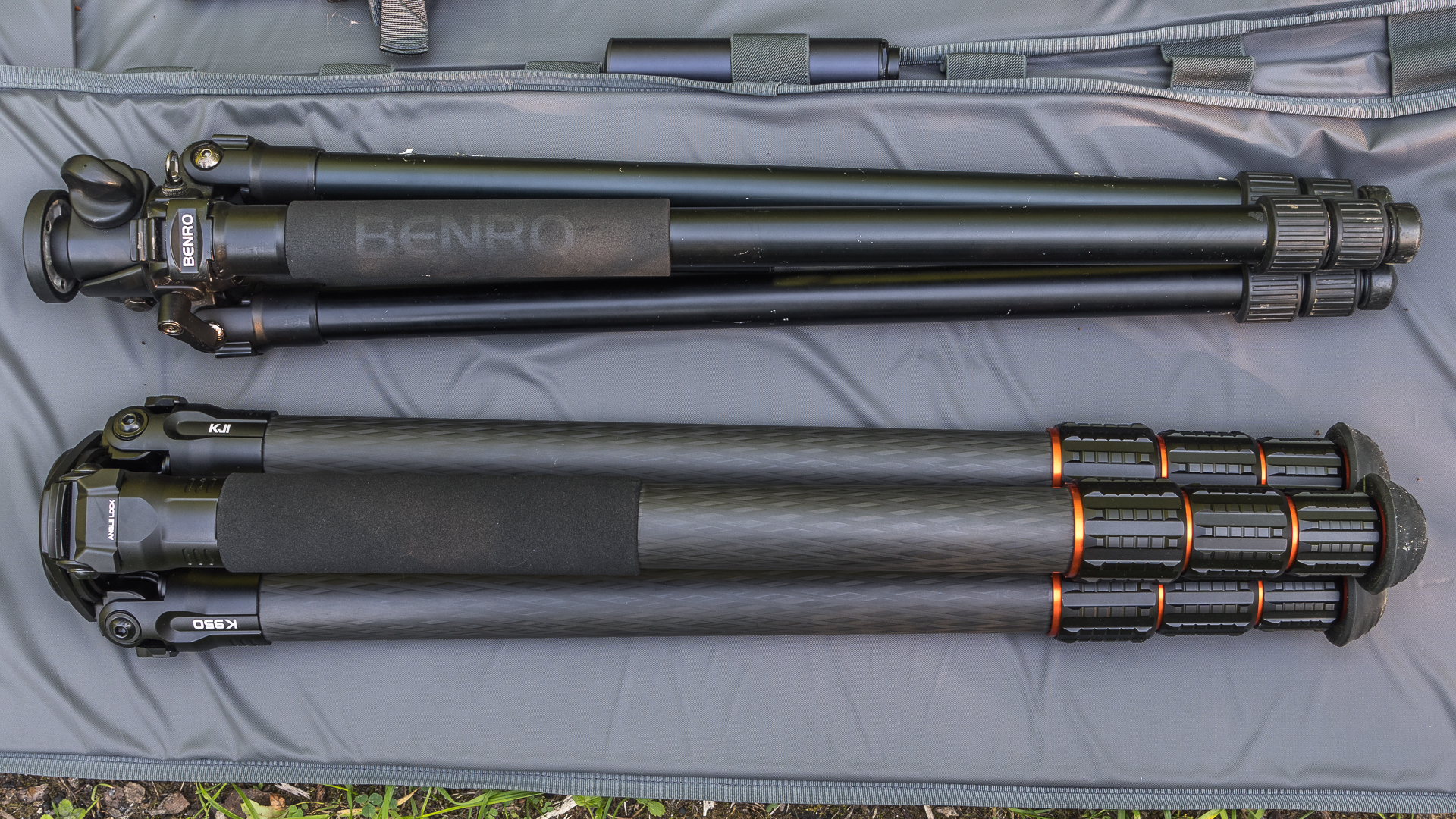
My average but trusty Benro tripod (top) and the professional KJI K950 Carbon shooting tripod (bottom). Both are almost identical in length. / Photos: Jarosław Lis, MILMAG
When folded, the KJI K950 Carbon is almost the same size as my Benro A-29705. Without the head, it measures 65 cm, making it even 2.5 cm shorter than the photographic tripod. At first glance, though, it is clear that it is larger ‒ the legs, their aluminum mounts, and the adjustment mechanisms are much thicker. Even so, the KJI is only 510 grams heavier. A total weight of 2,680 grams is not that much at all ‒ provided we are talking about equipment for PRS or precision shooting. I would not be surprised, however, if a hunter found it too heavy, as this field is usually dominated by very lightweight solutions designed with long distances covered on foot in mind.
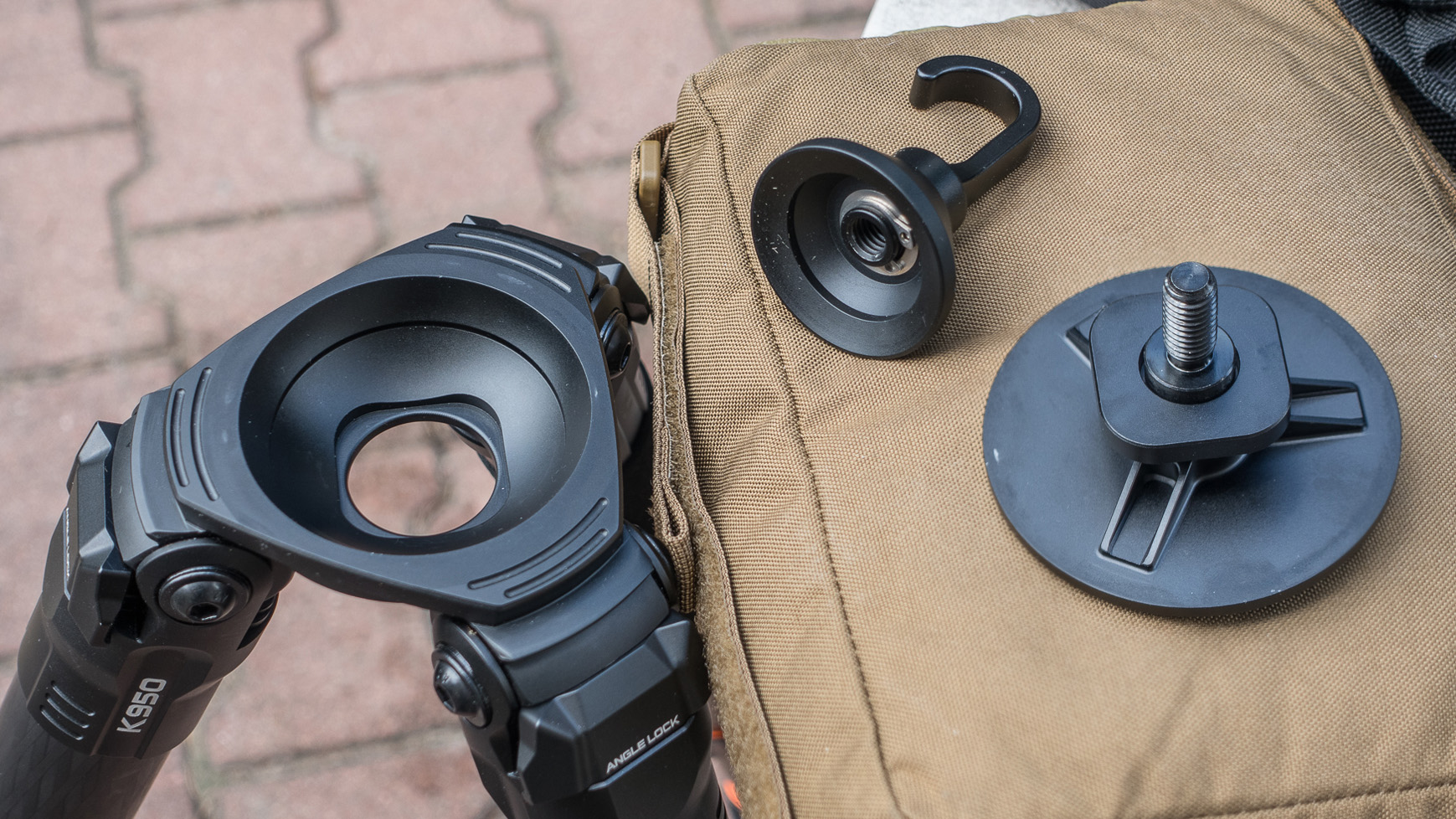
The head base is secured by a single thread, with the visible hook serving as the nut. It is a bit of a shame that, in the “bag support” setup, we lose the option of hanging additional weight
On the K950, the head base itself weighs 175 grams and yes, the manufacturer has made it removable. This lets us get rid of the vertically protruding thread, making it easier to set a shooting bag on top. A fairly large group of professionals prefers shooting this way rather than clamping the rifle into the head-mounted grip. Just as often, this setup is used as an observation platform for binoculars.
It's big!
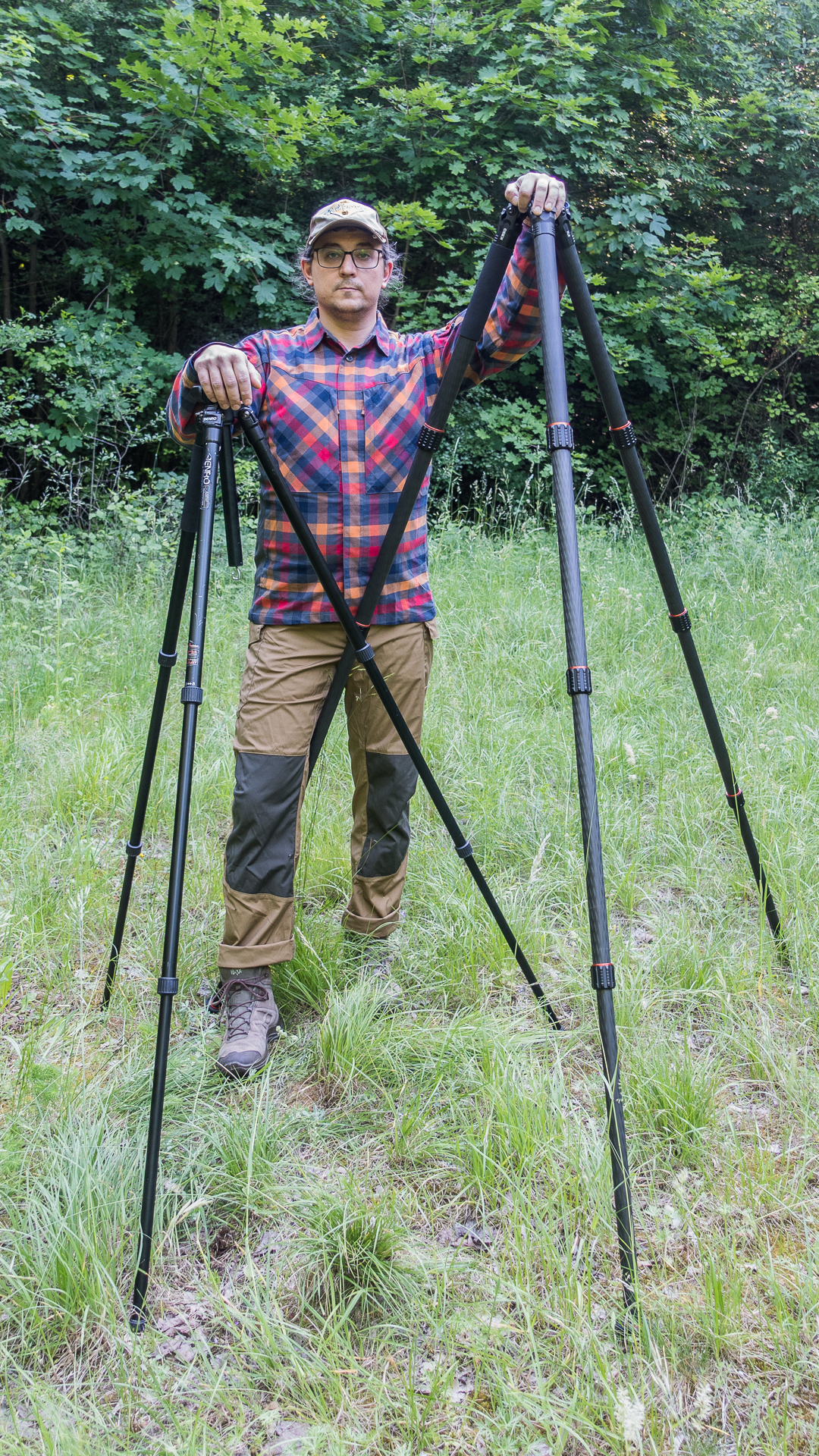
Once unfolded, the KJI extends to 181.6 cm! When folded, it does not show it. The photographic tripod is on the left ‒ the difference is enormous.
Things get more interesting once the K950 Carbon is extended to its full height. Each leg consists of four sections, and in its working position, fully extended, the KJI reaches as much as 181.6 cm. That is 8 cm more than my photographic tripod, even with its center column extended. That comparison is misleading in itself, because the K950 deliberately does not have one ‒ a single vertical tube would not provide sufficient stability in any sporting scenario. So, if I were to compare actual working height, the difference grows to a massive 34 cm, and to 40 cm in a “bag support” setup. And that is only if, through a titanic effort, I managed to unscrew the photographic Benro all the way down to the apex. The manufacturer never intended such an option, so it is not exactly simple. In the KJI, by contrast, it is a feature ‒ intended, planned, and implemented.
The K950 Carbon is therefore huge, even if it does not show it when folded.
77 kg load capacity
Load capacity is another important factor for a competitive shooter. Competition firearms are not exactly lightweight. My photographic tripod is rated for 10 kg, which is a perfectly solid result in its category. The K950 absolutely destroys it, reaching 76.8 kg! In other words: seven times as much, with a comfortable safety margin.
This was achieved by using carbon-fiber legs with a diameter of up to 39 mm. The thinnest tube has a cross-section of 27 mm ‒ exactly the same as the thickest one on the photographic tripod! The manufacturing technology used for the remaining components is also important. KJI opted for thick aluminum parts milled on CNC machines. The photographic tripod uses a lighter, though less durable, magnesium alloy.
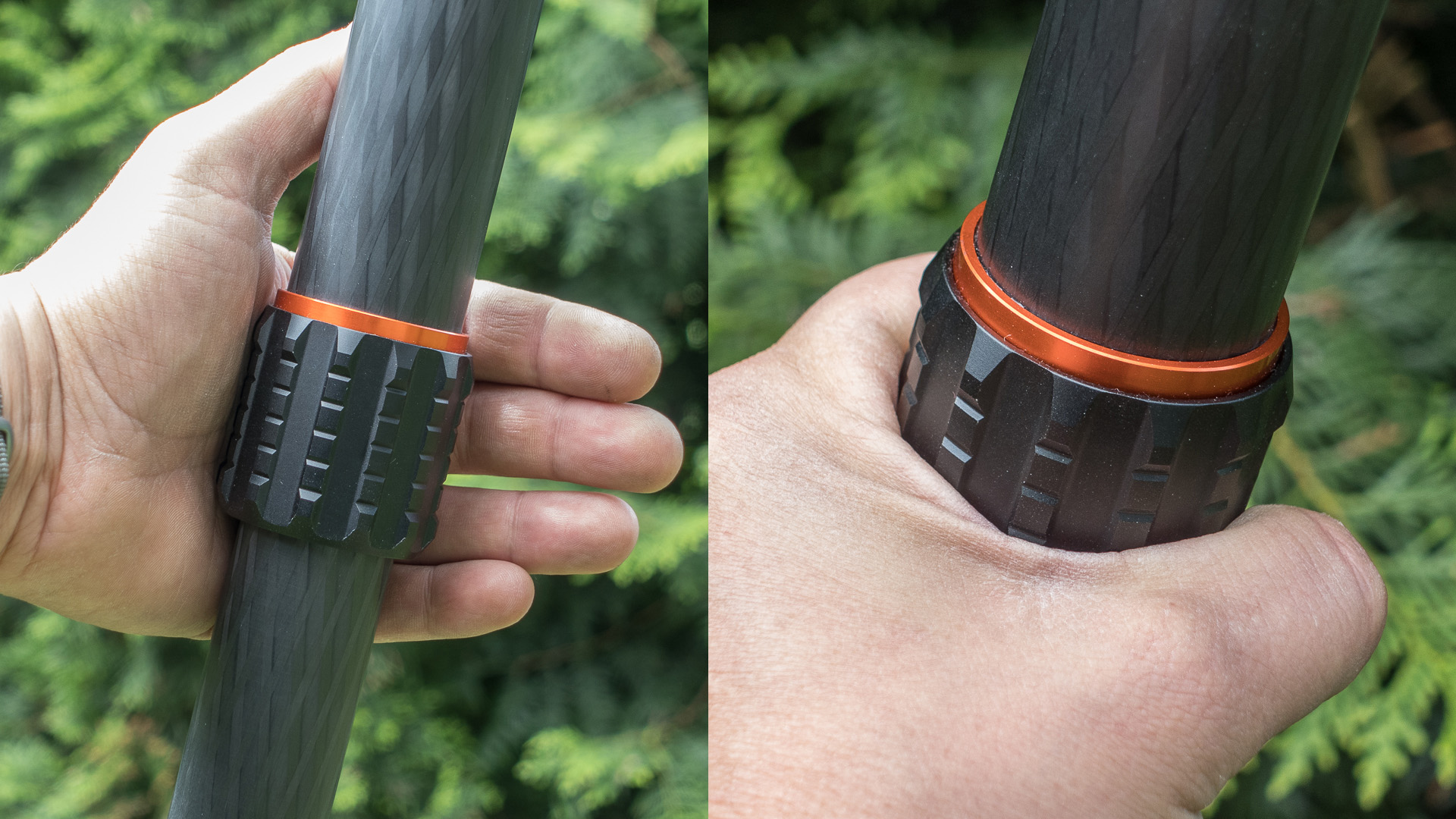
The legs and adjustment collars of the K950 tripod are, to put it mildly, thick and solid. The aluminum knobs have pronounced, grippy edges ‒ just shy of being uncomfortable
To sum up the KJI K950 Carbon’s design:
- When folded, it is 3.7% shorter than the photographic tripod
- When extended, it is 28% taller
- It supports 668% more weight
- It is 23% heavier
I realize that comparing these two designs is not entirely fair. The two products come from different worlds and completely different price brackets. Nevertheless, it gives you an idea of just how different these designs are and how wide the gap between them really is. It is also easier to grasp the scale when you have a commonly available “civilian” product as a point of reference.
The KJI K950 represents the premium standard
Statistics alone are not enough to evaluate a product. It is worth taking a look at the elements responsible for ergonomics and ease of operation. A truly good design is one that you actually want to use. Here, too, KJI did not disappoint.
The leg-length adjustment collars are made of aluminum. They are very large, making them easy to locate and operate under time pressure. Their surfaces are deeply cut and finished only just enough to avoid causing discomfort. In short, the edges are almost sharp, but in return they guarantee grip and control in all conditions. Frost, sweat, or thick gloves ‒ it makes no difference.
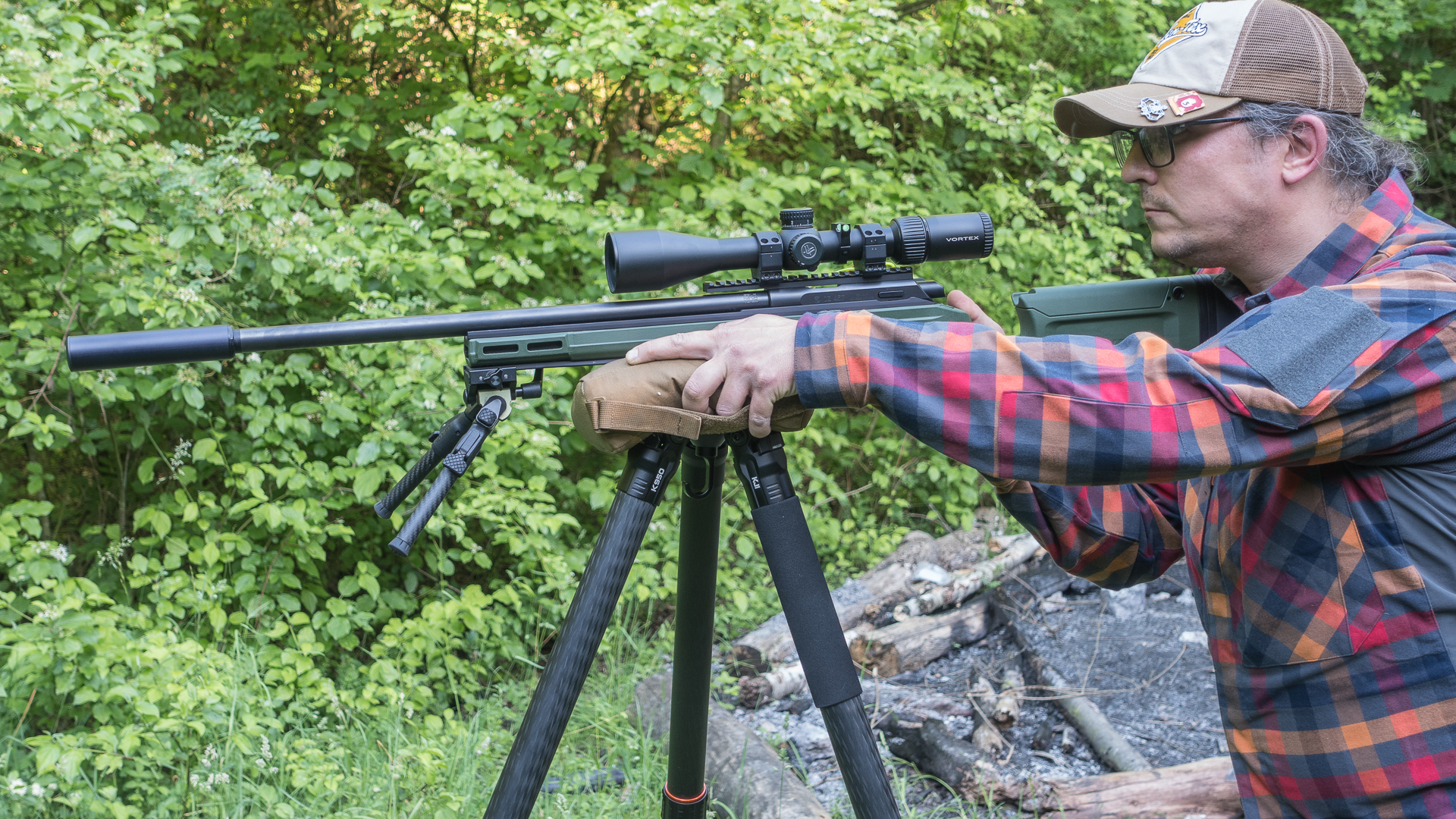
KJI K950 set to a height suited for a standing position. I used only a little more than two-thirds of the available adjustment range
Naturally, the K950 Carbon also features leg-angle adjustment. Thick, solid latches allow the legs to be locked in three positions: 23°, 55°, and 83° from vertical. That is enough to adapt the tripod to each of the three shooting positions. When fully splayed, the K950 becomes a platform as low as my MDT bipod at its lowest height setting. Of course, this applies only to shooting off a bag. If any kind of head is attached, the height increases enough that prone shooting will only be possible in a few exceptional cases.
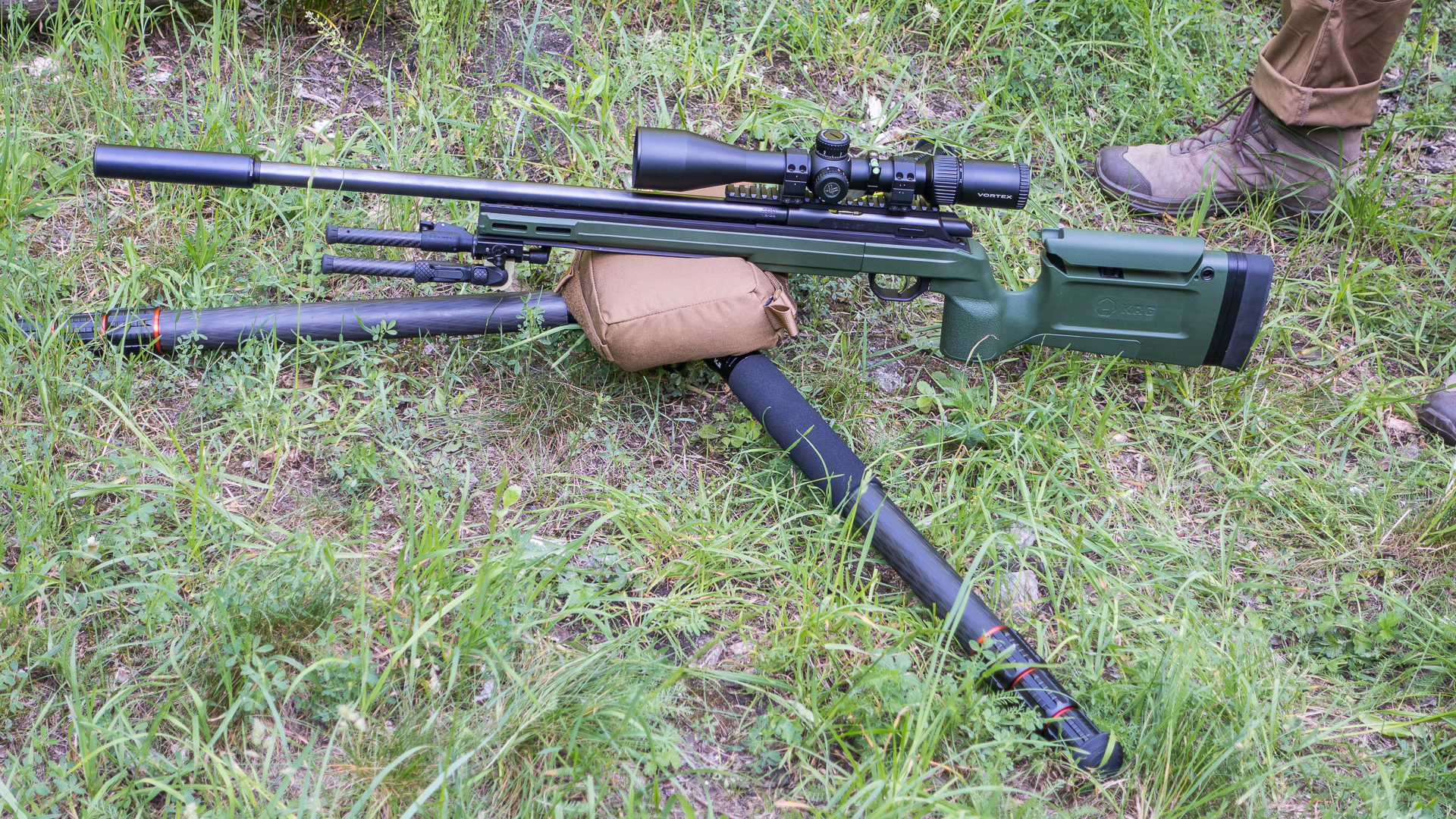
The K950 Carbon with the legs set at 83°. Shooting from the prone position is entirely possible
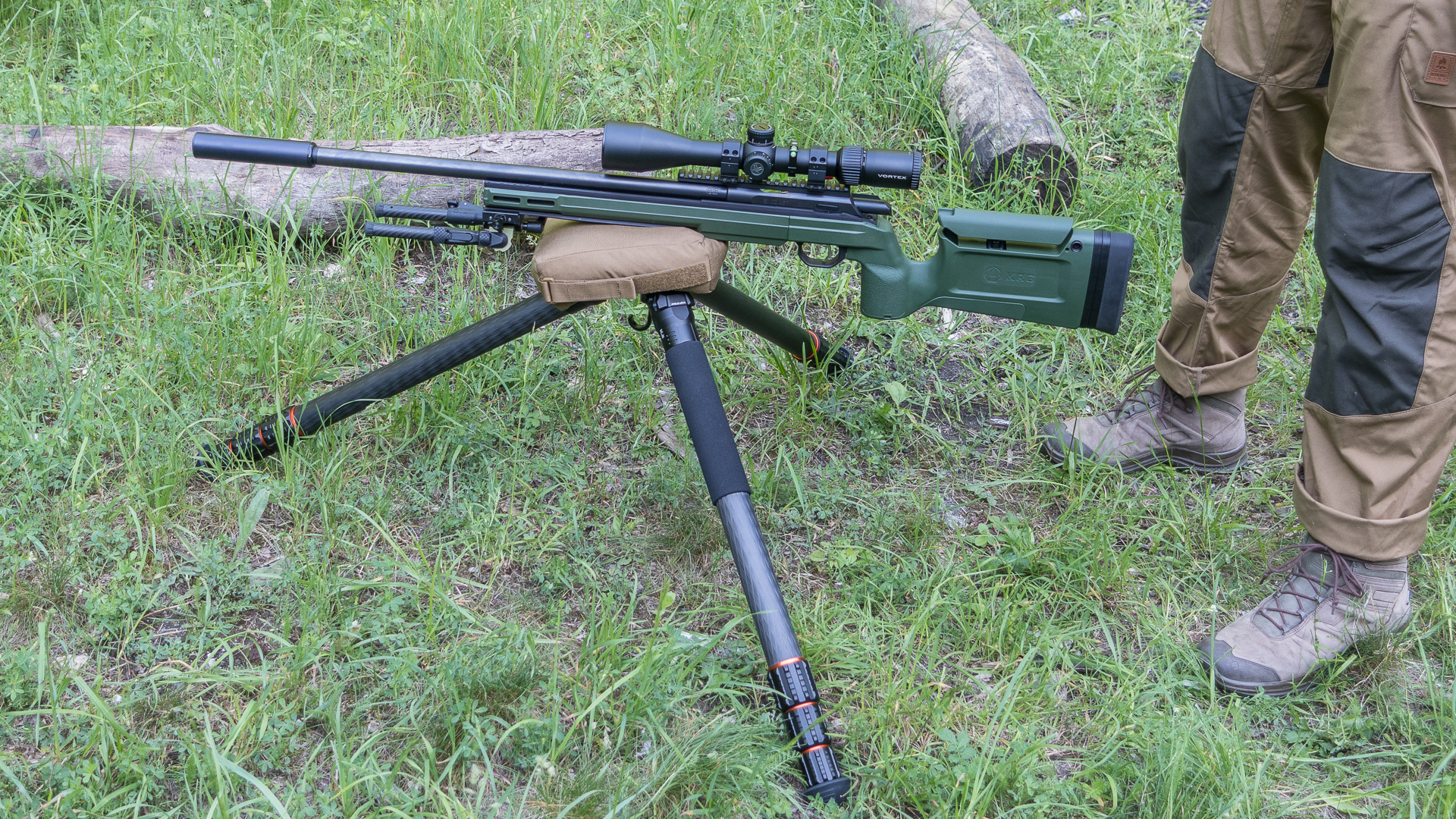
Legs splayed at 55° for a sitting position. In my case, they would need to be extended slightly, so shooters shorter than me will manage as well
To increase the leg angle, each of the three locks must be pulled, and the leg-angle latches are fitted with small magnets. Quite a clever solution! They are drawn toward the closed position, which creates a ratchet-like effect when the legs are folded inward. This way, the tripod always tends to return to the 23° setting.
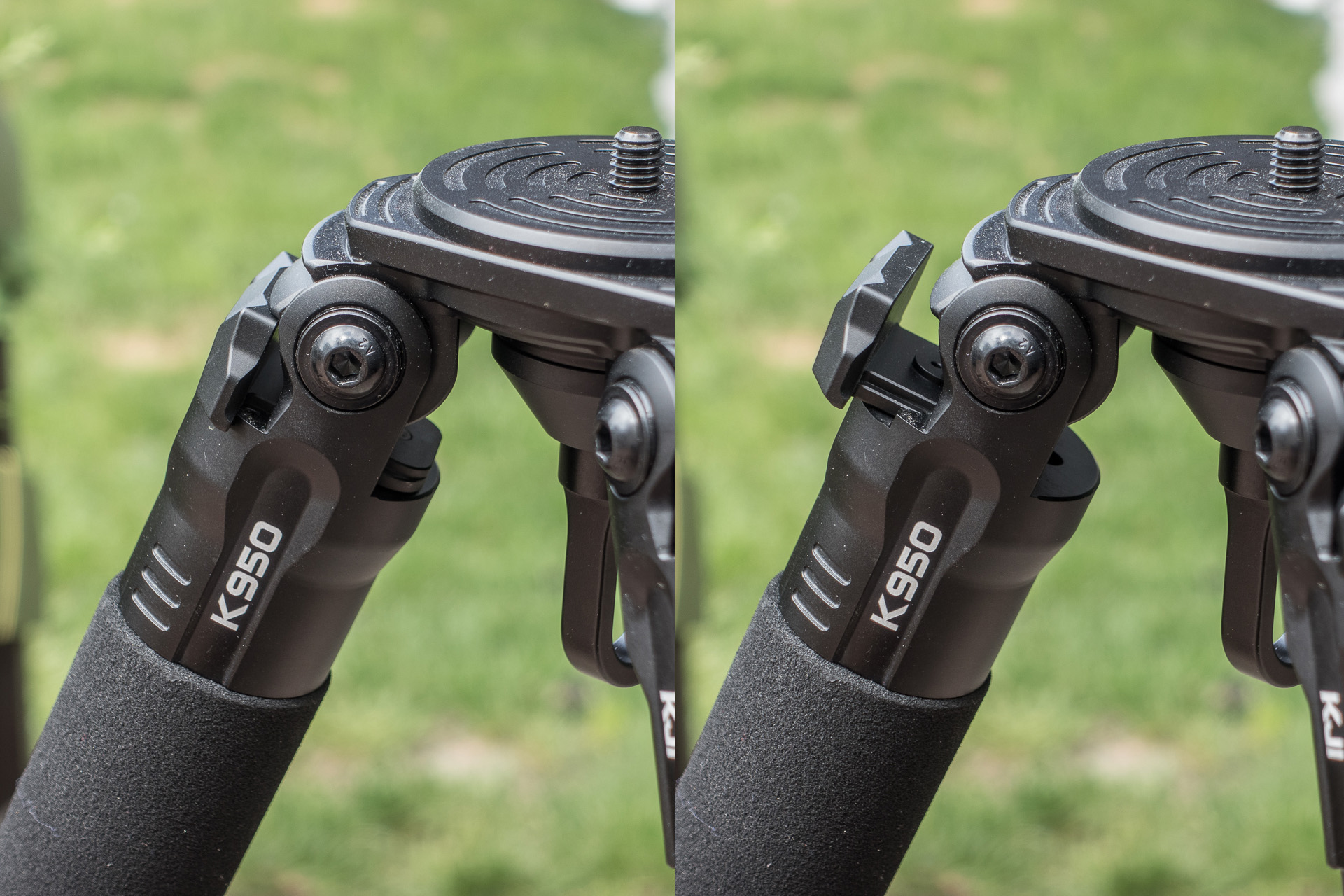
Leg-angle adjustment latches in the closed and open positions. The screws next to them allow you to adjust the resistance with which the legs splay out
There is, however, an exception to this rule. The magnets are arranged in such a way that, at the latch’s end position, they begin to repel each other, keeping the mechanism open. In this way, KJI has created a highly reliable semi-automatic leg-angle adjustment system. Clever! The carbon-fiber leg mounts allow for one more form of adjustment. On a factory-new tripod, splaying the legs requires noticeable resistance ‒ perhaps even too much. Fortunately, this can also be adjusted to suit the user by tightening or loosening the pairs of screws connecting the mounts to the main apex. Simple, and it works.
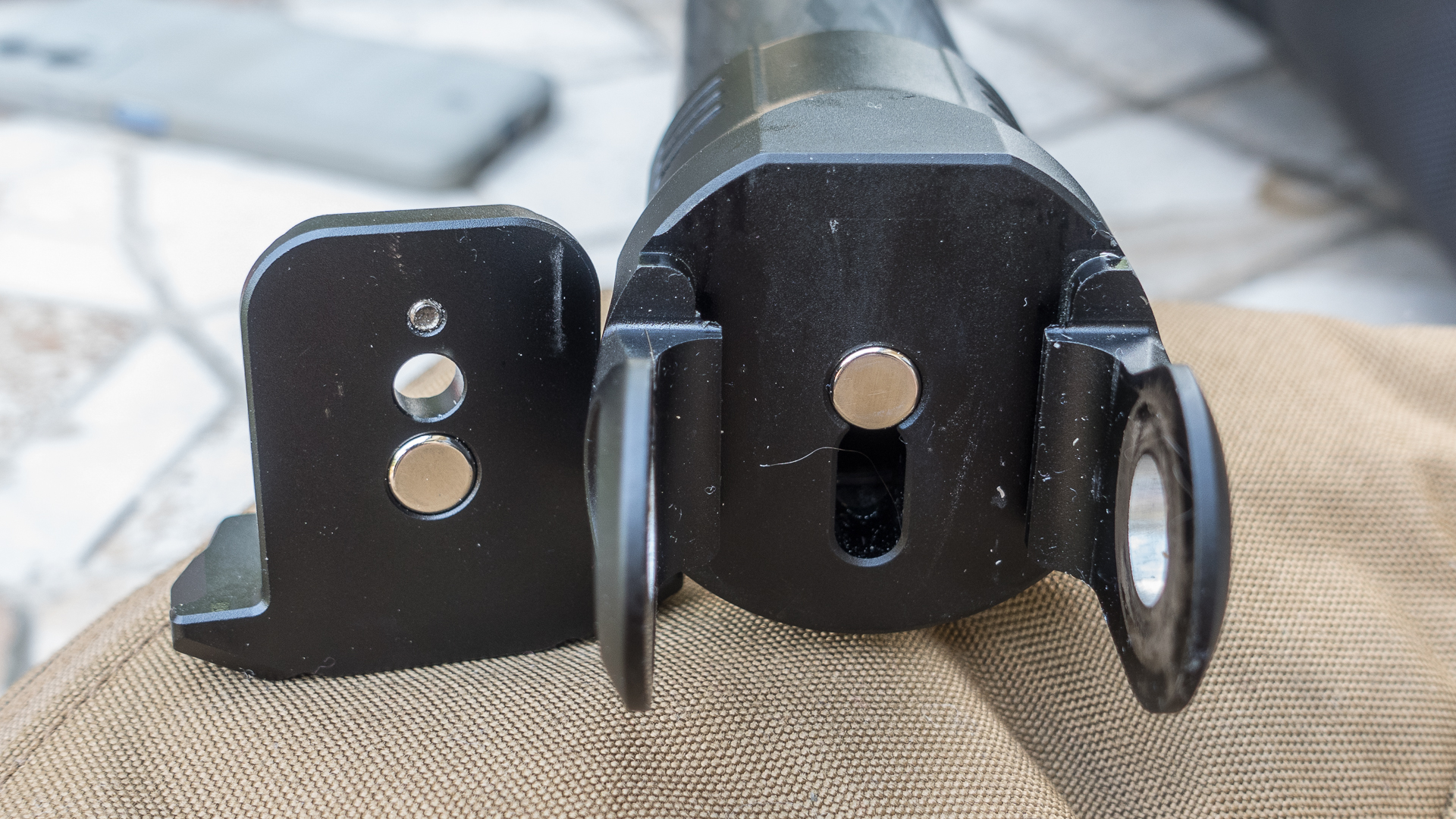
The opened latch from the inside, with the magnets visible
Solid support
Each leg of the KJI tripod is fitted with a screw-on rubber foot. There would be nothing particularly special about that if not for the fact that they are enormous. The flexible 55 mm hemispheres provide excellent support thanks to their large contact area with the ground. The manufacturer also remembered to mount them on threads (3/8″-16), allowing them to be replaced with spikes, which are included in the set. They even added small seals to protect the joints from moisture and dirt.
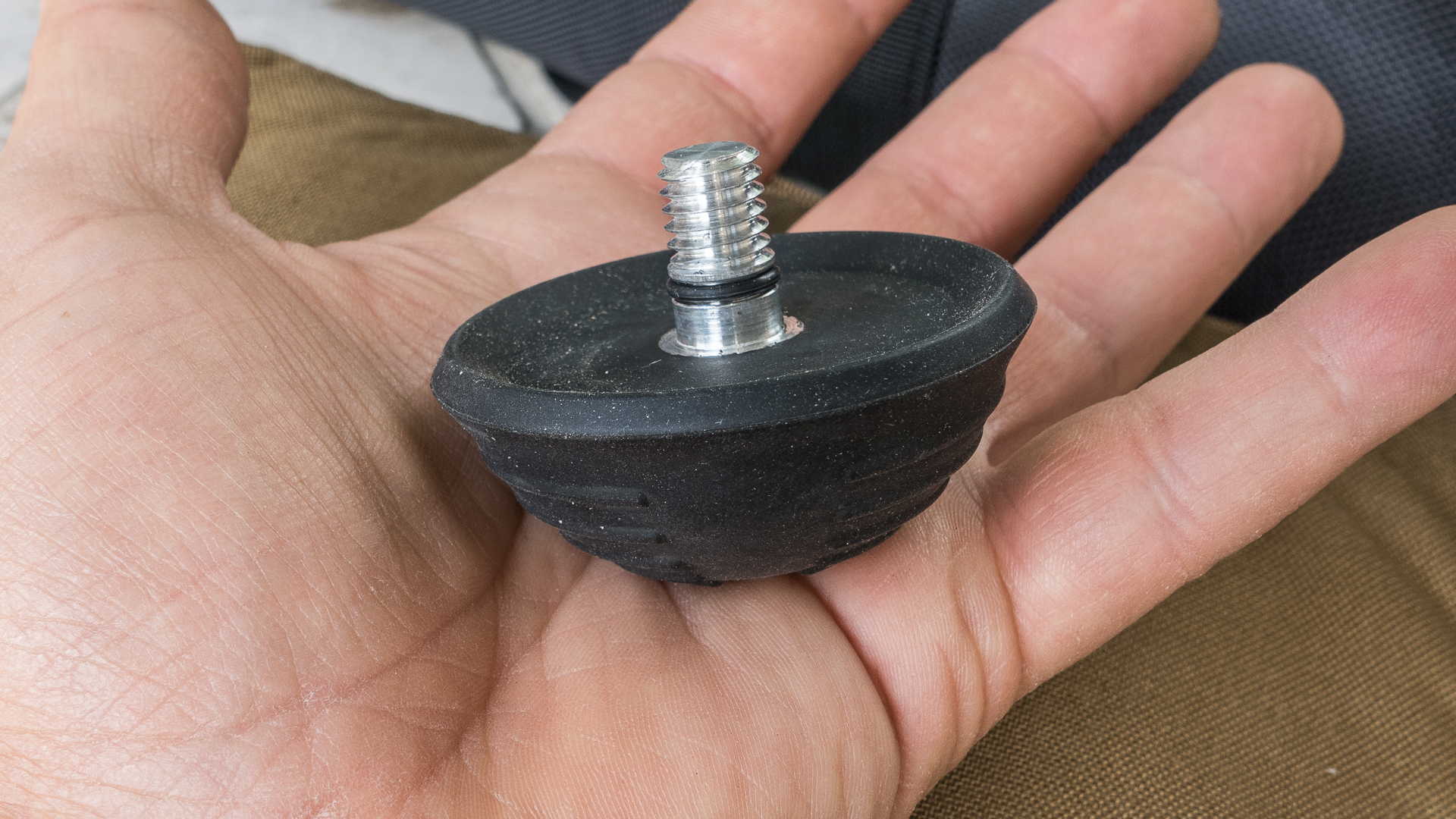
The rubber feet are enormous. The seal visible in the photo protects the thread from moisture and dirt
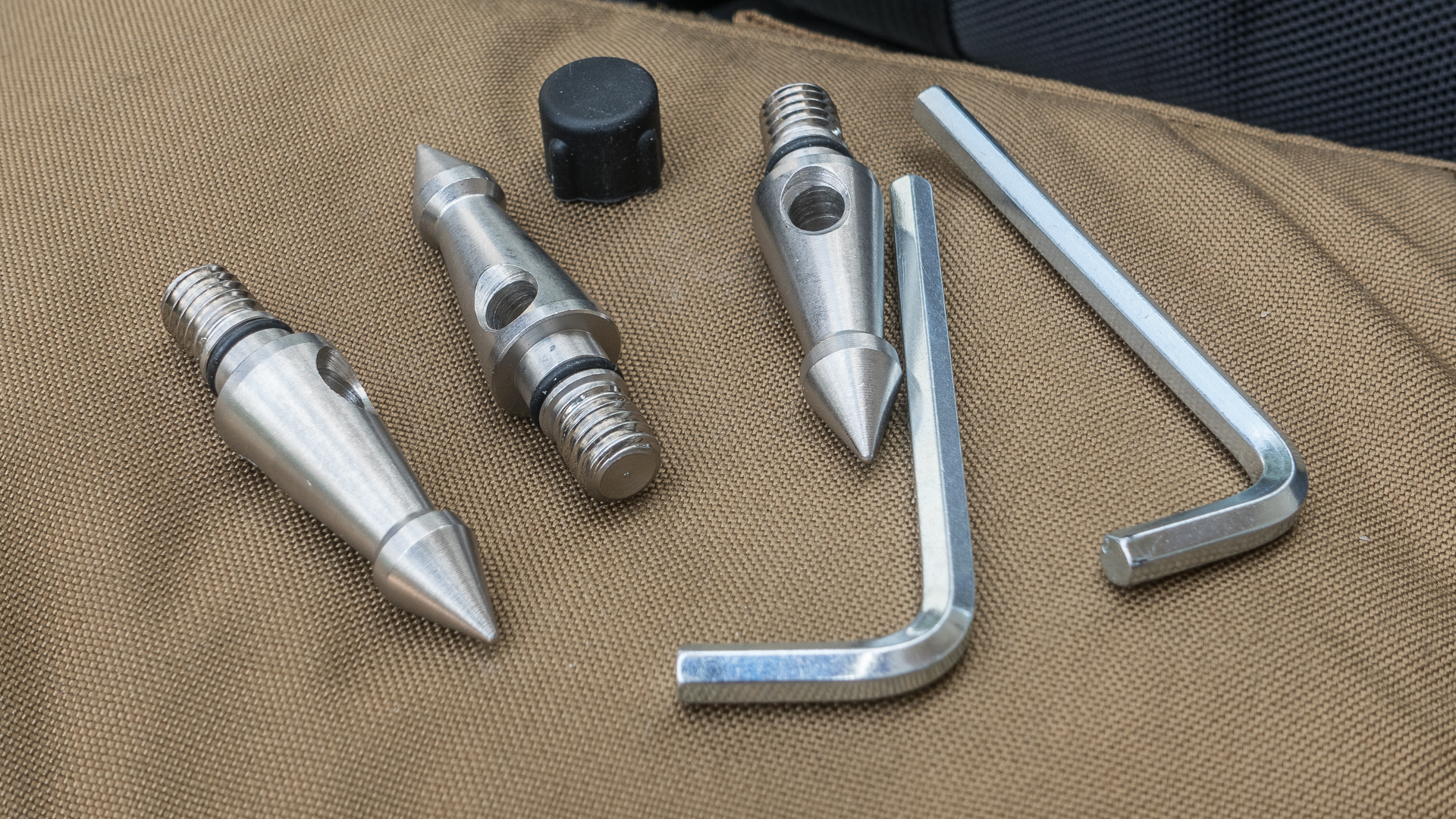
The rubber feet can be replaced with the spikes included in the set. The kit also includes a pair of wrenches for adjusting leg tension and a protective cap for the head thread
The upper tripod plate is no less solid. It is topped with a 3/8″-16 thread, the standard for photographic head-to-tripod connections. The main apex and base plate are held together by another thread, again 3/8″-16, with an aluminum hook serving as the nut. The latter is standard equipment on any tripod, allowing additional weight to be hung from it. Competitive shooters seem to use this feature incomparably more often than amateur photographers.
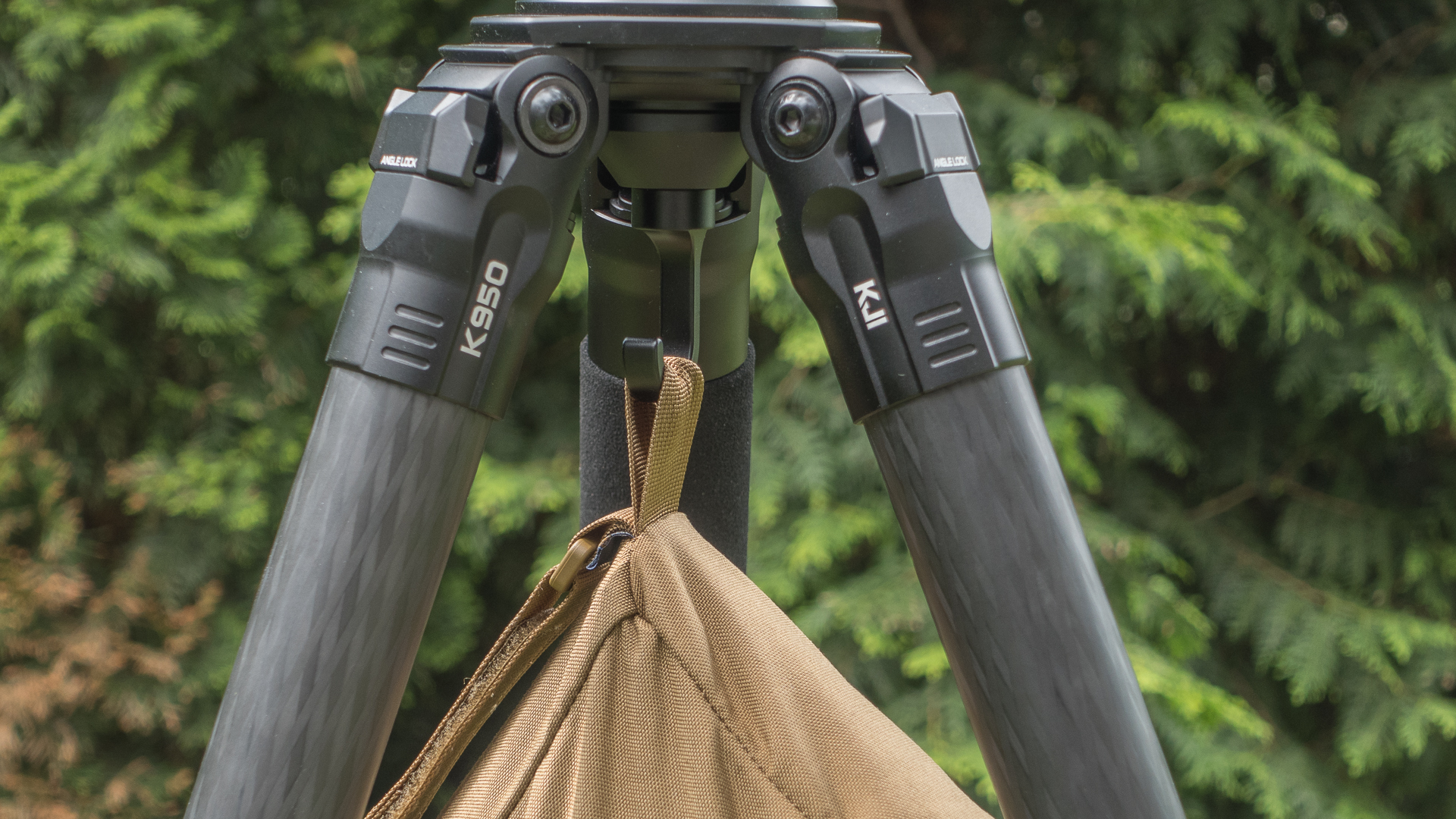
A solid hook allows additional weight to be hung from the tripod, further improving the stability of the setup
Summary
The K950 Carbon tripod is a top-tier, truly specialized product in KJI’s lineup. It looks and functions in a familiar way, but almost every component has been reinforced or optimized with competitive shooting in mind. Height, stability, the ability to adapt to any shooting position in all conditions ‒ the K950 Carbon offers a solid reserve of potential in every area. Keep in mind, however, that due to its price of approximately 750 USD, this is a product aimed primarily at professionals.
We would like to thank the Sellmark group for providing the KJI K950 Carbon tripod for testing. The distributor of KJI products in Poland is Hubertus Pro.
Advertising cooperation. We conduct product tests independently, and the opinions expressed are solely those of the author. The advertiser has no ability to interfere with the content of the review.
See also: