



















The story of the Grot is one of a Polish firearm maturing from an ambitious project into a real, widely used military weapon that has passed the test of intensive service in the Polish Armed Forces and of full-scale war. The essence of the MSBS was never a single carbine configuration, but rather modularity based on multiple interchangeable components. This means the ability to replace assemblies, change barrel lengths, weapon layouts, handguard components, stocks, and potentially also calibers. It shows that the development of the Grot has been the consistent creation of a comprehensive weapon system. The involvement of designers, the military, and the users themselves led to the creation of a Polish platform that, from the outset, was designed as a solution capable of adapting and evolving alongside the changing requirements of the battlefield.
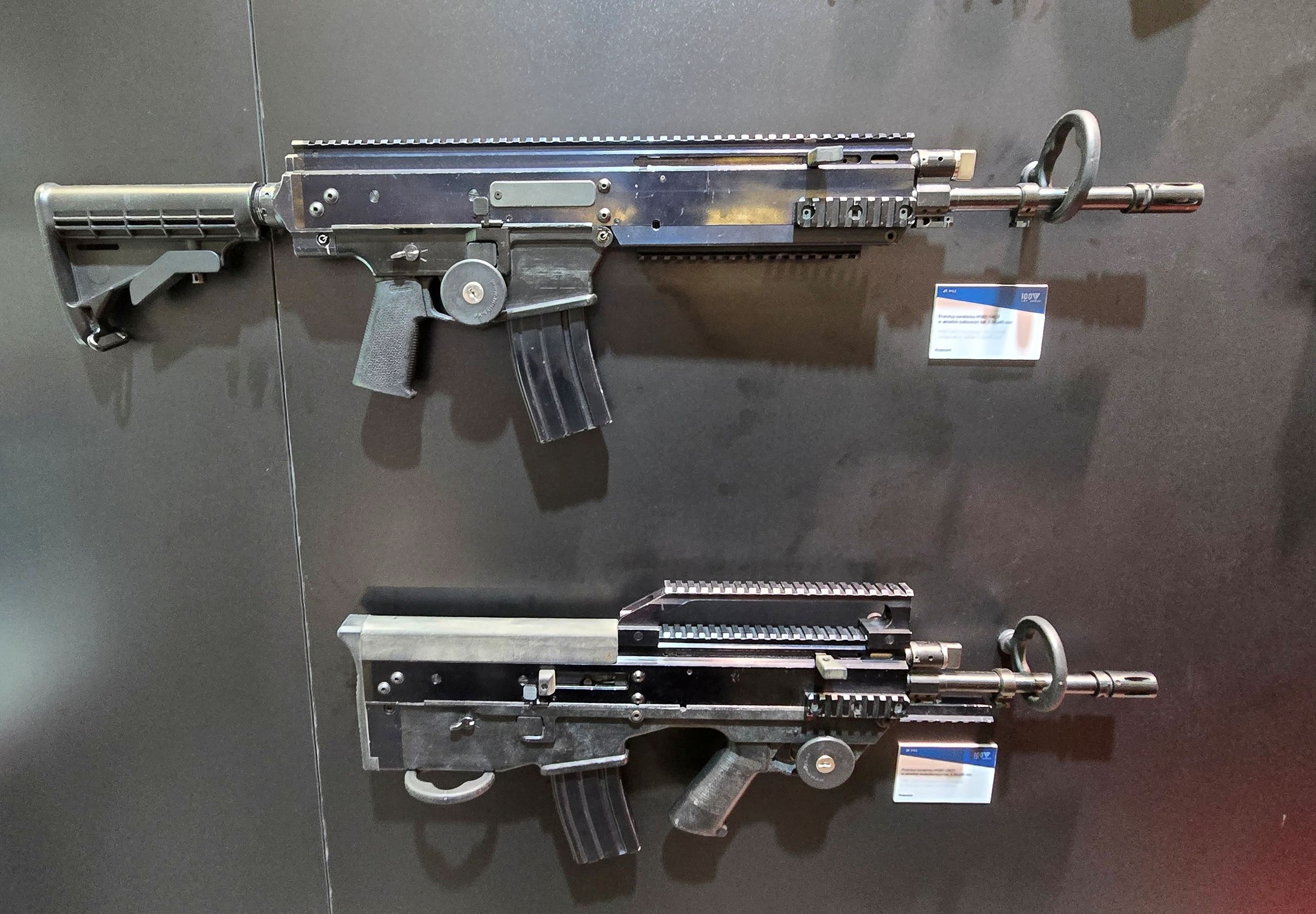 Early Grot rifle models in classic and bullpup layouts. Looking at the latest versions, it is clear how far Fabryka Broni’s designers have come. / Photo: Jakub Link-Lenczowski
Thanks to this approach, the MSBS Grot has probably become the first individual firearm in the history of the Polish soldier to be designed from the ground up and mass-produced domestically on such a scale. The RAWAT program, later work on the MSBS, and its fielding by the Polish Armed Forces created the foundation for a design that, from the beginning, aspired to go beyond the classic understanding of a rifle as a closed product.
From the Grot A0 to the A2: modernization through component replacement, not through a “new rifle”
The essence of the Grot proved to be not a single configuration produced in a fixed form, but a systems-based approach – the ability to modify the weapon, replace components, change barrel length, adapt the weapon’s layout, and integrate additional equipment. This approach meant that successive versions did not represent new generations breaking away from their predecessors, but rather the natural development of the same concept.
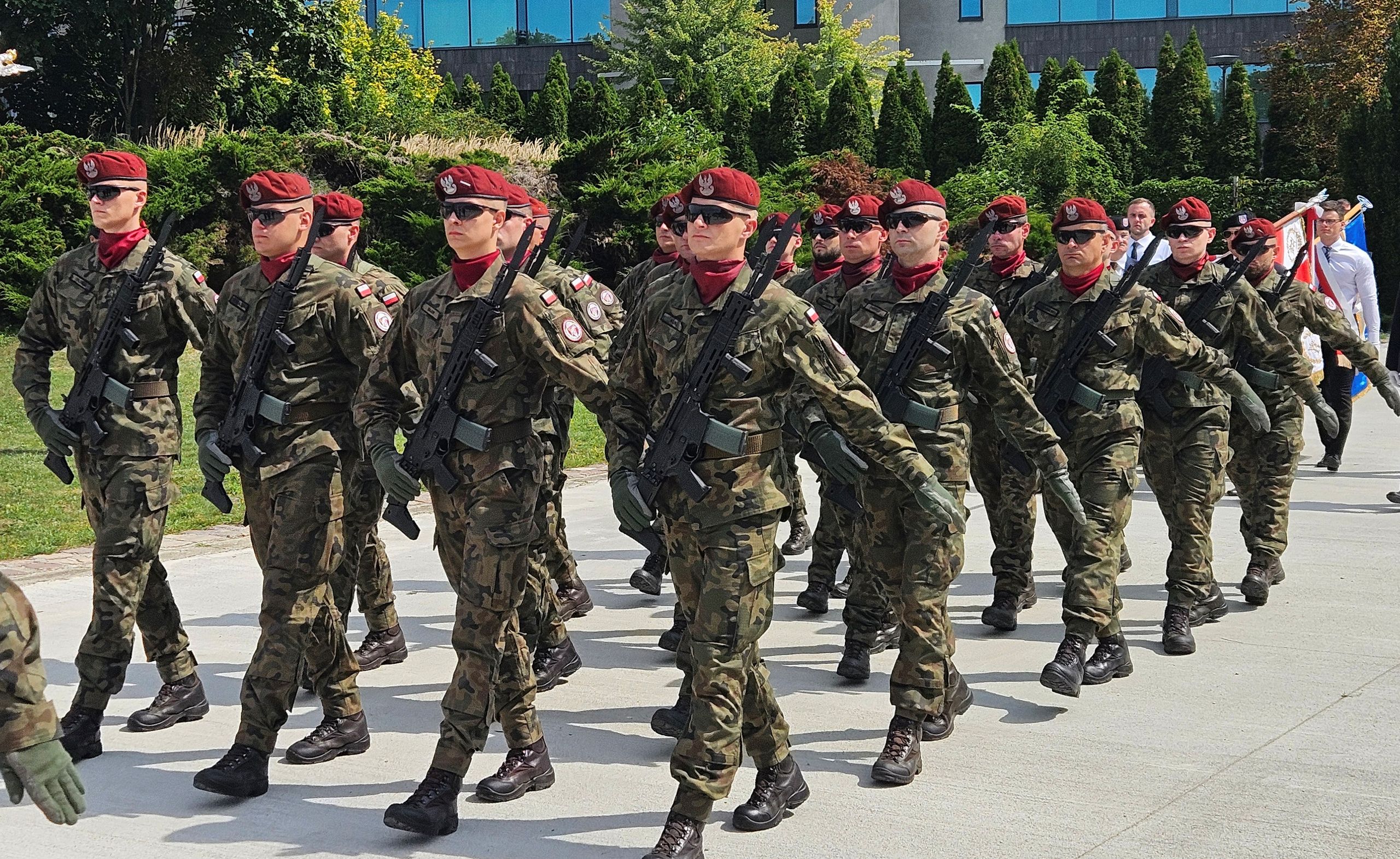 The Grot R is a special, manually operated variant used for ceremonial purposes. / Photo: Jakub Link-Lenczowski
At present, the basic version delivered to and operated by users in the military and uniformed services is the Grot C16A2. It is by no means an entirely new weapon, but precisely a consistent expansion of the same system. A common simplification is that in 2020 a “modified, different version of the Grot” was purchased; in reality, however, the same rifle that had been produced since 2017 was ordered, but in a different configuration resulting from soldiers’ expectations. This made it possible to replace components and manufacturing technologies that users had raised concerns about.
Undoubtedly, the most difficult test for the Grot was its transition from the hands of designers and experts into everyday use by soldiers. They received a new weapon at the very beginning of training, often without any prior preparation. That was also when the entire fielding system, the flow of instructions, the training system adapted to a new type of weapon, and the culture of use were put to the test. Earlier trials had mainly verified how the weapon fired, while focusing less on its day-to-day operation.
The transition from the initial fielding variants to subsequent configurations designated A1, A2, and ultimately A3 therefore did not result from abandoning the original assumptions, but from making use of feedback gathered through everyday operation and experience. As a result, the development of the Grot became an example of a modern approach to armaments – treating the design as a living system that can be continuously improved.
The modularity of the Grot: from the idea of a system to real modules
An important factor that accelerated the evolution of the Grot was the introduction of the semi-automatic S16 FB-M1 variant to the civilian market. When Grots reached store shelves in November 2018, modularity was still something exotic for the ordinary buyer.
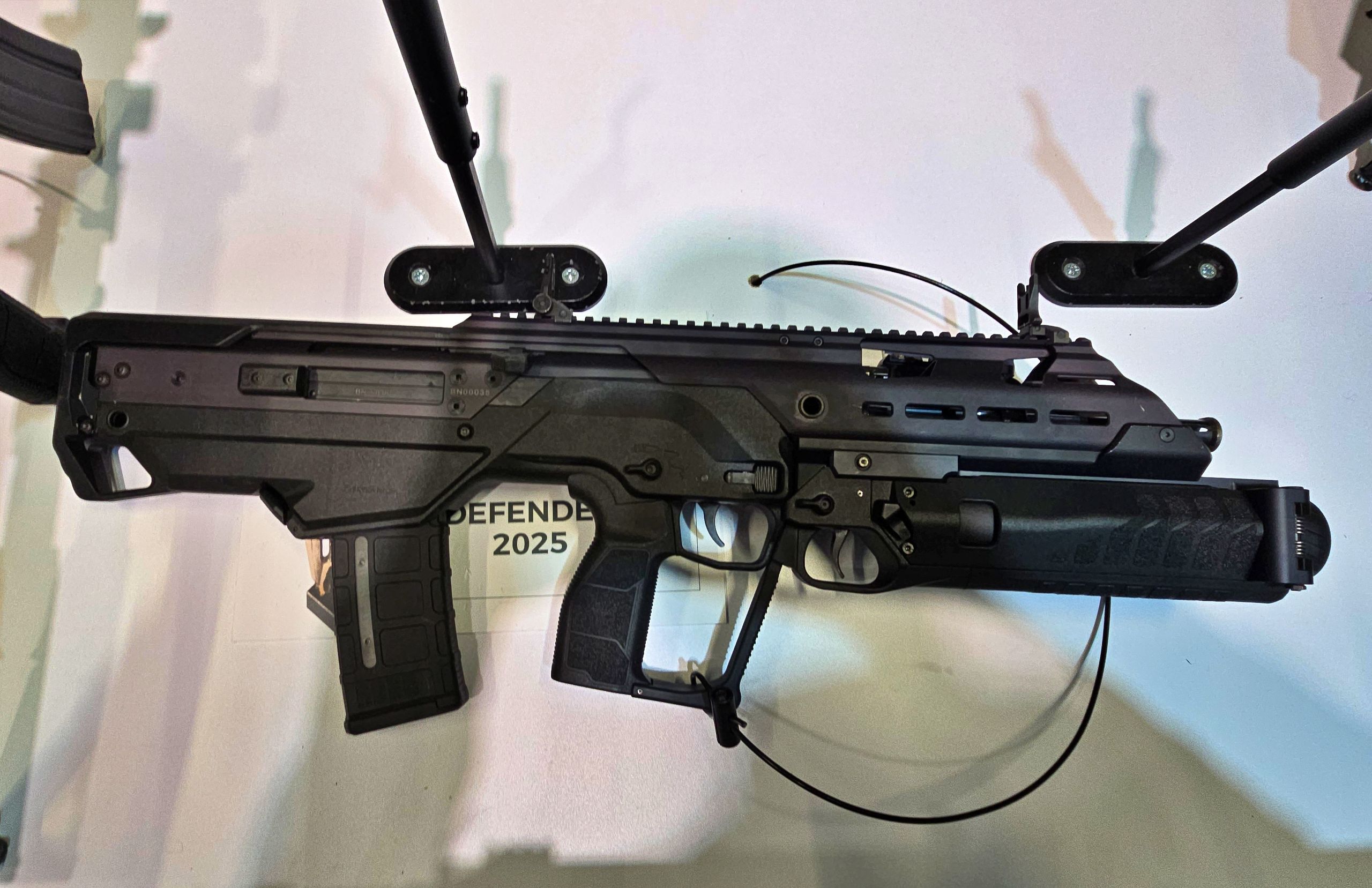 The latest bullpup variant of the Grot with an underslung GP grenade launcher, developed by Fabryka Broni as one of the system’s modules. / Photo: Jakub Link-Lenczowski
The year 2020 was crucial, as it brought real variety of modules for civilian Grot owners. In May 2020, elements such as a 10.5-inch barrel assembly, an extended handguard identical to the military version, an AR stock adapter, and a Polish pistol grip went on sale. For the first time, a user could actually buy interchangeable components and change the weapon’s configuration.
The next step came in the fall of 2021. Fabryka Broni introduced a conversion kit for adapting the Grot to 7.62 × 39 mm ammunition, as well as a 14.5-inch barrel assembly and folding AR stock adapters. The appearance of these components made it possible to say that the civilian Grot had become a modular, multi-caliber design.
The most recent module delivered so far was a conversion kit allowing the Grot’s classic layout to be changed into a bullpup configuration. Fabryka Broni began selling it in June 2025, complementing the range of bullpup rifles that had been available on the market since September 2024. From then on, every owner of a classic-layout Grot could turn it into a bullpup in a few steps, without using specialized tools.
Ukraine: the Grot’s most important combat test
The war in Ukraine proved to be the most demanding test for the Grot rifles. The first Grot rifles arrived there in March 2022, and Ukraine received around 10,000 rifles manufactured by Fabryka Broni “Łucznik”-Radom. It is worth noting, however, that this was not a delivery of a uniform, latest-generation configuration. Ukraine mainly received C16A0/A1 and C16A1 rifles.
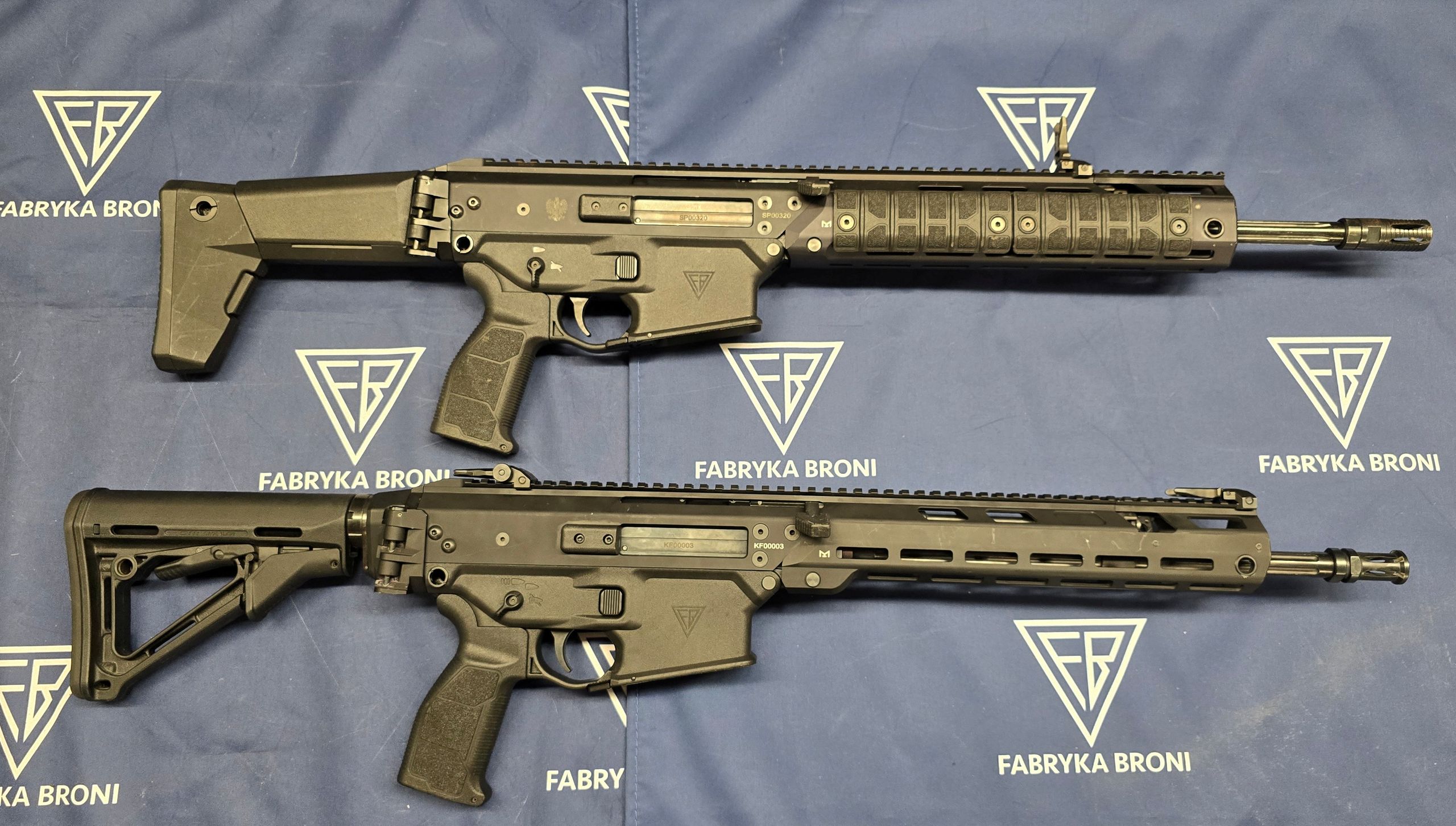 The Grot A2 rifle (top) and the latest Grot A3 rifle (bottom). / Photo: Jakub Link-Lenczowski
It was there that the Grot underwent its real baptism of fire. Unlike qualification tests or proving-ground trials, wartime operations made it possible to verify the weapon under conditions of prolonged, intensive use by soldiers operating under operational pressure.
Based on reports from Ukraine and Rwanda, it can be concluded that the Polish weapon proved resistant to battlefield conditions – ranging from harsh winters and muddy autumns in Ukraine to African humidity and heat – while users did not report many issues related to resistance to fouling or lower-quality ammunition. It should be acknowledged, however, that the Grot performs better with military 5.56 × 45 mm ammunition than with civilian .223-caliber ammunition.
Accuracy, ergonomics, and weight: strengths and weaknesses from the front
GROTOWISKO Conference: a dialogue on the development of the Grot
The GROTOWISKO conferences have also become an important element in the evolution of the Radom-made rifle. Today, their significance goes beyond a classic product presentation. They serve as a forum for exchanging experience among users, the Polish Armed Forces, the Armament Agency, and the manufacturer. It is precisely this model of cooperation that makes it possible to translate observations from field use into specific design solutions, ensuring that the development of the system proceeds in an orderly manner and is based on practical experience.
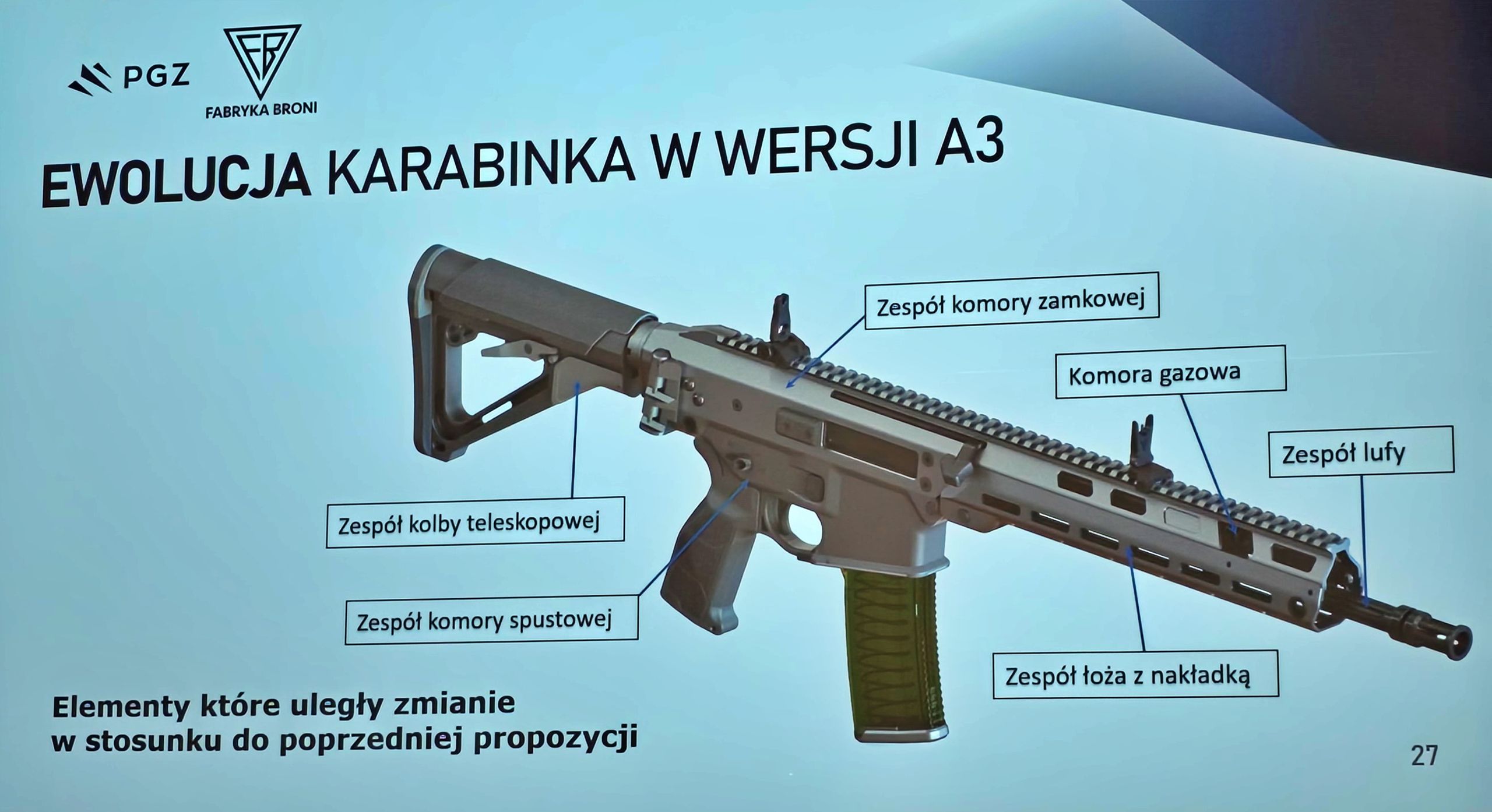 The latest changes introduced to the Grot design are presented during the GROTOWISKO conference. It also serves as a forum for exchanging views between users and the manufacturer. / Graphic: Fabryka Broni
It was no coincidence that the A3 variant was publicly presented during GROTOWISKO, where participants also discussed integration with new solutions such as systems supporting counter-drone operations. One result of this debate was the creation of a prototype integration of a computerized sighting system with the Grot rifle. This may enable the future use of the Radom-made rifle for effective soldier defense against incoming drones.
Year after year, GROTOWISKO emphasizes that the Grot is not treated as a closed design, but as a platform prepared for further development and integration with the technologies of the coming decades. It also shows that the Grot has reached a stage at which its strongest argument is no longer merely the fact that it was created in Poland, but its ability to combine modularity, ergonomics, and real user experience. In many areas, the solutions present in the MSBS family aligned with trends in small-arms development even before they became a more widely expected market standard.
Today, the Grot A3 can be seen not as the end of the project, but as another stage in building a complete Polish small-arms system – a design proven in service, verified in combat, and prepared for further evolution.
Grot A3: another package of changes and the maturing of the design
The Grot in its A3 variant is the result of continued dialogue between the manufacturer and soldiers, and of incorporating comments and needs arising from the use of earlier versions. At first glance, the Grot A3 stands out with its redesigned stock mounting block, which allows AR-15-standard solutions to be fitted, as well as its barrel shortened to 368 mm/14.5 inches. A new, slimmer handguard has also been introduced. As part of the changes, the weapon’s weight has been reduced to about 3.4 kg. To increase durability, a method was proposed for protecting the components most exposed to wear and weather conditions, including the bolt carrier, gas block with regulator, barrel trunnion, charging handle assembly, and parts of the trigger mechanism.
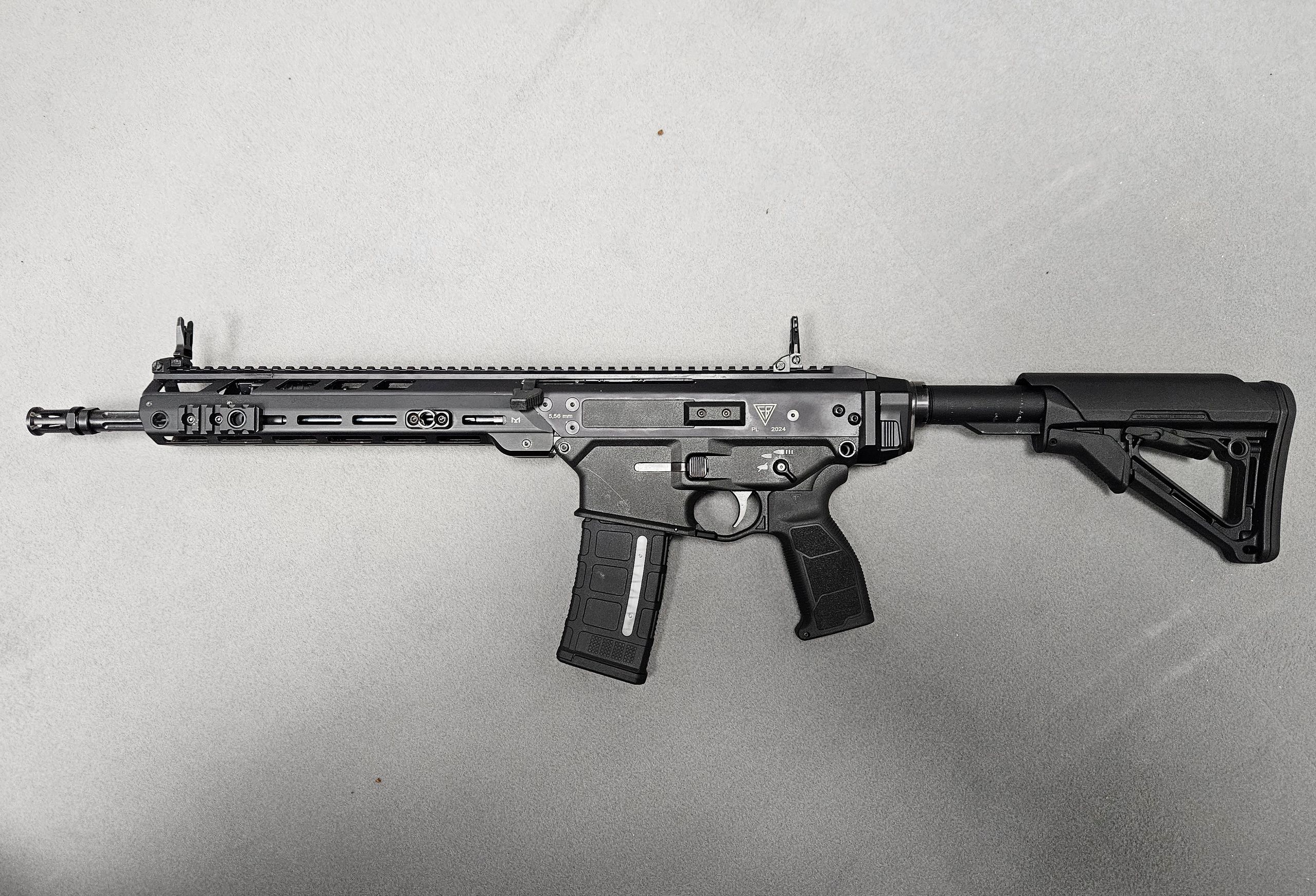 One of the first Grot A3 rifles publicly displayed. / Photo: Jakub Link-Lenczowski
To improve reliability and user comfort, the manufacturer also modified the gas block by properly directing the vent holes toward the front of the rifle. This minimized fouling both on the weapon itself and on the user’s hand. It also reduced overheating of the weapon, which is crucial during prolonged exchanges of fire in combat.
Another change was the removal of one opening in the front part of the upper receiver, intended to improve the weapon’s handling characteristics. The orientation of the holes used to mount the receiver end plate was also reversed. This made it possible to modify the stock mounting block, increasing the rigidity of its connection with the upper receiver assembly. The bolt-catch lever was redesigned to eliminate the possibility of disassembling the weapon when the moving assembly is locked in the rear position. As a result, the Grot A3 became more convenient and safer to operate.
The Grot’s regulator was also redesigned by introducing a new latch that prevents accidental removal of this component, for example as a result of an impact or snagging on a sling. Moreover, the operating rod and gas piston were also redesigned, combining the two components and allowing them to be withdrawn forward after the regulator is removed. Until now, cleaning the operating rod required unscrewing the entire barrel assembly.
The weapon in this configuration was officially accepted by the Armament Agency in early June 2026. This means that subsequent Grot rifles will now be able to leave Fabryka Broni in the A3 configuration. According to the company’s president, Seweryn Figurski, the Radom plant is already ready for this and can deliver up to 100,000 of the latest Grot rifles per year (Polish Grot A3 assault rifle nears completion).
MSBS Grot: truly Polish and truly modular
After years of development, the Grot has reached a stage at which its greatest strength is no longer merely the fact that it was created in Poland, but its ability to combine modularity, ergonomics, and real user experience with the requirements of the future battlefield. In many areas, the solutions present in the MSBS family aligned with trends in small-arms development even before they became a more widely expected market standard.
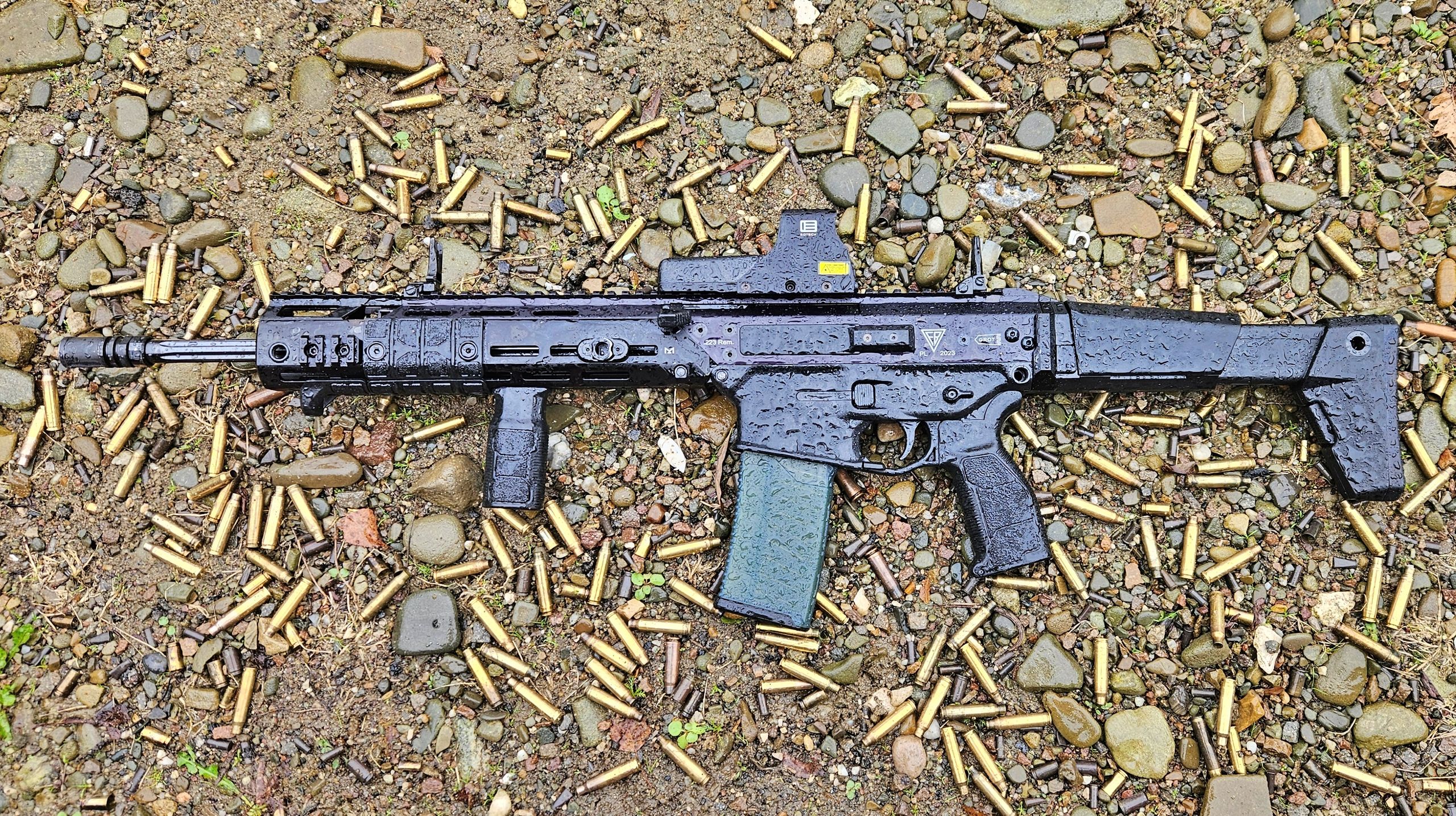 Despite the concerns of some users, a properly maintained Grot rifle is resistant to corrosion. / Photo: Jakub Link-Lenczowski
The Grot is also the first individual firearm in the history of the Polish soldier to have been designed and mass-produced domestically. The concept created under the RAWAT program has come a very long way. The involvement of designers, the military, and the users themselves led to the creation of a Polish platform that, from the outset, was designed as a solution capable of adapting and evolving alongside the changing requirements of the battlefield.
After creating the prototype, Fabryka Broni “Łucznik”-Radom did not rest on its laurels. Its designers successfully faced the challenge of creating and fielding an entirely new weapon. After years of development, we now have the Grot A3 – a design that is ahead of the competition in many areas. What remains now is to wait for the final pieces of the puzzle: a submachine gun and a light machine gun bearing the letters “FB” on their receivers.