














 Photos: Jakub Link-Lenczowski, MILMAG
Jakub Link-Lenczowski, MILMAG: Is loitering munitions and scalable modules for loitering munitions the main focus of Jakusz’s offering in Paris?
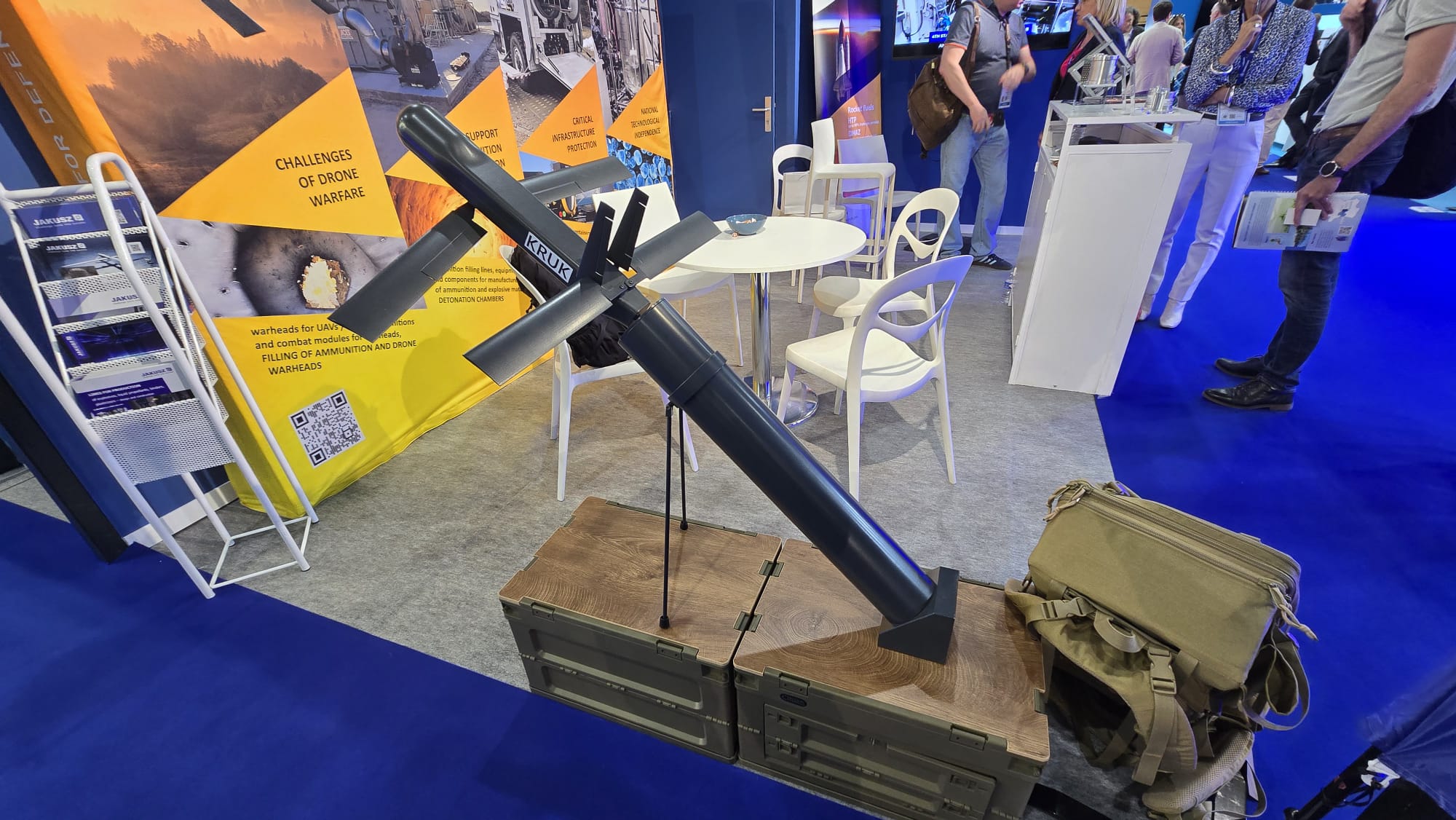
Marta Rados Jakusz, President of the Management Board: Yes, we are particularly promoting this loitering munition system, which we managed to build and test at a firing range. During CKL-26, organized by the Territorial Defence Forces in Toruń, we conducted tests of the KRUK loitering munition using a fragmentation-blast warhead with an anti-personnel effect. During those tests, our munition proved its effectiveness, it successfully detected and engaged targets in variable weather conditions, both in rain and strong wind. And I should add that the KRUK weighs only 1.5 kg, or 3.5 kg together with the launcher, so it is a very lightweight system. As the demonstration showed, the effector maintains flight exceptionally well. An important feature is the high image quality transmitted from the two cameras with which the KRUK is equipped, which enables the operator to very effectively detect and acquire a target and conduct the entire operation.
Jakub Link-Lenczowski: If I may ask, where do you source the communications, encryption, and control systems for the KRUK, as well as the observation turret or camera?
Marta Rados Jakusz: We are in a partnership with Turkish company Spira, and that area is handled by our supplier. Jakusz is currently focused on producing the full range of warheads and, of course, integration. We will also actively cooperate with the customer or end user in the areas of training, implementation, and ongoing support.
Ewa Soroczyńska, Business Development Director, Jakusz: We have years of experience working with explosive material, as the company has existed for over 40 years, and one of its core areas of activity is the design and manufacture of blast-resistant containers for the transport of unexploded ordnance, duds, and IEDs, as well as storage facilities for explosive materials. All of our products have always been tested at full scale on firing ranges, which is how we came to conduct, I think, over a thousand different detonation trials within the company and at the firing range to which we have access over the last ten years. This is what led us to bring in a partner who designs loitering munitions and specializes in their guidance, control, and electronics, while we contribute our own experience, a joint research and development project, and that is how we got the KRUK. But this is certainly not the end of our journey or our challenges. We very much want to develop our own warhead, which will of course take some more time, but we are committed to that R&D work.
Jakub Link-Lenczowski: So at the moment, if I understand correctly, you load warheads according to the requirements of specific projects and for specific platforms, but you have the capability to develop a warhead in the future according to the needs of potential users.
Marta Rados Jakusz: Together with partners, of course, yes.
Jakub Link-Lenczowski: So you are able to produce a warhead with up to 20 kg of explosive?
Ewa Soroczyńska: And larger. It all depends on capabilities, really mainly storage capacity, but we are also working on that, as we have purchased the site of a former military unit and are planning to build infrastructure there. We currently have approved magazines allowing storage of 9.5 tonnes of RDX equivalent, so we will certainly be expanding our capabilities for filling various types of military ordnance.
Jakub Link-Lenczowski: So essentially you have your own processing technology, your own loading technology?
Ewa Soroczyńska: Yes. We have our own cast-loading technology. We also offer ammunition casting installations.
Jakub Link-Lenczowski: And regarding other explosive components, loading of projectiles of types other than just warheads for loitering munitions, are you also developing those capabilities?
Ewa Soroczyńska: We are focusing more on smaller calibers, drone warheads and various types of mines. We simply do not have the capabilities or infrastructure to talk about a larger scale. Larger scale is possible when it comes to ammunition—
Marta Rados Jakusz: Mortar or artillery, that requires somewhat different processes and plant configuration.
Jakub Link-Lenczowski: But mine loading is also on the table?
Ewa Soroczyńska: It is on the table, yes, we can handle mine loading on commission, as subcontractors for various manufacturers. We are in fact conducting a whole range of discussions in this area with other partners.
Jakub Link-Lenczowski: Speaking of partners and your operations, I would like to ask about international cooperation, potential directions for development abroad, offerings for example with your Turkish partner or other collaborators. What are your strategic directions at the moment?
Ewa Soroczyńska: We are in Paris, of course, but these are global trade shows. We conduct export activities and also offer on the domestic market. Currently, from a security perspective, containers with electromagnetic and ballistic shielding are being strongly promoted on the Polish market. We are present in nearly 40 countries, including through local agents. The main directions remain the Middle East and Asia, but also Europe, Eastern and Central Europe.
Marta Rados Jakusz: We are also increasingly delivering projects in Ukraine.
Jakub Link-Lenczowski: Of course, you also supplied blast-resistant containers for local transport there, and also donated some free of charge.
Marta Rados Jakusz: Yes, we donated one such container a few years ago. Currently, these are more specialized installations for the production of various types of rocket propellant components.
Jakub Link-Lenczowski: So you are helping Ukraine build infrastructure for loading operations?
Marta Rados Jakusz: Exactly. And for the technologies we have also mentioned here, production lines for mixed explosive components and solid rocket propellants, market demand is much greater. That is why we participate in various projects concerning both the region beyond our eastern border and various European projects, and we are currently involved in tenders. Today at Eurosatory we are offering technology that is particularly sought after, installations for the production of HTPB, which is a component of solid rocket propellant, the binder. We are able to offer production lines of very varied capacity, in both stationary and containerized variants. The containerized variant is also significant because it does not require the construction of any additional infrastructure, it is a very quick project to implement.
Jakub Link-Lenczowski: It is mobile and can be relocated, which matters in wartime conditions.
Ewa Soroczyńska: Absolutely. And we try to present a flexible offering, because countries are very keen on building technological independence, and we support precisely that approach.
Jakub Link-Lenczowski: Thank you for the conversation.
KRUK
The KRUK intelligent loitering munition by Jakusz was originally unveiled in 2024 and was presented at both the XXXII MSPO 2024 and XXXIII MSPO 2025 at the Targi Kielce exhibition center.
According to Jakusz, the KRUK is fully operational in GPS-denied environments and resistant to radio communications jamming. The combat drone can remain airborne for up to 20 minutes, achieving a flight range of up to 20 km. It reaches a cruising speed of 120 km/h and a maximum speed of 180 km/h. The maximum flight altitude ranges from 250 m above ground level to 5,000 m above mean sea level.
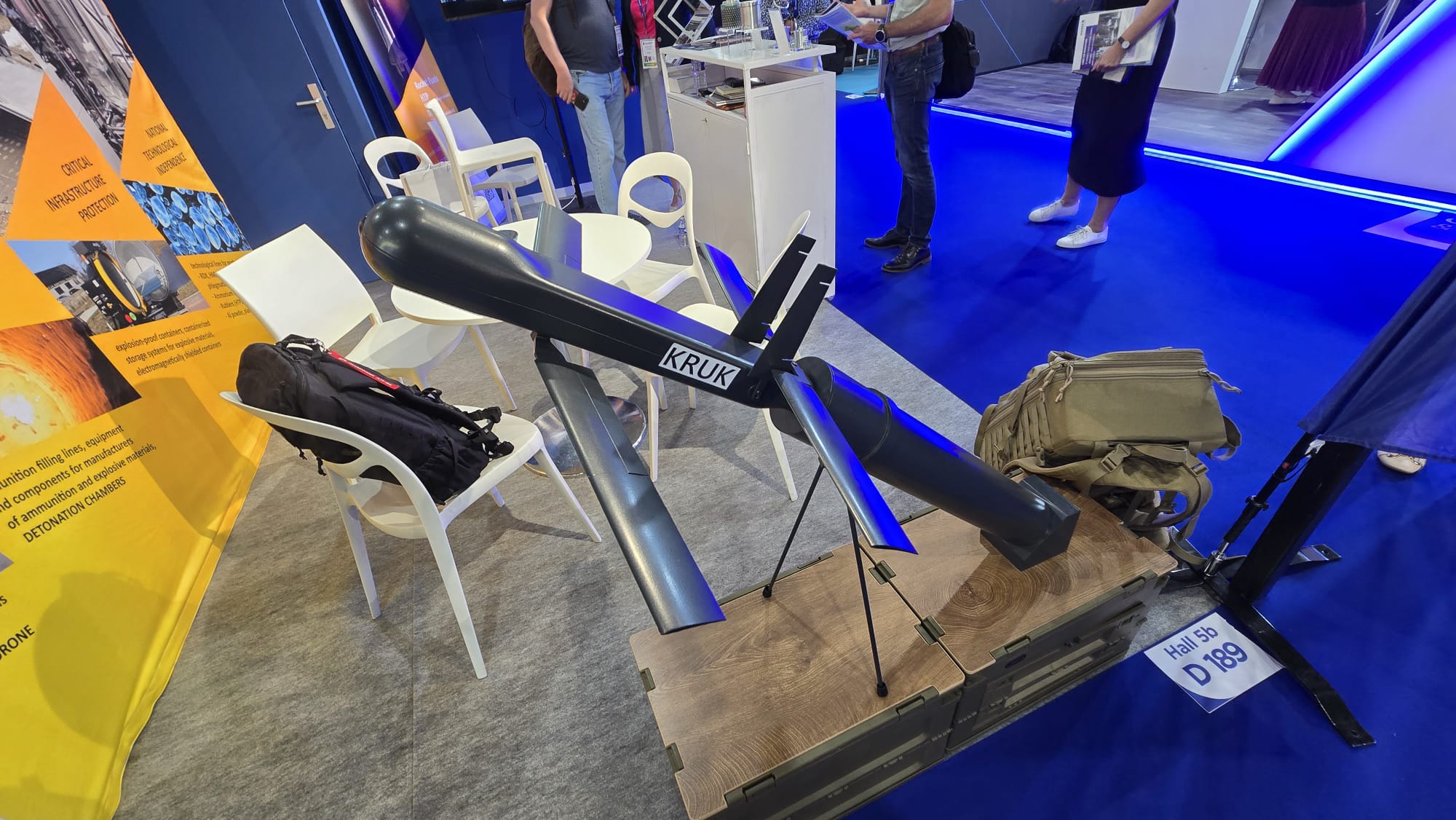
The drone has a total weight of 1.5 kg, or 3.5 kg together with the launcher. Of this, 0.5 kg is allocated to the warhead: a universal anti-armor warhead with a penetration capability equivalent to 180 mm of rolled homogeneous armor (RHA), effective against lightly armored targets, and a fragmentation-blast anti-personnel warhead.
KRUK system features:
- single-operator use and backpack-portable together with the launcher;
- rapid deployment in 2 minutes;
- reusable launcher;
- varied mission modes and intelligent in-flight decision-making algorithms;
- intelligent moving target tracking algorithms;
- precision target engagement using EO electro-optical cameras;
- outstanding performance exceeding tactical requirements;
- modularity enabling expansion;
- pneumatically integrated launcher;
- low cruising speed, high speed in attack mode;
- cost-effective technologies for precision target engagement with minimal collateral damage;
- ruggedized touchscreen computer serving as a ground control station;
- user-friendly interface software enabling KRUK control and visual data display via a secured two-way data link;
- ability to set and modify the flight program after launch;
- secured communications protocols;
- remotely piloted or autonomous flight for beyond-line-of-sight targets.
The KRUK offers full scalability and can be launched from various aerial, naval, and ground platforms:
- easy platform integration with the loading system;
- integration with military ground vehicles via existing power take-off (PTO) systems;
- both manual and automatic munition loading on an integrated platform;
- integration of the ground control station with the vehicle’s existing mission computer.
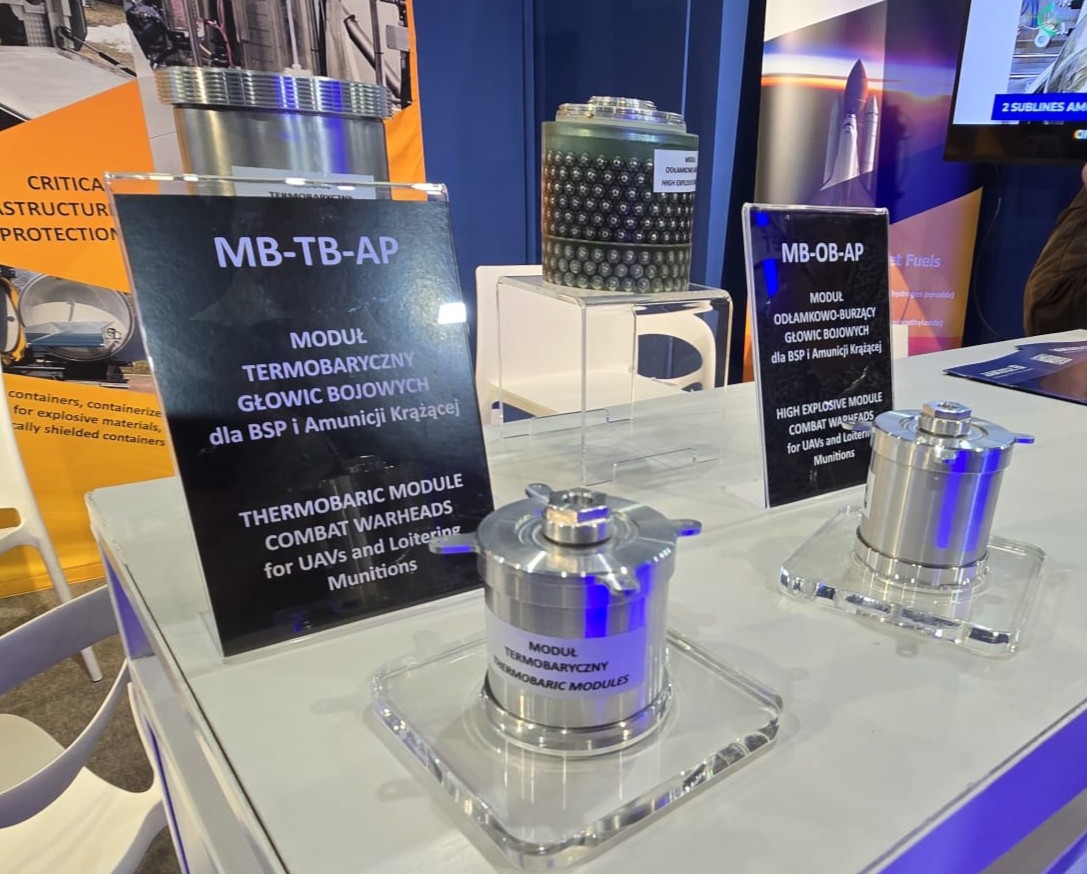
In addition, Jakusz presented at its stand the MB-OB-AP fragmentation-blast warhead module for UAVs and loitering munitions, and the MB-TP-AP thermobaric warhead module for UAVs and loitering munitions.
The company can also supply, for example, a 930 g fragmentation-blast warhead (60% RDX / 40% TNT, explosive fill mass 235 g) and a 900 g thermobaric warhead (TGAF) with an explosive fill mass of 650 g. Both warheads share the same dimensions: 100.5 mm in length and 90 mm in diameter. However, the scaling of explosive charges for warheads ranges from 120 g to 20 kg, translating to a total combat module weight of 500 g to 40 kg.
Furthermore, Jakusz is developing capabilities for processing HMX (Octogen) and RDX (Hexogen) explosive materials through recrystallization or phlegmatization processes in accordance with applicable military standards.
See also: