






















On Tuesday, July 14, 2026, the U.S. Army Contracting Command at Aberdeen Proving Ground, Maryland, acting on behalf of the U.S. Department of Defense, announced that it had awarded Neros Technologies Inc. of Torrance, California, an indefinite-delivery framework contract on June 30. The agreement, valued at up to 500 million USD, covers the multiyear supply of Archer first-person-view (FPV) one-way attack drones.
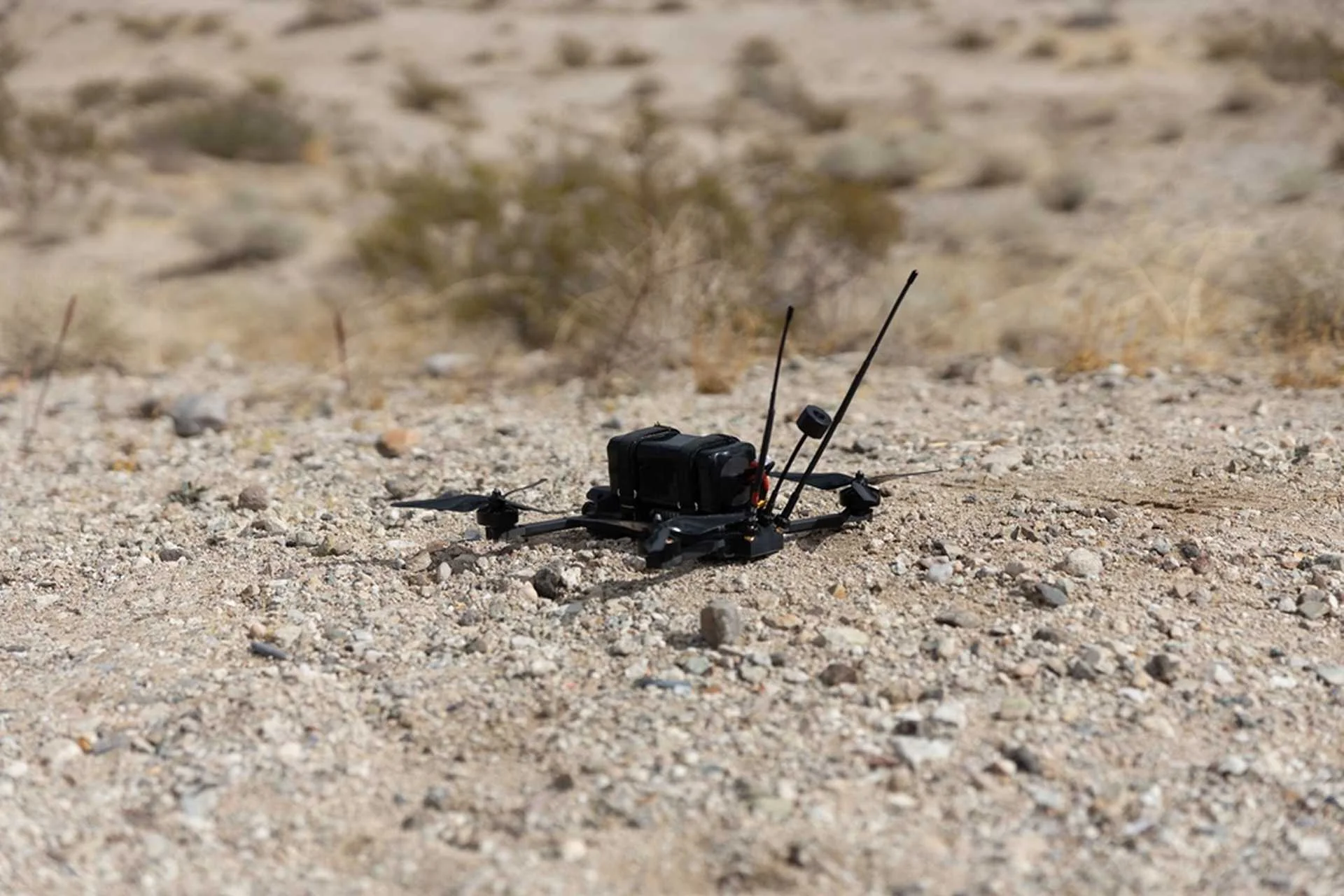 Neros Archer FPV during U.S. Marine Corps testing / Photo: Cpl. Anna Higman, Marine Corps Air Ground Combat Center via DVIDS
The indefinite-delivery/indefinite-quantity (IDIQ) framework contract covers Archer Strike drones, a purpose-built system for rapidly transporting the drones, ancillary equipment, testing and engineering support, and training. The place of performance and funding will be determined for each individual task order. The framework contract is expected to run through June 30, 2031.
Neros was selected as one of three suppliers for the first phase of the Purpose-Built Attritable Systems (PBAS) program in November 2025. The company offered the Archer and Archer Strike drones in 5-inch and 10-inch variants for deployment at U.S. Army platoon level, alongside the Hoverfly Spectre and Zone 5 Paladin. Initial deliveries were completed ahead of schedule in March 2026. The drones are being tested by units including the U.S. Army’s 7th Infantry Division. In February 2025, they were also delivered for testing by the U.S. Marine Corps and U.S. Special Operations Command.
The Archer and Archer Strike drones have been added to the Blue UAS Cleared List and approved for official use by the U.S. Department of Defense. They have also received Defense Innovation Unit certification confirming compliance with cybersecurity and National Defense Authorization Act requirements. Archer became the first FPV system to complete verification and receive authorization to operate under the Blue UAS program. This authorization allows the platform to be used globally without additional administrative approvals.
In addition to the drone itself, the Archer system includes radio modules, Crossbow flight controllers, GPS/GNSS receivers, and transceiver modules supplied by U.S. manufacturers. All verified components are modularly compatible with other systems and require no additional approvals.
In March 2025, Neros Technologies Inc. announced that it had raised 35 million USD in a Series B funding round led by Vy Capital US. Other investors included Sequoia Capital, Interlagos, D3, Keller Rinaudo Cliffton, CEO of Zipline, and existing investors such as Peter Thiel, Cantos, A*, and BoxGroup. The company said it planned to use the capital to expand production of Archer drones and the associated Crossbow ground control station, as well as to further develop vertically integrated military technologies in-house. Neros had previously raised 10.9 million USD in a Series A round. In 2024, it opened a 15,500-square-foot, or approximately 1,400 m², facility in El Segundo, California, where it manufactures and assembles key drone components.
Neros Technologies Inc. was founded in 2023 by Soren Monroe-Anderson and Olaf Hichwa. Both founders had backgrounds in drone racing and electronics manufacturing. Hichwa began building custom FPV drones and designing printed circuit boards at a young age, while Monroe-Anderson won the MultiGP World Championship in 2020. The current Neros team includes engineers from aerospace companies such as SpaceX, as well as personnel with national security experience, including Earl G. Matthews, a former Senior Director at the U.S. National Security Council.
The Archer drone uses components developed by Neros to reduce dependence on foreign supply chains. The system includes a wideband video transmitter, multiband operating capability, and jam-resistant radio receivers. The Crossbow station was designed to maintain a safe distance between the operator and electronic signal transmitters. Archer is designed for daytime, nighttime, and adverse-weather operations. Its payload bay supports several battery types, allowing endurance profiles to be tailored to specific missions. It is also compatible with explosive payloads developed in cooperation with Kraken Kinetics. Archer drones were delivered to Ukraine last year under a contract for 6,000 units fitted with locally manufactured warheads.
According to the manufacturer, Archer’s design was shaped by performance and scalability requirements identified during visits to Ukraine. Ukrainian Ministry of Defence officials reportedly indicated that the minimum acceptable production rate was 5,000 drones per month, prompting Neros to design its manufacturing process accordingly. The contract for Ukraine, coordinated through the International Drone Capability Coalition, was the largest order fulfilled by a U.S. manufacturer of FPV drones. By comparison, the U.S. Department of Defense’s Replicator initiative, announced on August 28, 2023, envisaged the delivery of 3,000 drones within two years.
Neros says its production system has eliminated dependence on Chinese components, which dominate global drone supply chains. The company has emphasized the difficulty of developing motors and cameras in-house, components traditionally considered difficult to source outside China. Although Neros acknowledges that production-cost differences between the United States and China remain, it says its systems are still manufactured at lower prices than other U.S.-made drones listed under Blue UAS. The company cited this pricing model as one of the reasons Archer was selected and moved into mass production.