

























On Monday, August 17, 2026, Lockheed Martin Aeronautics (part of Lockheed Martin) announced on social media that final assembly of the first F-35A Lightning II multirole combat aircraft for the German Air Force (Luftwaffe) had been completed at the Final Assembly and Check-Out (FACO) facility in Fort Worth, Texas. Work on the aircraft had been under way since March 23 this year.
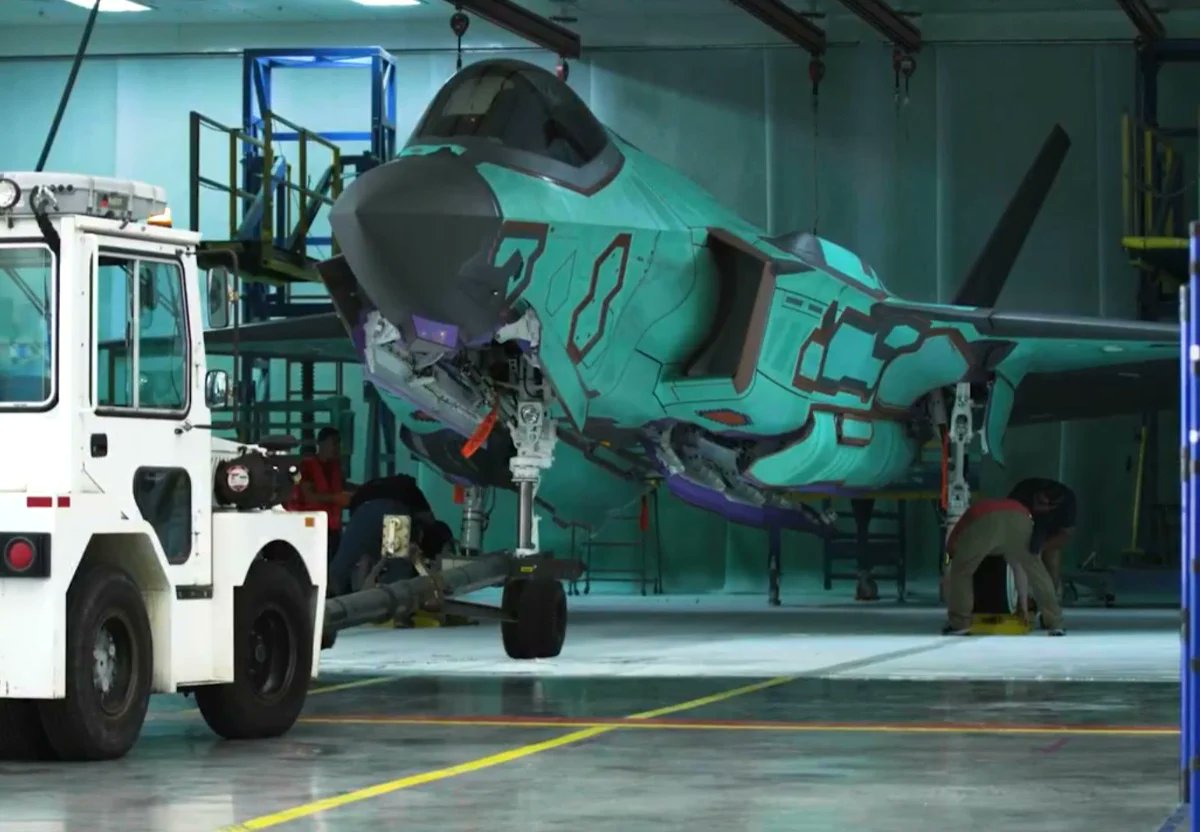 Photo: Lockheed Martin
The first German aircraft, bearing serial number MG-01, will now be transferred to the paint facility for the application of several layers of stealth coating and national markings as part of the Aircraft Final Finishes process. The fuselage arrived at the FACO facility on November 25, 2025, while construction of the aircraft began on December 5, 2024.
The official roll-out ceremony, to be attended by a German government delegation, is scheduled for September 18 this year. This will be followed by the aircraft’s first flight and transfer to Ebbing Air National Guard Base in Fort Smith, Arkansas, where seven additional aircraft will also be based to begin the training program for German instructor pilots and maintenance personnel. The aircraft are to be formally delivered by 2027, but will remain in the United States, although the original plan called for them to stay there only through 2026.
F-35A for Germany
On July 28, 2022, Germany received approval from the US Department of State for the purchase of 35 F-35A aircraft together with an equipment and weapons package worth up to 8.4 billion USD. On December 14, 2022, the Federal Ministry of Defence signed the relevant intergovernmental agreement (LOA). On August 17, 2023, the US Naval Air Systems Command (NAVAIR) awarded Lockheed Martin Aeronautics a 622.36 million USD contract for the initial work related to production of the German aircraft.
The German F-35As will be armed with AIM-120C-8 AMRAAM medium-range air-to-air missiles, AIM-9X Block II+ Sidewinder short-range air-to-air missiles, AGM-158B JASSM-ER extended-range cruise missiles, GBU-53/B SDB II StormBreaker guided bombs, GBU-31 JDAM and GBU-54 JDAM guided bombs, and JSM anti-ship missiles. Most importantly, and as the main reason behind the Berlin government’s selection of the platform, the aircraft will also be capable of carrying B61-12 guided thermonuclear bombs under the NATO Nuclear Sharing arrangement.
Media reports appeared last year and again this year suggesting that Germany might increase the number of F-35As on order, but these were denied by the government in Berlin.
German industry in the F-35 program
Germany’s defense industry has also joined the F-35 program. On February 17, 2023, Rheinmetall AG signed a letter of intent with Northrop Grumman and Lockheed Martin regarding the potential establishment of an F-35 center fuselage production facility in Germany.
On July 4, 2023, it was announced that the facility would be built in Weeze, North Rhine-Westphalia, near the border with the Netherlands. A ceremonial groundbreaking for the future facility took place on August 1, 2023, while on July 2, 2024, Rheinmetall Aviation Services (RAS), a subsidiary of Rheinmetall, signed an agreement with AERO-Bildungs to provide technical training for employees of the future Weeze plant. The facility began operations in July 2025 and currently employs around 200 people, with that figure expected to rise to 400 by the end of the year. The agreement covers at least 400 center fuselages.
The first center fuselage produced in Germany is to be delivered to the US partners in the first quarter of 2027. This is the second such assembly line after Northrop Grumman’s F-35 Integrated Assembly Line (IAL) in Palmdale, California.
Another milestone for Germany’s first F-35. 🇩🇪
Following final assembly, the aircraft moved to Aircraft Final Finishes, bringing it one step closer to supporting the Luftwaffe and Germany’s next generation of air power. ✈️ pic.twitter.com/Py2Yv6LZgu
— Lockheed Martin Europe (@LMEuropeNews) August 17, 2026