





















On Friday, August 7, 2026, the Executive Administration of the Organisation for Joint Armament Cooperation (OCCAR-EA) announced that it had amended the contract with the ARTEC GmbH consortium (ARmoured vehicle TEChnology, comprising Rheinmetall AG and KNDS in a 64:36 ratio) to include an additional 69 Schakal wheeled infantry fighting vehicles based on the GTK Boxer chassis, bringing the total previously contracted for the armed forces of Germany and the Netherlands to 222 vehicles.
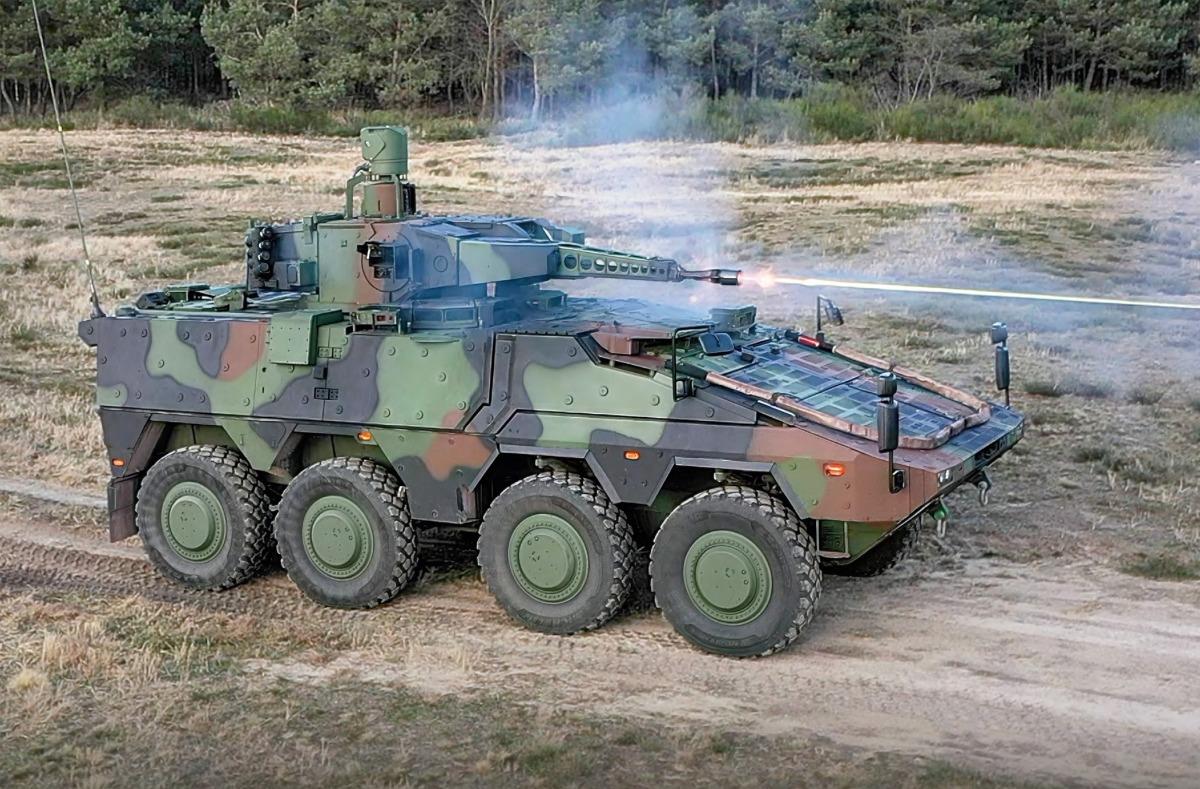 Prototype Schakal wheeled infantry fighting vehicle during live-fire testing / Photo: OCCAR
As a reminder, the base contract signed on October 17, 2025, worth 3.41 billion EUR, covered the delivery of 222 Schakal vehicles, including 150 for Germany and 72 for the Netherlands under the initial order, with deliveries scheduled for 2027–2031. Under the latest amendment, the German Army (Heer) will receive an additional 35 vehicles, bringing its total to 185, while the Royal Netherlands Army (Koninklijke Landmacht) will receive another 34, bringing its total to 106. The overall order has therefore increased to 291 vehicles.
Although OCCAR did not disclose the value of the amendment, according to sources cited by German defense outlet Hartpunkt, Germany’s share is worth nearly 650 million EUR. It can therefore be assumed that the Netherlands paid around 630 million EUR for one fewer vehicle (editor’s note). Deliveries from this tranche are scheduled for 2032–2033. With this amendment, the total value of new investments in the GTK Boxer program over the past 12 months has reached approximately 6.5 billion EUR.
It is worth noting that the base contract includes options for a further 248 vehicles, including 200 for Germany and 48 for the Netherlands, for a potential total of 470 vehicles. Berlin and The Hague can therefore still jointly order another 179 vehicles, respectively 165 and 14.
It is also worth noting that last year a parallel contract worth just over 1 billion EUR was signed for an additional 48 GTK Boxer vehicles in Driver Training Vehicle (DTV) and armored ambulance variants for Germany. Meanwhile, under an agreement signed on February 6 this year, Schakal vehicles operated by both countries will receive counter-drone capabilities supplied by German company TYTAN Technologies.
Schakal
As a reminder, on September 16, 2025, German magazine .loyal was the first to report that the new GTK Boxer-based wheeled infantry fighting vehicle variant would be designated Schakal. It had previously been unofficially referred to as PuBo (Puma Boxer) or Puma Rad. The vehicle had already attracted interest from the governments in Berlin and The Hague, as reported by Hartpunkt on May 13, 2024. The concept involves integrating the turret used by the heavy tracked SPz Puma infantry fighting vehicle.
The contracted vehicles will complement the 123 Boxer HWC (Heavy Weapons Carrier), or Schwerer Waffenträger Infanterie (sWaTrInf), vehicles ordered by Germany on March 21, 2024, for approximately EUR 2.7 billion (PLN 11.61 billion at the time). These are based on the Australian Boxer CRV (Combat Reconnaissance Vehicle). The first prototype was delivered for testing on May 2, 2024.
A key difference between the Boxer HWC and the newer Schakal is the turret system. The former is equipped with a two-man Rheinmetall Lance 2 Block II turret armed with a 30 mm Rheinmetall MK30-2 ABM automatic cannon. The Schakal is to receive the unmanned RCT30 turret system produced by KNDS Deutschland, also armed with the MK30-2 ABM cannon.
The Lance 2 Block II turret has a basket for the commander and gunner, which occupies part of the vehicle’s internal hull volume, while additional space is taken up by ammunition. The unmanned RCT30 turret avoids this issue, allowing the extra internal space to be used for carrying troops. In addition, the RCT30 turret is equipped with twin MELLS (Mehrrollenfähiges Leichtes Lenkflugkörper-System) launchers for Rafael Spike LR anti-tank guided missiles with a range of 4–5 km.
While a Boxer HWC configured in this way is sufficient as an infantry support vehicle for mechanized infantry units (Jägertruppe), armored infantry units (Panzergrenadier) require additional space for carrying dismounts. This is currently provided by the SPz Puma, which can transport six fully equipped soldiers fitted with the Infanterist der Zukunft-Erweitertes System individual soldier system.
GTK Boxer in Germany and the Netherlands
The German armed forces had previously received 403 GTK Boxer A1/A2 vehicles (Gepanzerte Transport-Kraftfahrzeug), including 72 armored ambulances (Sanitätsfahrzeug), 65 command vehicles (Führungsfahrzeug), 10 driver training vehicles (Fahrschule), and the remaining 256 in the infantry transport variant (Gruppentransportmodul).
Following the contracts discussed above, Germany is now set to receive another 377 vehicles: 123 Boxer HWC, 185 Schakal, 38 Sanitätsfahrzeug, and 10 Fahrschule, as well as previously ordered 19 Oerlikon Skyranger 30 gun-missile air defense systems and two vehicles in the Joint Fire Support Team configuration. This will increase Germany’s Boxer fleet to 780 vehicles, or 945 if the options are exercised.
According to operational requirements from 2012, the Bundeswehr’s minimum requirement for GTK Boxer vehicles was 684 units. Berlin’s ambitions are now reportedly much greater, however, as according to a Bloomberg report from July 4, 2025, the Bundeswehr would like to acquire a total of 2,500 new GTK Boxer vehicles over a 10-year period. In December last year, the purchase of 84 Boxer-based RCH 155 AGM 155 mm wheeled howitzers in the B0 variant was approved for 1 billion EUR. The broader initiative is currently known under the codename Arminius.
For the Netherlands, the acquisition of 106 Schakal vehicles, with an option for another 14, will significantly strengthen its mechanized infantry, which currently operates GTK Boxer wheeled armored personnel carriers armed only with a 12.7 mm M2 Browning machine gun for self-defense.
The Netherlands currently operates a total of 198 GTK Boxer vehicles, including 92 engineering support vehicles, 52 ambulances, 36 command vehicles, 12 infantry carriers, and eight driver training vehicles. The Schakal acquisition will increase the fleet to 270 vehicles, or 318 if the options are exercised. It is also worth noting that earlier plans included the acquisition of 10 specialized Knifefish electronic warfare vehicles.