
























On Tuesday, July 21, 2026, Deputy Prime Minister and Minister of National Defence Władysław Kosiniak-Kamysz announced on social media that deliveries of Baobab-K scatterable mine-laying vehicles to the Polish Armed Forces had begun. The vehicles are manufactured by Huta Stalowa Wola (HSW), part of the Polish Armaments Group (PGZ).
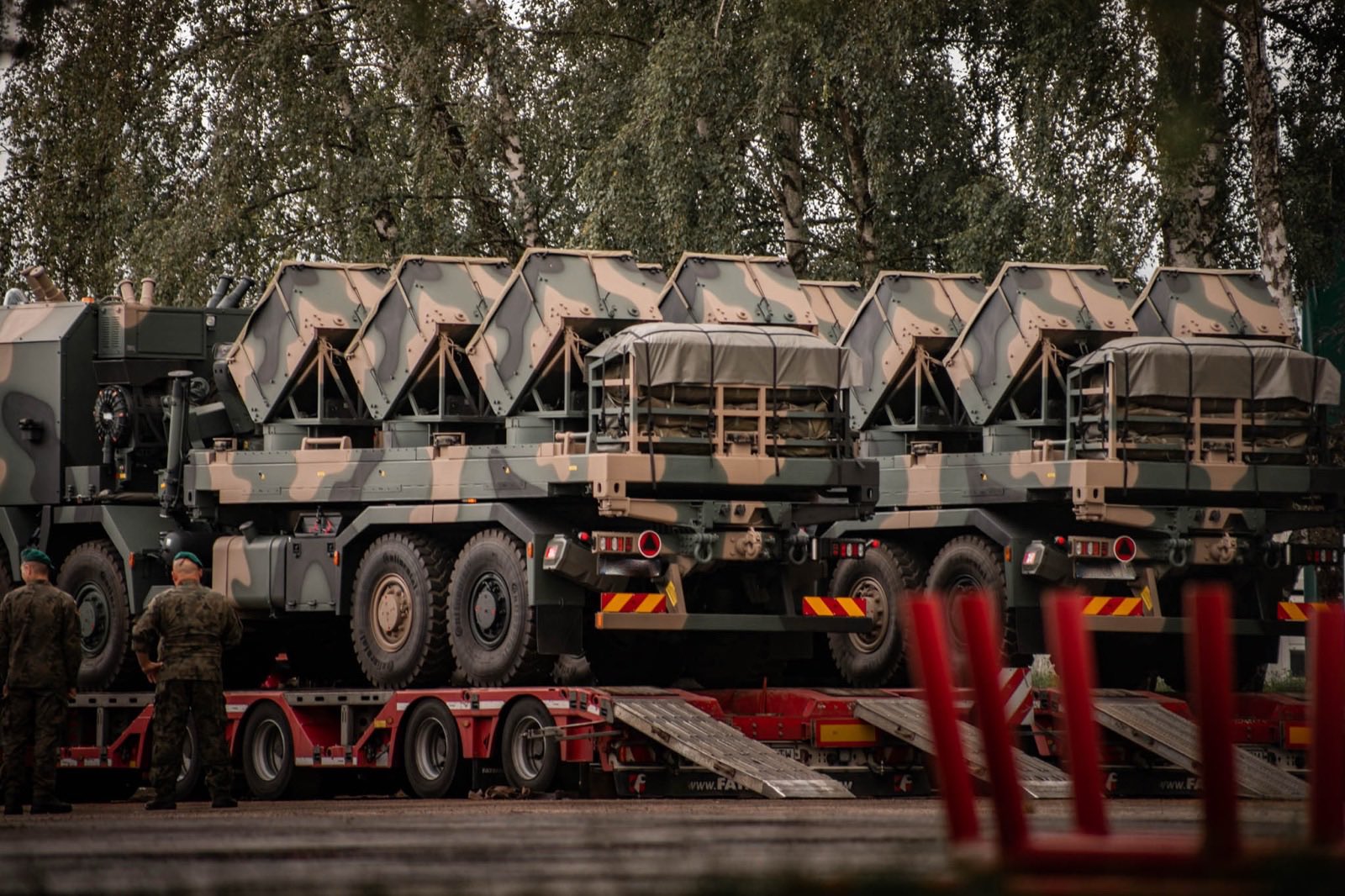 Photo: Władysław Kosiniak-Kamysz
“Modern Baobab-K scatterable mine-laying vehicles have arrived at the 16th Engineer Regiment, strengthening the capabilities of the engineering troops. This is a good and proven product from Huta Stalowa Wola. Modernizing the Polish Armed Forces on the basis of the Polish defense industry is one of our priorities.”
Władysław Kosiniak-Kamysz
According to the photograph published by the Minister of National Defence, two Baobab-K vehicles were delivered to Orzysz.
On June 14, 2023, the State Treasury–Armament Agency and a consortium comprising the Polish Armaments Group and Huta Stalowa Wola signed a contract worth approximately 510 million PLN gross for the delivery of 24 Baobab-K scatterable mine-laying vehicles, together with logistics and training packages. Deliveries were scheduled for 2026–2028 and are therefore proceeding according to plan. On May 30 this year, the contract was amended to include a further 11 vehicles, increasing the total to 35. The amendment is financed through the SAFE instrument.
The Baobab-K will enhance the Polish Armed Forces’ ability to carry out engineering support tasks by enabling engineer units to automatically and autonomously lay scatterable minefields in designated areas.
Negotiations concerning the procurement of the Baobab-K began in March 2023, while qualification testing of the prototype was successfully completed in July 2022.
The Baobab-K prototype was developed by Huta Stalowa Wola in cooperation with Jelcz, Bydgoskie Zakłady Elektromechaniczne BELMA, WB Electronics of WB Group, and the Military Institute of Engineer Technology. It made its public debut in September 2021 at the 29th International Defence Industry Exhibition in Kielce.
The Baobab-K is based on the Jelcz P882.53 8×8 chassis with an armored cab meeting STANAG 4569 Level 1 ballistic protection requirements. Eight smoke grenade launchers are mounted on the cab roof. The system consists of six MN-123 mine launchers. Each cassette can hold up to five mines, while each launcher accommodates 20 cassettes, giving the vehicle a total capacity of up to 600 mines. The vehicle features a fully automated mine-laying process, from calculating settings and rotating the launchers to maintaining the required mine-dispensing rate according to vehicle speed and the programmed minefield layout.
WB Group supplied the electromechanical system from Arex, the FONET vehicle communication system, a communications system from Radmor and an IT system with specialized minefield-management software.
A 19,948,177.22 PLN gross contract for the development of the final Baobab-K prototype was signed with the Armament Inspectorate of the Ministry of National Defence on December 28, 2018. The procurement procedure had been underway since May 9, 2018. It was the fourth attempt to carry out the program.
The vehicle was developed for engineer units, originally as a supplement to the tracked Kroton Engineer Mine-Laying System introduced into armored and mechanized units in 2004 on the MTLB-U chassis. Initial demand for the Baobab-K was estimated at 12–15 vehicles, with the possibility of increasing the number to as many as 50, including adaptations for mechanized brigades and the Territorial Defence Forces.
It is now known that the Baobab-K will eventually be supplemented by the Baobab-G tracked scatterable mine-laying vehicle. A contract worth approximately 1 billion PLN for its development was signed with Huta Stalowa Wola on December 31, 2025. Deliveries are scheduled to begin in 2029.
Video: 16th Orzysz Engineer Regiment
MN-123
The Baobab-K scatterable mine-laying vehicle is designed to deploy MN-123 anti-tank mines fitted with a bidirectional explosively formed penetrator warhead. The mines can penetrate 60 mm of rolled homogeneous armor. The MN-123 is equipped with a non-contact magnetic fuze with either instantaneous or delayed activation, as well as programmable self-destruction after 1–30 days and a self-neutralization function, in accordance with the Convention on Certain Conventional Weapons. Each mine has a diameter of 180 mm, a thickness of 90 mm, and weighs 3.7 kg.
For this reason, alongside the Baobab-K contract, the Armament Agency also placed orders for MN-123 mines.
In 2023, Bydgoskie Zakłady Elektromechaniczne BELMA received an order for more than 10,000 ISM mine cassettes containing MN-123 scatterable mines, several hundred mine cassettes containing MN-123/C training mines, and more than 6,000 MR-123 anti-tank mines for manual emplacement. The order was worth approximately 566 million PLN gross, with deliveries scheduled for 2023–2026.
Then, on April 29 this year, BZE BELMA signed a record contract worth approximately 3.4 billion PLN for the delivery of 360,000 scatterable anti-tank mines. One month later, on May 29, additional ISM mine cassettes containing MN-123 scatterable mines were ordered under the SAFE program for approximately 1.36 billion PLN net.
Do 16 Pułku Saperów dotarły nowoczesne pojazdy Minowania Narzutowego Baobab-K, które zwiększą zdolności wojsk inżynieryjnych. To dobry i sprawdzony produkt Huty Stalowa Wola @PGZ_pl. Modernizacja #WojskoPolskie w oparciu o polski przemysł zbrojeniowy to jeden z naszych… pic.twitter.com/zFHClKJSMf
— Władysław Kosiniak-Kamysz (@KosiniakKamysz) July 21, 2026
