



















On Wednesday, April 29, 2026, Bydgoskie Zakłady Elektromechaniczne Belma, part of Polish Armaments Group (PGZ), signed a record contract worth approximately 3.4 billion PLN with the State Treasury – the Armament Agency of the Ministry of National Defence – for the delivery of 360,000 scatterable anti-tank mines. This is another step in the development of the Polish Armed Forces’ engineering capabilities. The contract was signed in Bydgoszcz in the presence of Deputy Prime Minister and Minister of National Defence Władysław Kosiniak-Kamysz and Secretary of State at the Ministry of National Defence Paweł Bejda.


Photos: PGZ
“A homeland is defended not only by the strength of its military and alliances, but also by the strength of its citizens – each and every one of us. It is incredible that we have plants like this one in Poland – probably still not fully used or promoted globally. We will continue working on that. They are capable of concluding extraordinary contracts, such as the one signed today: nearly 3.5 billion PLN for the delivery of tens of thousands of mines, some of them live and some training variants. This is a major framework agreement that will help us feel safer in Poland,” Deputy Prime Minister Władysław Kosiniak-Kamysz said after the contract was signed.
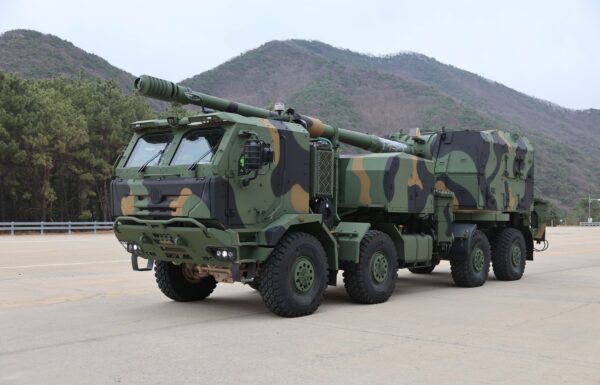
“All of this is produced by Polish Armaments Group. At the end of last year, Minister Paweł Bejda signed a contract for 24 ground minelaying vehicles on Jelcz chassis, the first five of which will be delivered to units in Rzeszów and Nisko in the coming weeks. They will already be able to serve and help build the defensive shield. The project we are implementing today – the purchase of anti-tank mines – is part of building protection for the eastern flank of the European Union and NATO. It is a strategic security program for our continent, and therefore for the entire Republic of Poland,” Deputy Prime Minister Władysław Kosiniak-Kamysz emphasized (Baobab-K vehicles on Jelcz chassis were ordered in June 2023 under the previous Ministry of National Defense leadership, while in December last year the current administration ordered tracked Baobab-G vehicles – editor’s note).
“However, our production capacity is much greater, and we will want to use it. We want the first executive contract to be worth 600 million PLN, under a framework agreement worth nearly 3.5 billion PLN, while subsequent contracts would also cover anti-personnel mines. Today, I received information from CEO Zakrzewski that production capacity for anti-personnel mines may soon reach 100,000 per month, or more than one million per year. This is an opportunity not only for Poland, but also for our friends in the Baltic states. They face very serious threats. Together with us, they have denounced the Ottawa Convention, as has Finland. This is a good market, but also an expression of solidarity and allied responsibility. That is why I am asking CEO Leszkiewicz, head of Poland’s largest defense group, Polish Armaments Group, to expand in this direction: from Finland through Estonia, Latvia, and Lithuania, but also Romania and Moldova,“” the head of the Ministry of National Defense added.
“Today’s contract with the Armament Agency is a record order for our company. But it should be emphasized that by signing this contract, we are placing much more than the mines themselves at the disposal of the Polish Armed Forces. They are part of a larger whole, a coherent and well-designed solution. It is a system comprising not only mines, but also cassettes, launchers, and, ultimately, specialized scatterable minelaying vehicles. This is a weapon platform whose first wheeled examples are already in service with the Polish Armed Forces, while an order has been placed for the tracked version,” said Adam Leszkiewicz, President of the Management Board of Polish Armaments Group. “Moreover, we have market signals indicating interest in this product from foreign customers. This creates good prospects for both Belma and Huta Stalowa Wola,” he added.


Photos: Krzysztof Niedziela
The contract covers the procurement of tens of thousands of mine cassettes, each containing five mines, for scatterable minelaying systems. These include the modern Baobab-K wheeled Scattered Minelaying Vehicles (PMN), future Baobab-G Tracked Scattered Mine Laying Vehicle (TMN), and the previously operated Kroton Engineer Minelaying Systems (ISM), based on the SPG-2A armored carrier chassis, a Polish development of the Soviet MT-LB.
The contract is worth approximately 3.4 billion PLN gross, with deliveries to be carried out in 2027–2029.
The acquired munitions will significantly increase the capabilities of the Polish Armed Forces in rapidly creating anti-tank obstacles. The PMN and TMN systems enable dynamic deployment of scatterable minefields with varying density, adapted to the tactical situation. The MN-123 anti-tank mines used in these systems make it possible to effectively disable and destroy enemy vehicles.
The system’s modern architecture ensures a high level of automation in the minelaying process, from programming parameters to recording minefield coordinates in digital systems. At the same time, the operator retains the ability to control the system manually, increasing flexibility of use in combat conditions.
Baobab PMN and TMN vehicles can carry up to 600 MN-123 anti-tank mines in total, in immediate-action and delayed-action variants with a programmable self-neutralization option. Each launcher is fitted with 20 tubes, each holding five mines. The minelaying process can be fully automated, with the option of manual control by the system operator. During minefield deployment, the depth of the mined area corresponds to the required mine density. The parameters and coordinates of the minefield being laid are recorded on digital maps.
The scatterable mines, 180 mm in diameter and 90 mm high, weigh 3.7 kg. They can be fitted with explosively formed penetrator (EFP) charges and are capable of penetrating 60 mm of armor. Detonation can be initiated by a magnetic, delayed-action, or immediate-action fuze. Before launch, the mine can be programmed to explode at the desired moment — after a specified time from fuze activation or after a specific number of vehicles have passed over it. In accordance with international convention requirements, MN-123 mines are neutralized after a specified period. Neutralization is achieved either by detonation or by blocking the ability to detonate the explosive charge.
Wicepremier W. @KosiniakKamysz: Uwierzcie mi, trochę lat już pracuję w polityce i w relacjach z ludźmi, więc wiem, o czym mówię. Czuje się dobrą atmosferę, skupienie na pracy, oddanie dla swojej firmy, często także oddanie dla Polski. Jakby to górnolotnie nie zabrzmiało, żyjemy w… pic.twitter.com/o8MxhDvJAj
— Ministerstwo Obrony Narodowej 🇵🇱 (@MON_GOV_PL) April 29, 2026
Wicepremier W. @KosiniakKamysz: Dzisiejszy kontrakt pokazuje strategię naszego rządu. Będziemy realizować kolejne umowy, korzystając ze środków europejskich. Nie jest to łatwe. Niektórzy próbują rzucać nam kłody pod nogi, utrudniając zawieranie korzystnych kontraktów, które mają… pic.twitter.com/lzxf70AtwT
— Ministerstwo Obrony Narodowej 🇵🇱 (@MON_GOV_PL) April 29, 2026
💥 BUM! Rekordowa umowa Belmy na miny dla #WojskoPolskie!
✍️ Umowa pomiędzy @AgencjaUzbr a Bydgoskimi Zakładami Elektromechanicznymi #BELMA na dostawę bojowych i ćwiczebnych min narzutowych krajowej produkcji podpisana!Robimy kolejny krok w rozwoju zdolności inżynieryjnych… pic.twitter.com/I0JTrS9HfD
— Polska Grupa Zbrojeniowa🇵🇱 (@PGZ_pl) April 29, 2026
Kolejne 3,4 mld zł przeznaczone na nasze bezpieczeństwo. Podpisana dziś umowa pomiędzy @AgencjaUzbr a Bydgoskimi Zakładami Elektromechanicznymi „Belma” S.A. na dostawę 360 tys. bojowych i ćwiczebnych min narzutowych dla #WojskoPolskie to kolejny krok nie tylko we wzmacnianiu… pic.twitter.com/zZdL8szAIe
— Władysław Kosiniak-Kamysz (@KosiniakKamysz) April 29, 2026
See also: