

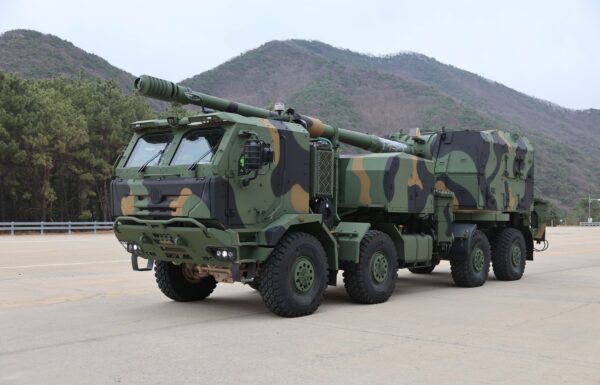



























On Thursday, February 5, 2026, the Armed Forces General Command (DG RSZ) announced via social media that a demonstration of the innovative unmanned–manned scattere mining system Bluszcz was held at the 1st Sapper Regiment in Brzeg (Opole Voivodeship).
 Photos: 1st Sapper Regiment
“This modern solution enables rapid and precise deployment of mine barriers from the air, increasing operational effectiveness while enhancing soldier safety. The project is the result of cooperation between Polish industry and academia – another step in the modernization of the Engineer Troops and proof of the strength of Polish engineering thought,” reads a brief press release from the Armed Forces General Command (DG RSZ).
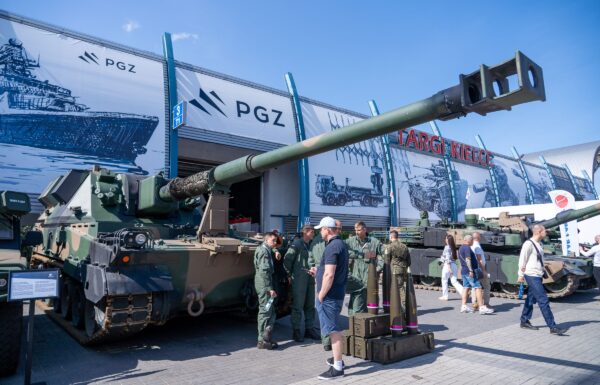
Bluszcz was unveiled at the International Defence Industry Exhibition MSPO 2025 at Targi Kielce by Bydgoskie Zakłady Elektromechaniczne Belma, a member of the Polish Armaments Group (PGZ). The system was developed in cooperation with the Białystok-based company STEKOP and the Military Institute of Armoured and Automotive Technology (WITPiS) from Sulejówek.

The unmanned–manned scattered mine-laying system codenamed Bluszcz is a modern solution designed for the rapid and precise creation of minefields. An innovative feature of the system is the ability to switch between manual and remote vehicle operation by the operator, depending on the threat level.
The vehicle is equipped with a central control system that enables unmanned operation, incorporating elements of autonomy that allow the route of movement to be preprogrammed.

The core element of the system is a launcher package integrated with the chassis, consisting of 20 interchangeable canisters, each loaded with five MN-123 anti-tank mines. The system can deploy mines across a strip 30 to 90 meters wide. Both the coverage area and mine density are programmable.
The platform is based on the TAERO manned–unmanned vehicle.

The system employs MN-123 anti-tank mines (also used by the older ISM Kroton system). These scatterable mines, with a diameter of 180 mm and a height of 90 mm, weigh 3.7 kg. They can be fitted with EFP (Explosively Formed Penetrator) shaped charges and are capable of penetrating armor up to 60 mm thick. Detonation can be initiated by a magnetic, delayed, or instantaneous fuze. Prior to deployment, the mine can be programmed to explode at a desired moment, either after a specified time following fuze activation or after a defined number of vehicles have passed over it. In accordance with international conventions, MN-123 mines are subject to neutralization after a set period. Neutralization is carried out either by detonation or by disabling the ability to detonate the explosive charge.

Currently, the Polish Armed Forces operate manned scattered mine-laying systems, namely the Engineering Mine-Laying System ISM Kroton mounted on the SPG-2A armored personnel carrier chassis (a Polish development of the Soviet MT-LB), with six units in service. Later this year, the first of 24 Baobab-K wheeled scattered mine-laying vehicles, based on the Jelcz 8×8 chassis with an armored cab, are scheduled to enter service. Meanwhile, on December 31, 2025, Huta Stalowa Wola was tasked with developing the tracked Baobab-G scattered mine-laying vehicles, which are intended to replace the ISM Kroton systems in the future.

See also: