

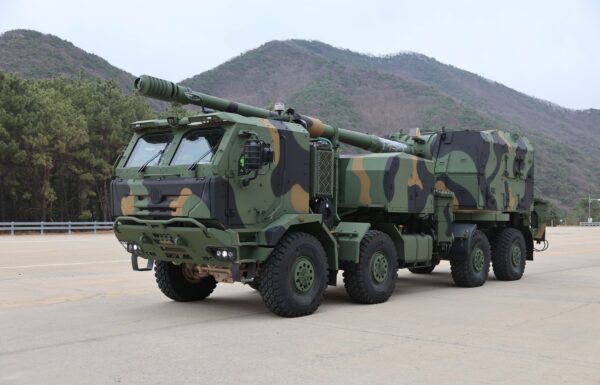
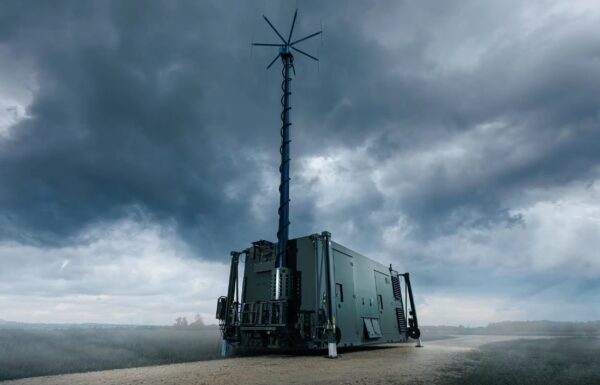




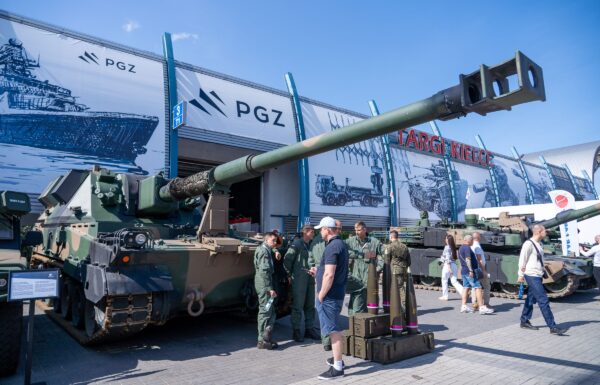






















At BEDEX 2026 (Brussels European Defence Exhibition), held on March 12–14 in Brussels, the Polish Armaments Group (PGZ) and the Czech holding Czechoslovak Group (CSG) jointly presented the Modular Mine Laying System (also appearing in previous texts as Modular Scatterable Mine System, Modułowy System Minowania Narzutowego, MSMN in Polish – translator’s note) mounted on a Tatra 6×6 chassis.
 Photo: Jakub Link-Lenczowski, MILMAG
The full-scale prototype vehicle in this configuration made its public debut on February 9 this year, the second day of the World Defense Show 2026 in Riyadh, when the Polish Armaments Group (PGZ) and Czechoslovak Group (CSG) signed an agreement on the integration of the Polish Modular Mine Laying System with Tatra 6×6 chassis and the joint offering of this solution on export markets. While the first country to which the offer was directed was Saudi Arabia, the joint solution is now intended to be promoted in Europe (during WDS it was reported that another potential sales destination is a European NATO member state – editor’s note).
Meanwhile, yesterday, March 11, CSG and PGZ concluded a Framework Cooperation Agreement, establishing the framework for further, expanded industrial, technological, and business partnership. The agreement opens the way to broaden the existing cooperation between PGZ and CSG, including projects related to the production of ammunition and armored tactical vehicles.
The Modular Mine Laying System (MMLS), is a modern solution developed and produced by Belma Electromechanical Works in Bydgoszcz, a company belonging to the PGZ Group. The system is distinguished by the full automation of minefield deployment with varying sizes, mine densities, and self-destruction times. The depth of the minefield ranges from 60 to 180 meters, while its length can reach up to 1,800 meters. Belma also produces the MN-123 scatterable mines used in the system.

The Modular Mine Laying System is a new offering from PGZ that allows the mine-laying system to be configured according to the customer’s requirements and needs. The Scatterable Mine System, known in Poland as the PMN Baobab-K, has been delivered to the Polish Armed Forces since 2023. Meanwhile, on December 31, 2025, Huta Stalowa Wola was tasked with developing tracked TMN Baobab-G scatterable mine-laying carriers, which will replace six units of the Kroton Engineering Mine-Laying System (ISM) mounted on the SPG-2A armored transporter chassis (a Polish development of the Soviet MT-LB). An optionally unmanned Bluszcz scatterable mine-laying system has also been developed.
The MMLS, Baobab-K, Baobab-G, and Bluszcz systems use MN-123 anti-tank mines. These scatterable mines have a diameter of 180 mm and a height of 90 mm, with a mass of 3.7 kg. They can be equipped with EFP shaped-charge warheads capable of penetrating 60 mm of armor. The explosion can be initiated by a magnetic, delayed, or instantaneous fuze. Before deployment, the mine can be programmed to detonate at a desired moment, either after a specified time following fuze activation or after a certain number of vehicles have passed over it. In accordance with international convention requirements, MN-123 mines are neutralized after a specified period. Neutralization is carried out either through self-detonation or by permanently disabling the detonation capability of the explosive charge.