






















On Thursday, July 2, 2026, Reuters, citing official Belgian sources, reported that the government in Brussels intends to purchase 10 NASAMS air defense systems from Norway and 20 Skyranger 30-series anti-aircraft artillery systems from Germany. The procurement budget could reach 3.1 billion EUR.
 NASAMS / Photo: RTX
The plans must be approved by the Belgian Council of Ministers and could be announced at the NATO Summit in Ankara, scheduled for July 7–8 this year. Belgium intends to make both purchases under framework contracts held by the Ministry of Defence of the Kingdom of the Netherlands in order to accelerate the process, the official added.
It should be recalled that the Kingdom of the Netherlands decided to purchase NASAMS systems in the form of six batteries on June 5, 2023, which will join two stationary systems purchased in 2006. The acquisition was approved by the Dutch parliament on October 14, and the contract was signed on November 21, 2024, together with shorter-range NOMADS systems. As for Skyranger 30 systems, the purchase was announced on January 29, 2025, and a contract for 22 systems on the tracked ACSV G5 chassis, or PMMC G5, was signed on December 12 of the same year.
Media leaks suggesting that Belgium was considering the purchase of NASAMS systems had already appeared in June 2025. The acquisition is expected to cost around 1.2 billion EUR. The cost of the Skyranger 30 systems has not yet been disclosed.
The aim of this strategic initiative is to create a comprehensive, multilayered air defense network that will protect the port of Antwerp, key logistics hubs, and transport corridors against advanced low- and medium-altitude air threats. This will be the first large-scale reconstruction of ground-based air defense since its disappearance as a result of reductions in the 1990s. It is worth adding that deliveries of 40 launchers and 300 missiles for Piorun man-portable air defense systems began in December 2025. It is estimated that rebuilding air defense capabilities will cost Belgian taxpayers around 4 billion EUR.
NASAMS
A NASAMS battery consists of six launchers for Sidewinder, AMRAAM, and AMRAAM-ER missiles, an AN/MPQ-64F1 Improved Sentinel three-dimensional radar, a command and fire-control vehicle with a Link 16 data transmission system, and a vehicle fitted with an electro-optical observation and targeting sensor. A single battery, operating as part of an integrated air defense system, can engage up to 36 air targets simultaneously, including aircraft, helicopters, and cruise missiles.
In recent months, mainly due to operational experience with Ukrainian NASAMS systems, Lithuania, Spain, Kuwait, and Norway have also decided to purchase the system or additional systems. The next users will be Denmark, Luxembourg, Taiwan, and Egypt. In previous years, the systems were purchased by Australia, Chile, Finland, Hungary, Indonesia, Oman, Qatar, and the United States. Slovakia has also expressed interest, while the system was considered by Romania, which selected Israel’s SPYDER, by Estonia and Latvia, both of which selected Germany’s IRIS-T SLM, as well as by India and Switzerland.
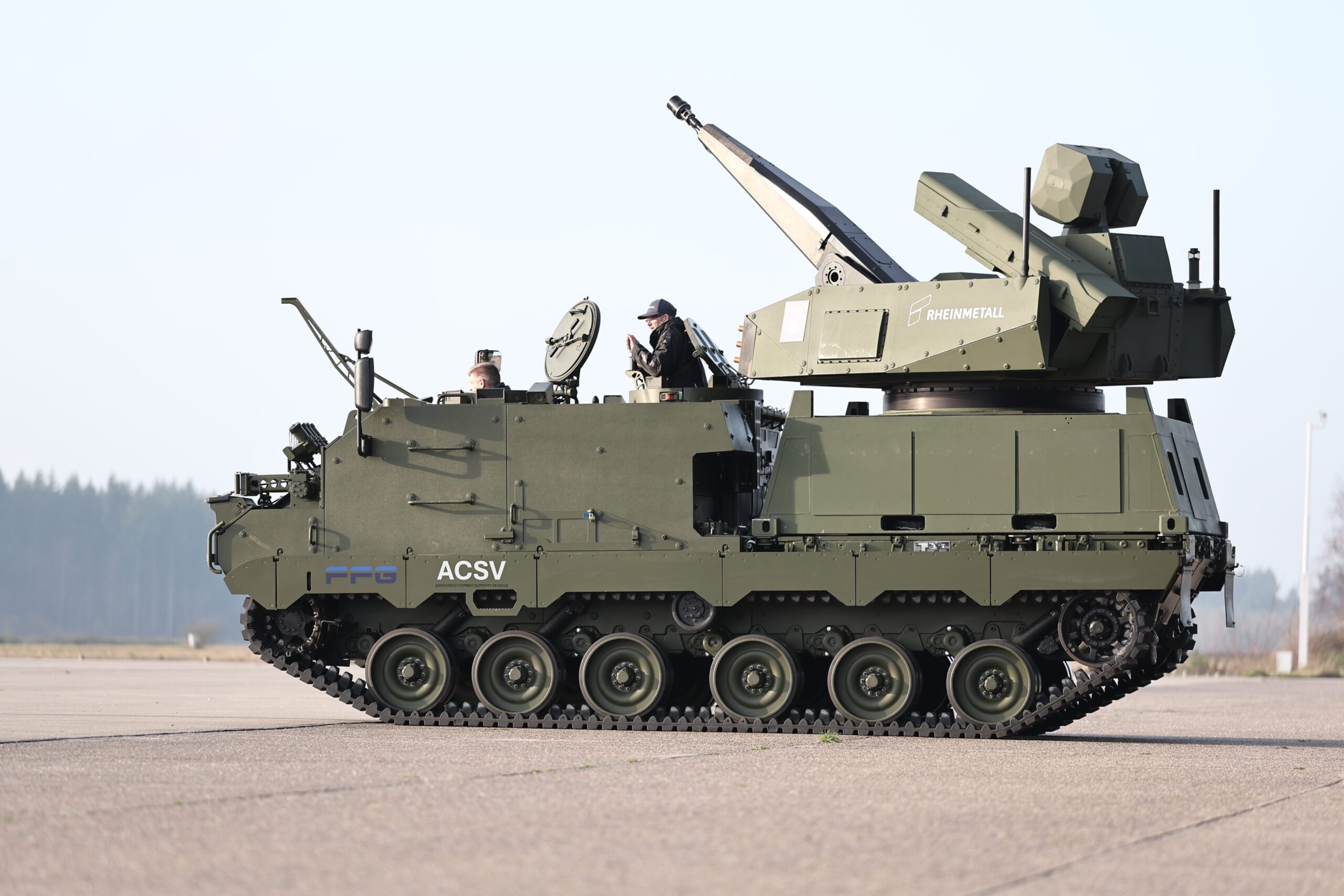 Skyranger 30 on the ACSV G5 (PMMC G5) chassis selected by the Dutch / Photo: Rheinmetall AG
Skyranger 30
The Oerlikon Skyranger 30 was unveiled in March 2021 and made its public debut later that year during an event dedicated to presenting counter-unmanned aircraft solutions, organized by the Swiss federal defense procurement office Armasuisse in Bure, in the district of Porrentruy, attracting significant interest from experts attending the event.
As recently as December 2023, a functional Skyranger 30 demonstrator successfully completed trials at Rheinmetall’s Ochsenboden test range in Switzerland, proving itself both in stationary mode and on the move. The functional demonstrator produced important new findings that will make the development and integration of the German system faster and less risky.
The Skyranger 30 turret system is armed with an Oerlikon KCE revolver automatic cannon, firing 30 mm × 173 ammunition, with a theoretical rate of fire of 1,200 rounds per minute and an effective range of up to 3,000 meters. The cannon can fire programmable airburst munition (ABM), armor-piercing fin-stabilized discarding sabot-tracer (APFSDS-T), and target practice-tracer (TP-T) rounds. The ammunition supply is 250 rounds. The cannon is a development of the proven Oerlikon KCA from the Swedish Saab JA 37 Viggen fighter-attack aircraft, developed by the then Oerlikon Contraves.
The prototype turret is fitted with five AESA antennas of the multifunction AAMR (AESA Multi-Mission Radar), operating in the S-band, which provide 360-degree coverage and an instrumented range of up to 20 km. It was developed by Rheinmetall Italia. It is supplemented by the FIRST (Fast InfraRed Search and Track) passive infrared detection system and the TREO tracking and identification system, featuring a cooled mid-wave infrared thermal imaging camera with a field of view from 1.3° to 23°, an HD TV camera with variable magnification and a field of view from 0.75° to 37°, and two laser rangefinders, one for air targets at distances of up to 6 km and one for ground targets.
The turret weighs approximately 2–2.5 tonnes, and is 5,175 mm long, 2,568 mm wide, and 1,444 mm high. It is operated by a crew of three. It provides Level 2 protection under STANAG 4569, with the option of increasing this to Level 4. Optionally, it can be equipped with air defense missile launchers, such as MBDA Mistral 3, FIM-92 Stinger, Cheetah for counter-unmanned aircraft operations, or SkyKnight. There is also an option to integrate a 20 kW high-energy laser weapon system as the Skyranger 30 HEL, with plans to increase output power to 50 kW.
So far, in addition to the Kingdom of the Netherlands, which selected the system on various base chassis, Skyranger 30 systems have been ordered by Germany, Denmark, and Austria, while Lithuania has expressed interest. A 35 mm variant has also been developed, which was delivered to Ukraine and was recently ordered by Romania under the SAFE program.
