























On Thursday, January 29, 2026, the U.S. Defense Security Cooperation Agency (DSCA) published the U.S. Department of State’s approval of a potential sale to the Kingdom of Spain of an MLU (Mid-Life Upgrade) modernization package for five F100 Álvaro de Bazán–class guided-missile frigates, valued at up to 1.7 billion USD.
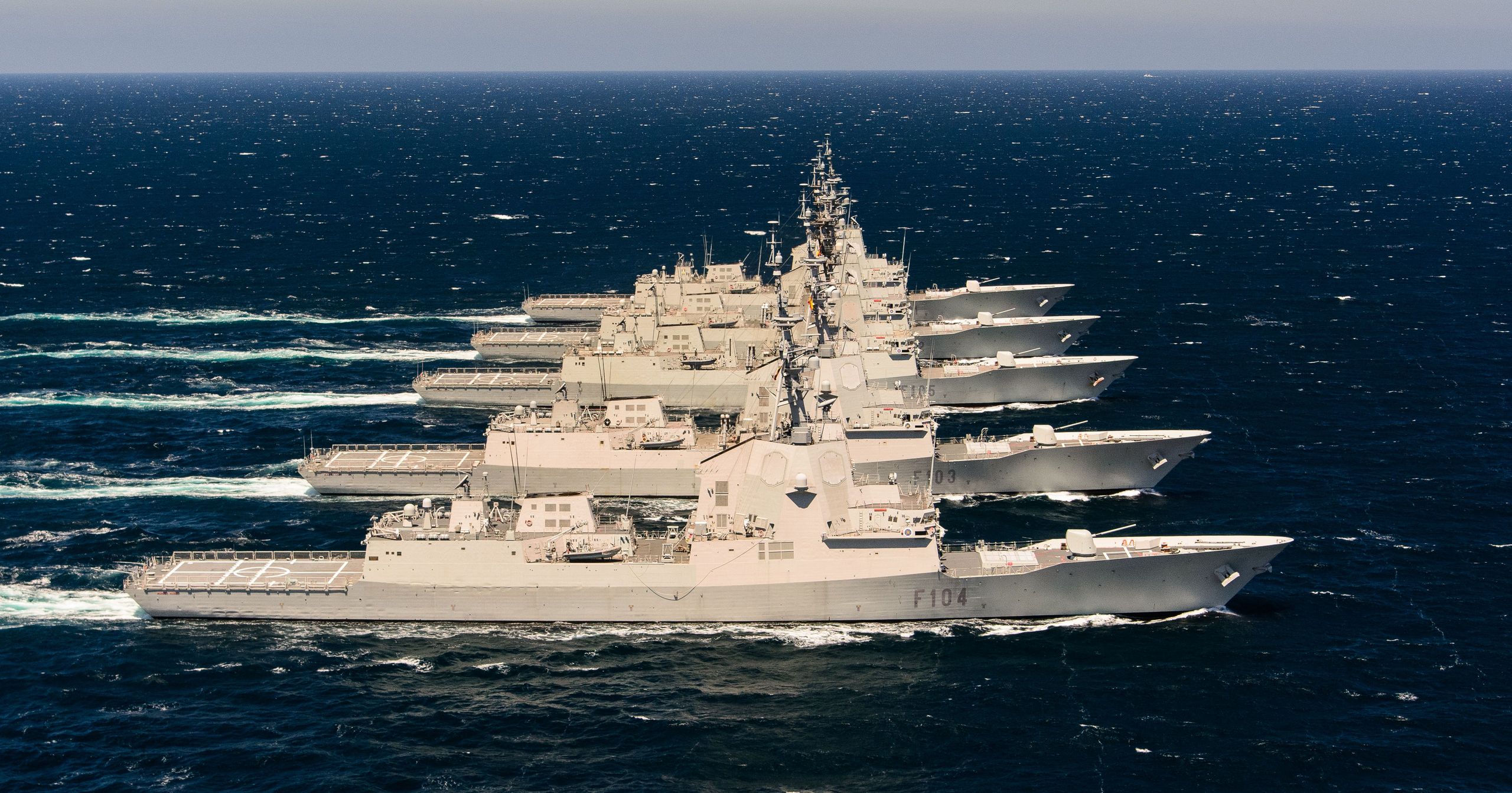 Photo: Navantia
According to the published information, the government in Madrid requested the possibility of acquiring five sets of the Aegis Combat System, six sets of central digital signal processing computers (Digital Signal Processor), five sets of 48-cell Mark 41 Vertical Launch System (VLS) universal launchers in the Baseline VII Strike Length Launcher configuration (the so-called “long” version), and five sets of AN/SPS-73(V)18 NGSSR (Next Generation Surface Search Radar) surface-search radars.
In addition, the package includes the following items classified as non-MDE under the definition: high-frequency UHF SATCOM satellite communications terminal systems; miniature GPS receivers with M-Code; the AN/SRQ-4 Ku-band datalink; equipment required to support the upgrade of the AN/SLQ-25A Nixie passive electro-acoustic anti-torpedo system to the SLQ-25E standard; Mk 331 torpedo control panels; upgrades to Mk 32 torpedo launchers; U.S. government support for 127-mm Mk 45 Mod 2 and Mod 2B naval guns; other modernization activities; integration as well as test support and equipment; ammunition support and auxiliary equipment; spare parts, consumables, and accessories; repair and return support; delivery and support of classified software; classified and unclassified publications; technical documentation; personnel training and training equipment; studies and surveys; contractor logistics support (Lockheed Martin, RTX, Ultra Maritime Naval Systems and Sensors, and General Dynamics); U.S. government and contractor engineering, technical, and logistics services; and other related elements of logistics and program support.
On November 26, 2025, according to information from the Spanish company Navantia, the Council of Ministers approved the conclusion of a contract with an estimated value of 3.2 billion EUR for the MLU modernization of five F100 Álvaro de Bazán–class frigates. The work is expected to take up to 120 months (10 years) from the date of signing the relevant contract with the contractor. The modernization will be carried out at Navantia’s shipyard in Ría de Ferrol.
Five ships (out of six planned), built by Navantia, are in service with the Spanish Navy (Armada Española). These are Álvaro de Bazán, Almirante Juan de Borbón, Blas de Lezo, Méndez Núñez, and Cristóbal Colón, which entered service between 2002 and 2012.
The objective of the MLU program is to extend the service life of the entire class to 2045, eliminate identified aging issues, ensure commonality of upgraded systems, improve performance and functionality, and bring the ships into compliance with environmental regulations.
The F100 class has a length of 146.7 meters, a beam of 18.6 meters, a draft of 4.75 meters, a standard displacement of 5,900 tons, and a full load displacement of 6,594 tons. Propulsion consists of two General Electric LM2500 gas turbines with a combined output of 46,650 hp (34,790 kW) and two Caterpillar 3600 diesel engines with a combined output of 12,000 hp (8,900 kW). This provides a maximum speed of up to 28 knots and a range of up to 4,500 nautical miles at an economical speed of 18 knots. The crew comprises 201 officers and sailors.
The ships are equipped with a 48-cell Mk 41 VLS vertical launch system for 32 SM-2MR Block IIIA surface-to-air missiles or 64 RIM-162 ESSM missiles, eight RGM-84 Harpoon anti-ship missile launchers, a 127-mm Mk 45 Mod 2 naval gun, and two 325-mm Mk 32 Mod 9 torpedo launchers for 12 Mk 46 Mod 5 lightweight torpedoes. The stern accommodates one SH-60B Seahawk (LAMPS III) multirole helicopter.
Based on this design, three slightly larger Australian Hobart-class air warfare destroyers (Hobart, Brisbane, and Sydney) were developed and commissioned between 2017 and 2020. The design was modified and features expanded capabilities of the U.S. Aegis Combat System in the Baseline 7.1 version.
The F100 also served as the baseline design for five slightly smaller Norwegian Fridtjof Nansen–class frigates (Fridtjof Nansen, Roald Amundsen, Otto Sverdrup, Helge Ingstad, and Thor Heyerdahl), commissioned between 2006 and 2011. One of them, Helge Ingstad, was rammed on November 8, 2018, by the Maltese tanker Sola TS and subsequently sank near the Sture oil terminal in the Norwegian municipality of Øygarden. After salvage, towing, and assessment of the damage, it was decided to scrap the ship. The Norwegians accused the Spanish side of design flaws, but in June of that year a court settlement was reached, stating that the accident resulted from a series of human errors and that the sinking was due to a combination of damage and design deficiencies.
The F100 was also unsuccessfully offered to Poland under the Miecznik program.