






















Gavia
On Wednesday, June 10 of this year, the results were published of a tender conducted under a restricted competitive procedure for the servicing of Teledyne Gavia autonomous underwater mine detection vehicles of the AUV (Autonomous Underwater Vehicle) class for the period 2026-2028.
 Polish configuration of Teledyne Gavia / Photo: Michał Szafran, MILMAG
The deadline for submitting applications for admission to the tender expired on March 31, and the sole selection criterion was price (100%). One bid was received from Enamor, which has been the Polish representative of the system’s American manufacturer — Teledyne Marine – Vehicles (part of Teledyne Marine Technologies and Teledyne Technologies Incorporated) — since 2013.
Enamor has delivered eight vehicles to the Polish Navy, including three of the latest under a contract dated November 24, 2022, for the Kormoran II Project 258 minehunters. Enamor is also the partner responsible for servicing and repairs. It is a research and production company working with new technologies and active in numerous projects in Poland in the fields of navigation, communications, hydrography, and automation.
Enamor submitted a bid of 4,471,544.72 PLN net (5,500,000 PLN gross), and the contract was signed on June 8 of this year with a completion deadline of November 17, 2028. The value of the base order is 2,996,034 PLN net (3,685,121.82 PLN gross).
In the Polish configuration, the Gavia vehicles are equipped with EdgeTech 2205 side-scan sonar systems operating at 600/1600 kHz, with a Teledyne Reson BlueView MB2250 microbathymetry module enabling seabed scanning beneath the mother vessel, and an iXblue PHINS C5 inertial navigation system, aided by a Teledyne RDI Pathfinder DVL Doppler velocity log. Additionally, the vehicles were fitted with Kongsberg Maritime C-Node modems for underwater positioning.
Thanks to the imaging and navigation sensors listed above, the Gavia is capable of collecting high-resolution sonar images and determining precise positioning while remaining submerged for several hours of continuous operation at survey speeds of up to 5 knots. Each vehicle was delivered with several operationally exchangeable battery modules. The synergy of sensors ensures that the Gavia is ideal for minehunters, as well as for search and rescue operations, both on and beyond the continental shelf. With the addition of a Reson T20 multibeam echo sounder, it provides enhanced pipeline tracking and critical infrastructure inspection capabilities.
Głuptak
The second proceeding, also conducted under a restricted competitive procedure, was concluded yesterday, June 22. The Military Port Command in Gdynia was seeking a supplier of spare parts for the Głuptak Deep-Water Mine Countermeasures System.
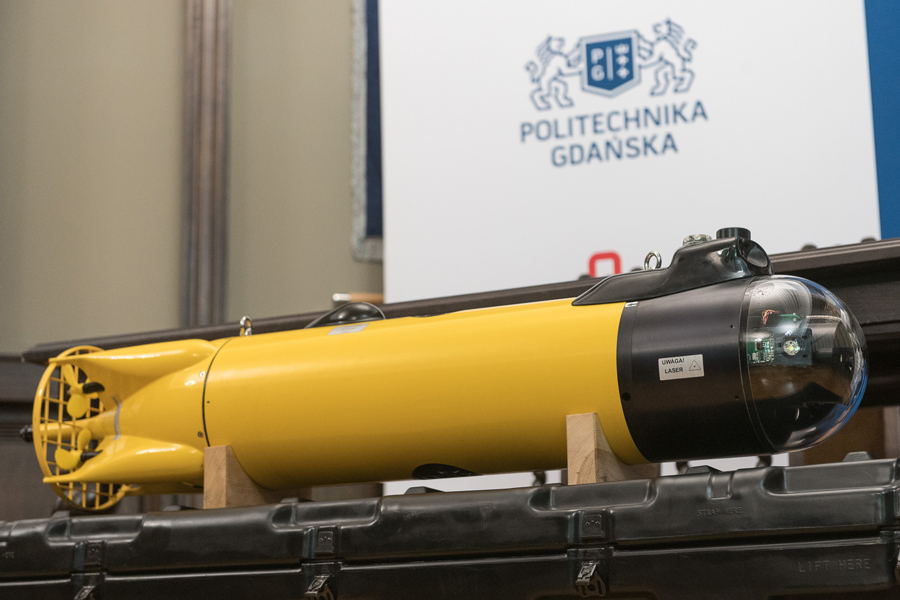 Photo: Bartosz Bańka, Gdańsk University of Technology
The deadline for submitting applications for admission to the tender expired on March 31, and the sole selection criterion will be price (100%). The only bidder was the Security and Defence Technology Centre of Gdańsk University of Technology, and the bid was valued at 17,047,800 PLN gross. The contract in this matter was signed on June 10 and will remain in force until November 15, 2028.
In this case, the identity of the bidder is also unsurprising. The Głuptak deep-water mine countermeasures system was developed by a team from Gdańsk University of Technology. The principal project manager and creator of the system was Associate Professor Lech Rowiński, PhD, DSc, of the Department of Ship Design and Underwater Robotics of the Faculty of Ocean Engineering and Ship Technology at Gdańsk University of Technology.
The system is designed for the identification and neutralization of hazardous objects in bodies of water, including those resting on the seabed, buried in silt, or concealed behind terrain obstacles. The Głuptak can operate at depths from 5 to 200 m. To extend its operational range, it can be installed on the Morświn remotely operated underwater vehicle – also developed at Gdańsk University of Technology.
The Głuptak mine countermeasures system uses a small, remotely operated vehicle approximately 1.5 m in length with a torpedo-like shape. Propelled by small propellers driven by electric motors, it is used to carry an explosive charge that destroys a sea mine. Since it is a one-shot (kamikaze) vehicle, the vehicle itself is also destroyed during such an operation. The system complement also includes training vehicles that can be used for operator training. However, at any time, by replacing the dimensional-mass mock-up (a mock-up of the destructive charge) with a live destructive charge, the training variant vehicle can become a combat variant vehicle. It is used, among other platforms, on Project 207P (Gardno-class) minesweepers and is planned for use on Project 258 Kormoran II minehunters, ordered by the Naval Technology Research and Development Centre (OBR CTM).
See also:
