






















Gavia
On Tuesday, March 10, 2026, the Naval Port Command in Gdynia published a notice on the launch of a procurement procedure conducted under a restricted competitive procedure for the servicing of Gavia-class AUV (Autonomous Underwater Vehicles) used for mine detection in the years 2026–2028.
 Polish configuration of Teledyne Gavia / Photo: Michał Szafran, MILMAG
The deadline for submitting applications to participate in the tender is March 31, 2026, at 9:30 a.m. The sole criterion for selecting the winning bid will be price (100%). A detailed description of the subject of the contract will be included in the terms of reference, which will be provided to contractors invited to submit bids.
The manufacturer of the Gavia vehicles is the American company Teledyne Marine – Vehicles (part of Teledyne Marine Technologies and Teledyne Technologies Incorporated). Since 2013, the Gdynia-based company Enamor, which serves as the Polish representative of the manufacturer, has delivered eight vehicles to the Polish Navy, including three of the newest units under the contract of November 24, 2022, intended for Project 258 Kormoran II minehunters.
Enamor is also the partner responsible for servicing and repairing the equipment. It is a research and manufacturing company specializing in new technologies and participating in numerous projects in Poland in the fields of navigation, communications, hydrography, and automation.
In the Polish configuration, the Gavia vehicles are equipped with EdgeTech 2205 side-scan sonars operating at 600/1600 kHz with a Teledyne Reson BlueView MB2250 micro-bathymetry module, enabling scanning of the seabed beneath the mother ship, as well as an iXblue PHINS C5 inertial navigation system supported by a Pathfinder DVL Doppler velocity log supplied by Teledyne RDI. In addition, the vehicles have received Kongsberg Maritime C-Node modems for underwater positioning.
Thanks to the imaging and navigation sensors mentioned above, Gavia can collect high-resolution sonar imagery with precise positioning while remaining submerged for several hours of continuous operation at survey speeds of up to 5 knots. Each vehicle was delivered with several modules of batteries that can be replaced under operational conditions. The synergy of the sensors ensures that Gavia is well suited for minehunters, as well as for search-and-rescue operations in continental shelf waters and beyond. With the addition of the Reson T20 multibeam echosounder, it also provides expanded capabilities for pipeline tracking and critical infrastructure inspection.
Głuptak
In a separate procedure launched the same day, also conducted under a restricted competitive procedure, the Naval Port Command in Gdynia is seeking a supplier of spare parts for the Głuptak Deep-Sea Mine Countermeasure System.
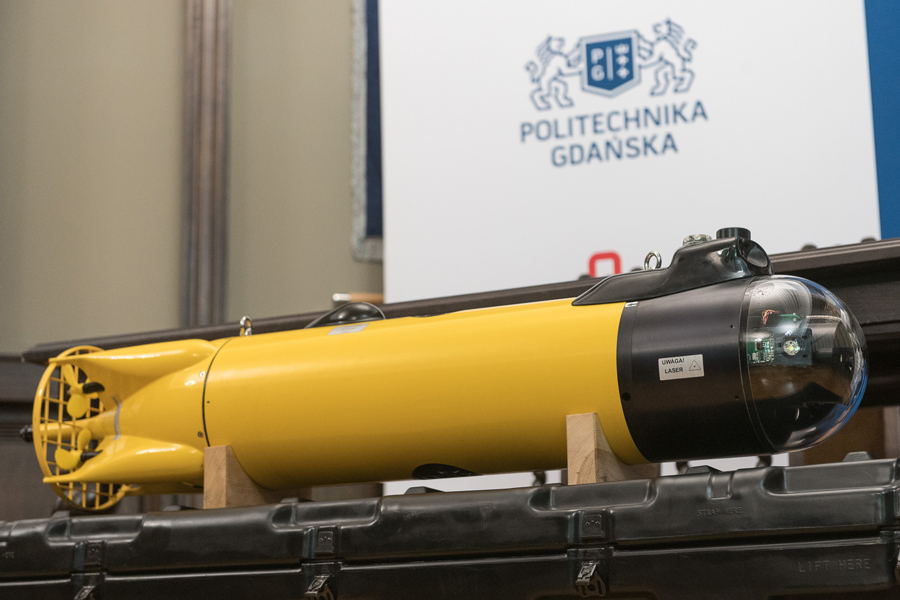 Photo: Bartosz Bańka, Gdansk University Of Technology
The deadline for submitting applications to participate in the tender is March 31, 2026, at 9:00 a.m. The sole criterion for selecting the winning bid will be price (100%). A detailed description of the subject of the contract will be included in the terms of reference, which will be provided to contractors invited to submit bids.
The Głuptak deep-sea mine countermeasure system (OPM), codenamed Głuptak, was developed by a team from the Gdańsk University of Technology. The principal project leader and creator of the system was Dr. Hab. Eng. Lech Rowiński, Associate Professor at the Gdańsk University of Technology, from the Department of Ship Design and Underwater Robotics at the Faculty of Ocean Engineering and Ship Technology.
The system is intended for the identification and neutralization of hazardous objects located in bodies of water, including those resting on the seabed, buried in silt, or hidden behind terrain obstacles. Głuptak can operate at depths ranging from 5 to 200 meters. To extend its operational range, it can be installed on the Morświn remotely operated underwater vehicle—also developed at the Gdańsk University of Technology.
The Głuptak mine countermeasure system uses a small remotely operated vehicle about 1.5 meters long, shaped similarly to a torpedo. Propelled by small propellers driven by electric motors, it is designed to carry an explosive charge used to destroy a naval mine. As it is a one-shot (kamikaze-type) vehicle, the vehicle itself is also destroyed during such an operation. The system also includes training vehicles that can be used to train operators. However, at any time, by replacing the mass-and-dimension mock-up (a mock-up of the destructive charge) with a live explosive charge, the training version can be converted into a combat version. The system is used, among others, on Project 207P (Gardno-class) minesweepers and is planned for use on Project 258 Kormoran II minehunters, ordered by the Research and Development Center for Maritime Technology (OBR CTM).
