



















On Wednesday, April 1, 2026, the UK Ministry of Defence’s Defence Equipment & Support (DE&S) agency and the French Directorate General of Armaments (Direction générale de l’Armement, DGA), operating under the Ministry for the Armed Forces and Veterans, signed a memorandum of understanding (MoU) to launch joint research work on the development of a next-generation long-range air-to-air missile, codenamed the Next-Generation Air-to-Air Missile, which is intended to replace the MBDA Meteor BVRAAM (Beyond Visual Range Air-to-Air Missile) in the future.
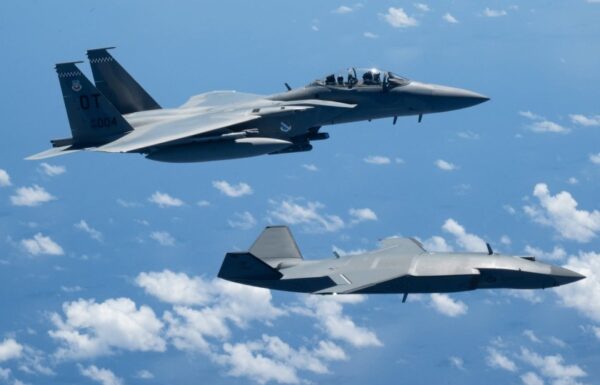
 Photo: DE&S
The agreement, a key element of the Lancaster House 2.0 Treaties, strengthens the deep defense partnership between the two countries as well as their shared commitment to European security and NATO capability.
The 12-month research effort will make it possible to assess the future air-threat landscape and develop new missile concepts capable of meeting the challenges of air warfare in the coming decades. The work will help determine which technologies should be incorporated into the next-generation weapon system and will define its development roadmap.
The MBDA Meteor missile, currently used by the UK Royal Air Force (RAF) on Eurofighter Typhoon FGR4 aircraft and in the future on F-35B Lightning II fighters, as well as by the French Air and Space Force (Armée de l’air et de l’espace) and Navy (Marine nationale) on Dassault Rafale aircraft, serves as the benchmark for the performance of European missiles.
Developed through a partnership of six countries, it demonstrates what can be achieved through close industrial cooperation. The new work on the Next-Generation Air-to-Air Missile is intended to be the first step toward achieving similar success, ensuring that the United Kingdom, France, and future partner nations maintain air superiority in the years ahead.
This initiative forms part of the renewed Entente Industrielle between the two countries, focused on reducing duplication, improving industrial efficiency, and strengthening NATO’s edge in high-end air combat. A new joint Complex Weapons Portfolio Office will be established to coordinate this and other missile programs, ensuring closer alignment between the military priorities of the respective states and opening opportunities for cooperation with other partners.
Luke Pollard, UK Parliamentary Under-Secretary of State for the Armed Forces at the Ministry of Defence, said:
“In a new era of threat we are increasing co-operation with our friends and allies. This agreement is a significant step forward in delivering on our Lancaster House 2.0 commitments, demonstrating the strength of our UK-France defence partnership. We are strengthening NATO’s capabilities and European security by working with France on the next generation of air-to-air missiles – exactly the kind of close collaboration needed to deter our adversaries in this new era of threat.”
 Image: MBDA
MBDA Meteor
Meteor is the result of cooperation among a consortium of European partners led by MBDA. The partnership includes Germany, the United Kingdom, France, Italy, Spain, and Sweden. The missile is equipped with a ramjet powered by a variable-flow, ducted solid-fuel rocket produced in Germany by MBDA subsidiary Bayern-Chemie. This ramjet provides thrust all the way to target interception, giving the missile a unique no-escape zone greater than that of many other air-to-air missiles.
Meteor missiles can be used in all weather conditions against combat aircraft, unmanned aerial vehicles, and cruise missiles. The missile uses active radar homing and is equipped with a data link, allowing it to operate in a network-centric environment and increasing the precision of air operations. The missile is 3.7 m long, 178 mm in diameter, and weighs 190 kg. It is fitted with impact and proximity fuzes and a fragmentation warhead, allowing it to destroy targets at ranges of, as mentioned, up to about 150 km.
The missiles have entered service with the armed forces of the United Kingdom, Germany, Italy, France, Croatia, Greece, India, Qatar, Spain, and Brazil, and in the future they will also be fielded by South Korea and the United Arab Emirates. Hungary had previously planned to acquire them, while Saudi Arabia abandoned its plans to do so.
In addition to the Typhoon and Rafale, the missiles have been integrated with the Saab JAS 39 Gripen and KF-21 Boramae multirole aircraft. In 2025, integration of the missile with the F-35 made progress, including the first flight on the F-35B and ground tests ahead of the first flight on the F-35A. In November 2025, the Brazilian Air Force confirmed successful tests of the missiles on F-39E Gripen fighters.
🇬🇧 🇫🇷 The UK and France have signed a Memorandum of Understanding to explore a successor to the Meteor missile, one of the most capable air-to-air weapon systems ever built.
A 12-month study will assess future threats and develop new missile concepts.
🔗 https://t.co/mCEog5Cn48 pic.twitter.com/ohdUUYXNy1
— Defence Equipment & Support (@DefenceES) April 1, 2026