

























On Wednesday, December 31, 2025, the Electronic Systems Contracting Branch of the Air Force Life Cycle Management Center (AFLCMC), part of the USAF Air Logistics Command in Warner Robins, Georgia, acting on behalf of the U.S. Department of Defense, signed a contract worth 328,500,000 USD with Lockheed Martin for the production of AN/AAQ-33 Sniper ATP targeting pods, LANTIRN navigation pods, and IRST21 infrared search-and-track sensors housed in Legion centerline pods for the Republic of China (Taiwan).
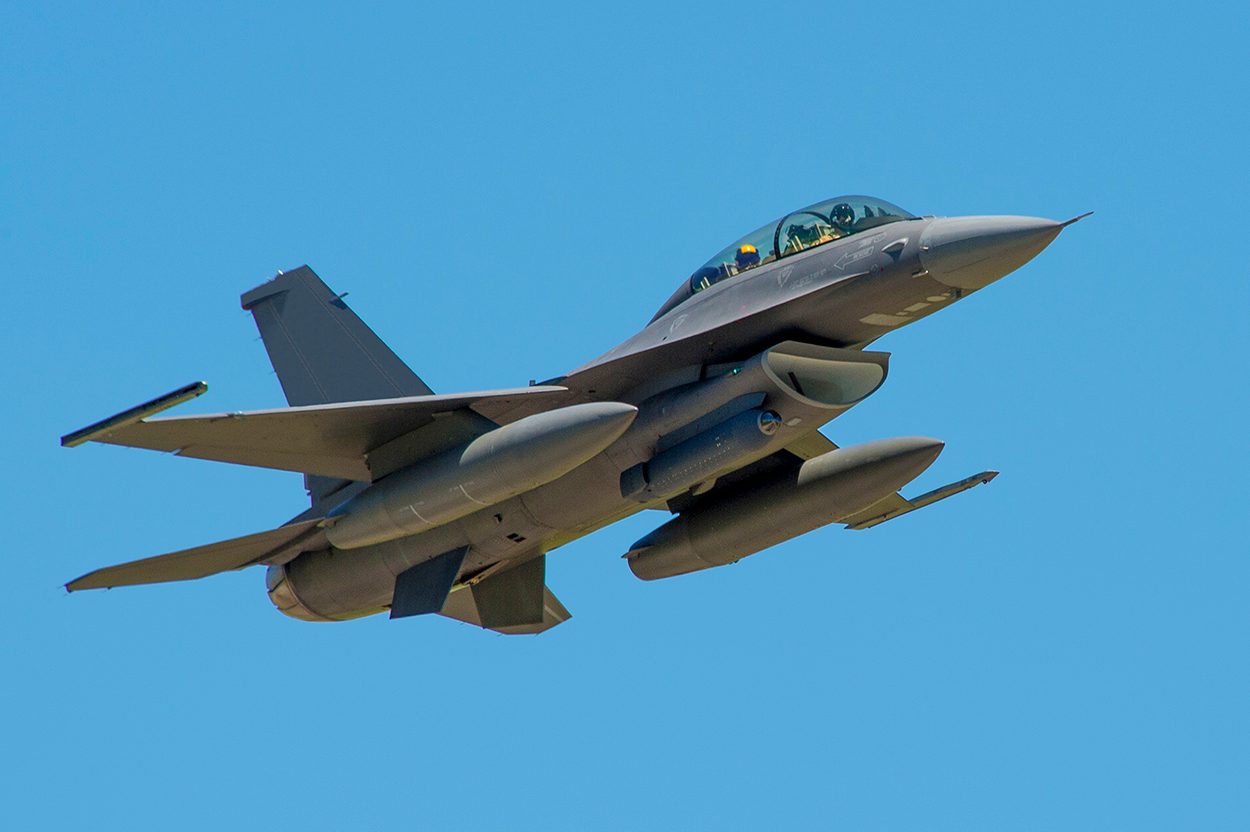 F-16D with IRST21 infrared sensor in Legion pod / Photo: Lockheed Martin
The contract covers an unspecified number of Sniper ATP (Advanced Targeting Pod) targeting pods, Taiwan had previously requested 18 units, as well as LANTIRN (Low Altitude Navigation and Targeting Infrared for Night) navigation pods, and 55 Legion (Enhanced Sensor) pods equipped with IRST21 (Infrared Search and Track) sensors. The agreement also includes processors, pod housings, and processor containers.
Work will be performed in Orlando, Florida, and is scheduled for completion by June 30, 2031. The contract is being executed under the Foreign Military Sales (FMS) program for Taiwan. The agreement was negotiated with Lockheed Martin as the sole contractor. At the time the contract was awarded, funding in the amount of 157,300,000 USD was obligated.
The Lockheed Martin AN/AAQ-33 Sniper ATP electro-optical targeting pod provides combat aircraft with capabilities to support the employment of precision air-to-ground munitions (laser-guided and GPS-guided) as well as reconnaissance. To a limited extent, it can also detect objects at long ranges, though not in the short-wave infrared (SWIR) band. The manufacturer has delivered more than 1,650 pods to various users, which have accumulated over 5 million flight hours. On November 17, 2025, the new network-centric Sniper NTP (Networked Targeting Pod) was unveiled.
The LANTIRN system consists of two pods: the AN/AAQ-13 navigation pod for low-altitude flight at night and in adverse weather conditions, equipped with a terrain-following radar and a Forward-Looking Infrared (FLIR) sensor, enabling automatic obstacle avoidance and terrain imagery display for the pilot; and the AN/AAQ-14 targeting pod, used for detecting, tracking, and laser-designating targets.
Meanwhile, on August 23, 2023, the U.S. Defense Security Cooperation Agency (DSCA) published approval by the U.S. Department of State for a potential sale of an undisclosed number of IRST infrared search-and-track sensors for Taiwan’s F-16 Fighting Falcon family of multirole aircraft, with an estimated maximum value of 500 million USD.
The IRST21 will be integrated into the Legion pod, a newly developed system which, in its Block II version, is being fielded on upgraded carrier-based F/A-18E/F Super Hornet Block III multirole fighters and EA-18G Growler Block II electronic warfare and air-defense suppression aircraft of the U.S. Navy, as well as the F-15E Strike Eagle and Lockheed Martin F-16C/D Fighting Falcon operated by the Air National Guard. It has also been tested on the Avenger (Predator C) jet-powered unmanned combat air vehicle.
The Legion pod is equipped with the IRST21 infrared search-and-track sensor, which provides passive, precise detection and tracking of aerial targets at long ranges based on their thermal signatures. This capability is particularly important in operations where using an onboard radar for such tasks would risk revealing the aircraft’s electromagnetic emissions to the enemy. In such cases, the target could be engaged with an air-to-air missile equipped with its own infrared-homing seeker.
In the Block II version, the system enables target detection at ranges comparable to onboard radar systems – i.e., over 100 km, and in practice up to 200 km. The pod can track multiple aerial targets simultaneously and is resistant to enemy countermeasures. It generates video imagery that allows for visual target identification and also supports obstacle avoidance during low-altitude flight, as well as nighttime landings and operations in difficult weather conditions.
