


















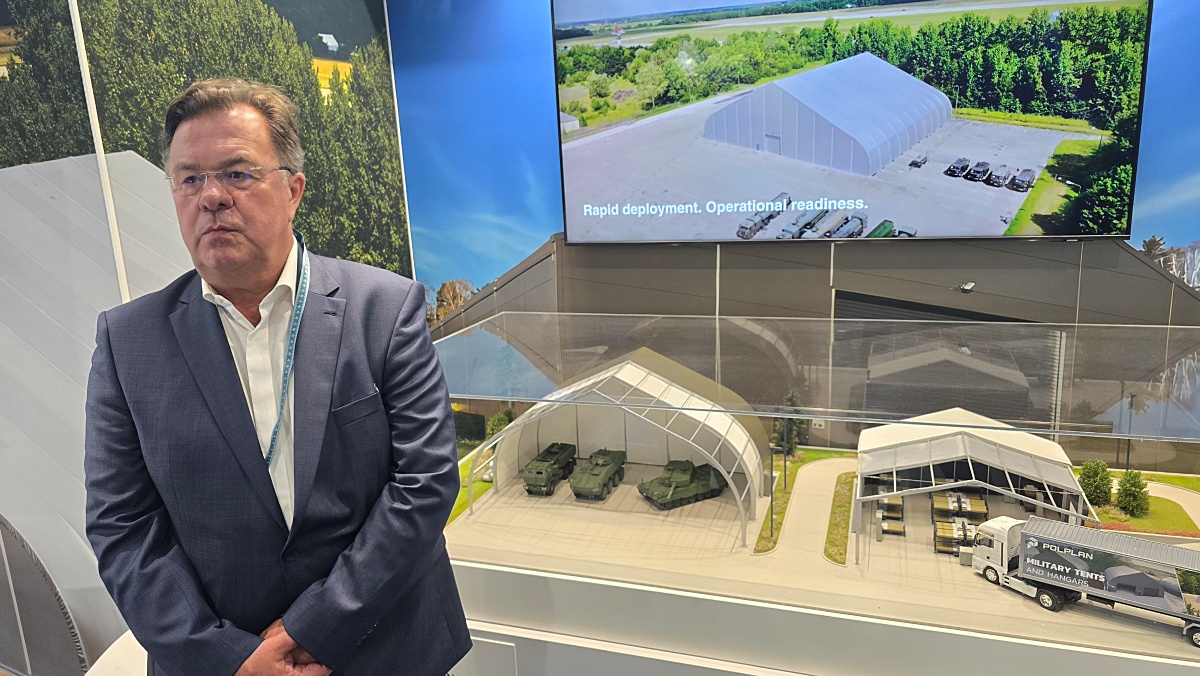
 Benedykt Bródka, President of POL-PLAN
Jakub Link-Lenczowski, MILMAG: We are speaking with Benedykt Bródka, President of POL-PLAN, a company that has been supplying specialist halls and hangar facilities to the Polish Armed Forces for many years. We are currently in Paris, at the EUROSATORY trade show. Mr. President, what is most important for you at this show?
Benedykt Bródka, President of POL-PLAN: This is our first time in Paris as a company. We have attended many foreign events focused on the defense sector. Today in Paris we are exhibiting two new core production models featuring exceptional widths for tent construction, based on aluminum structures with spans of up to 60 meters. Only three companies in Europe are capable of producing this type of structure, with volumes reaching heights of up to 21 meters. We are talking about volumetric capacities that can accommodate virtually every application that exists in the world in the military domain.
Jakub Link-Lenczowski: I understand that these are solutions that support the rapid expansion of growing military units and the construction of new infrastructure. When you mention all applications and such large hall volumes, does that include aircraft as well?
Benedykt Bródka: Of course, that is the primary use case for this type of large-volume structure, with floor areas ranging from a minimum of 20 meters in width, as I mentioned, up to 60 meters in width, with no internal supports. However, the most important element, as you noted, is the mobility of these structures. Here, the construction of a base with storage capacities in the order of 10,000 or 20,000 square meters begins and ends with logistics completed within two months.
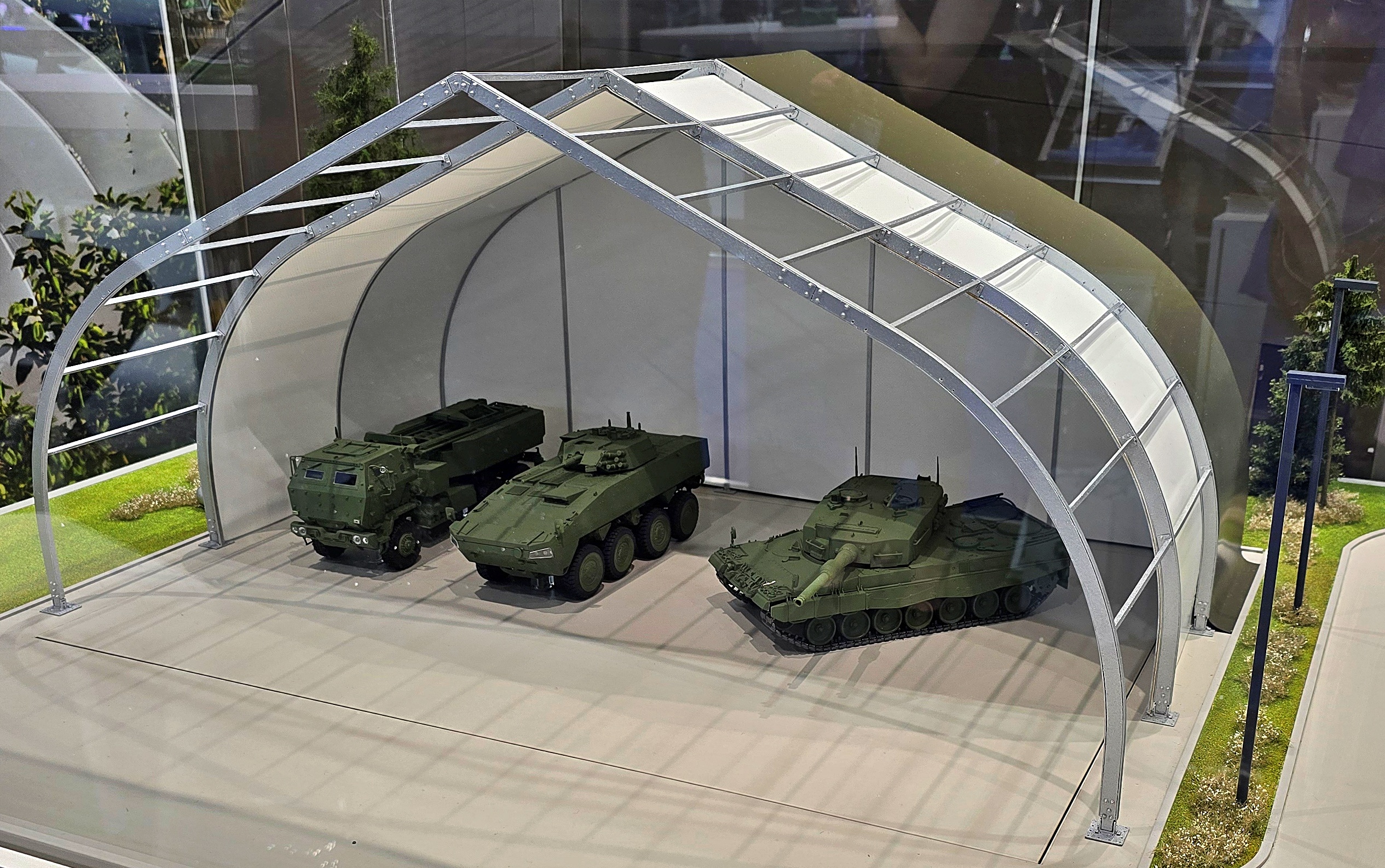 Specialist halls enable servicing of virtually any military equipment
Jakub Link-Lenczowski: Is this your own proprietary system for constructing these hall frameworks, or do you use established solutions from elsewhere?
Benedykt Bródka: No, similar products, and I emphasize similar, with the modular design we developed nine years ago, without yet knowing about the conflicts that have since erupted around us, in this case I mean Ukraine, the territory of Ukraine, but not only; we are talking about hubs, whether Polish or Romanian, operating in support of the current, unfortunately ongoing conflict. Without knowing this would happen, we were already proposing these structures for other purposes, primarily equipping airfield aprons and the full range of aviation production facilities.
Jakub Link-Lenczowski: In that case, a follow-up question, are your structures modular and scalable?
Benedykt Bródka: Absolutely. The fundamental feature of these structures is their capacity for repeated expansion to many thousands of square meters. The average usage falls in the range of 1,200 to 3,000 square meters; however, larger installations have been built – the largest structure we have ever built as a company was a structure measuring 25 by 1,150 linear meters, the length of the structure, traveling on a rail track above a motorway construction site in Germany.
Jakub Link-Lenczowski: I would also like to ask about specialist equipment. These are portable halls, but obviously if we need a hall for a vehicle park, there are issues of air conditioning, heating, exhaust extraction, and in the case of aircraft, additional specialized infrastructure – I assume your structures are prepared for this?
Benedykt Bródka: Full infrastructure, and also, in the other direction, heating elements, various types of thermal or gas extraction systems, lighting systems, automatic gates, sliding, rolling, and so on. All of these elements are technically compatible and equipment-wise adapted to our products in our technical proposals.
Jakub Link-Lenczowski: Do you supply a complete solution, or can the customer choose a configuration?
Benedykt Bródka: The customer makes the choice of equipment for a given structure and, in practice, within known technical constraints, selects the solutions optimal for them from the available technical options.
Jakub Link-Lenczowski: So if I understand correctly, you offer modular solutions, but customers can also order bespoke solutions that you design, build, and deliver for them?
Benedykt Bródka: These are relatively dedicated structures, that is, specially equipped ones. And here I have in mind, to a lesser extent, high-bay volumetric storage facilities with large floor areas in a single building mass. This primarily concerns equipment in smaller structures such as dining facilities or field kitchens. Equipment that is required with large facilities, for instance, various types of waiting areas, or indeed sleeping quarters in the form of tent halls, but insulated ones, meaning those providing thermal delay at minus ten degrees. So we are talking about not fully heating the structure, but achieving so-called minimum positive temperatures, which facilitate the operation of the structure, including during assembly, disassembly, and transport logistics. All of these elements are of enormous importance, perhaps not on the battlefield itself, but in its immediate vicinity, at distances of around twenty to fifty kilometers, as rear-area support, for example for smaller, ongoing maintenance and repair operations. I will not expand on this further, as it moves into territory that is less military and more wartime in nature.
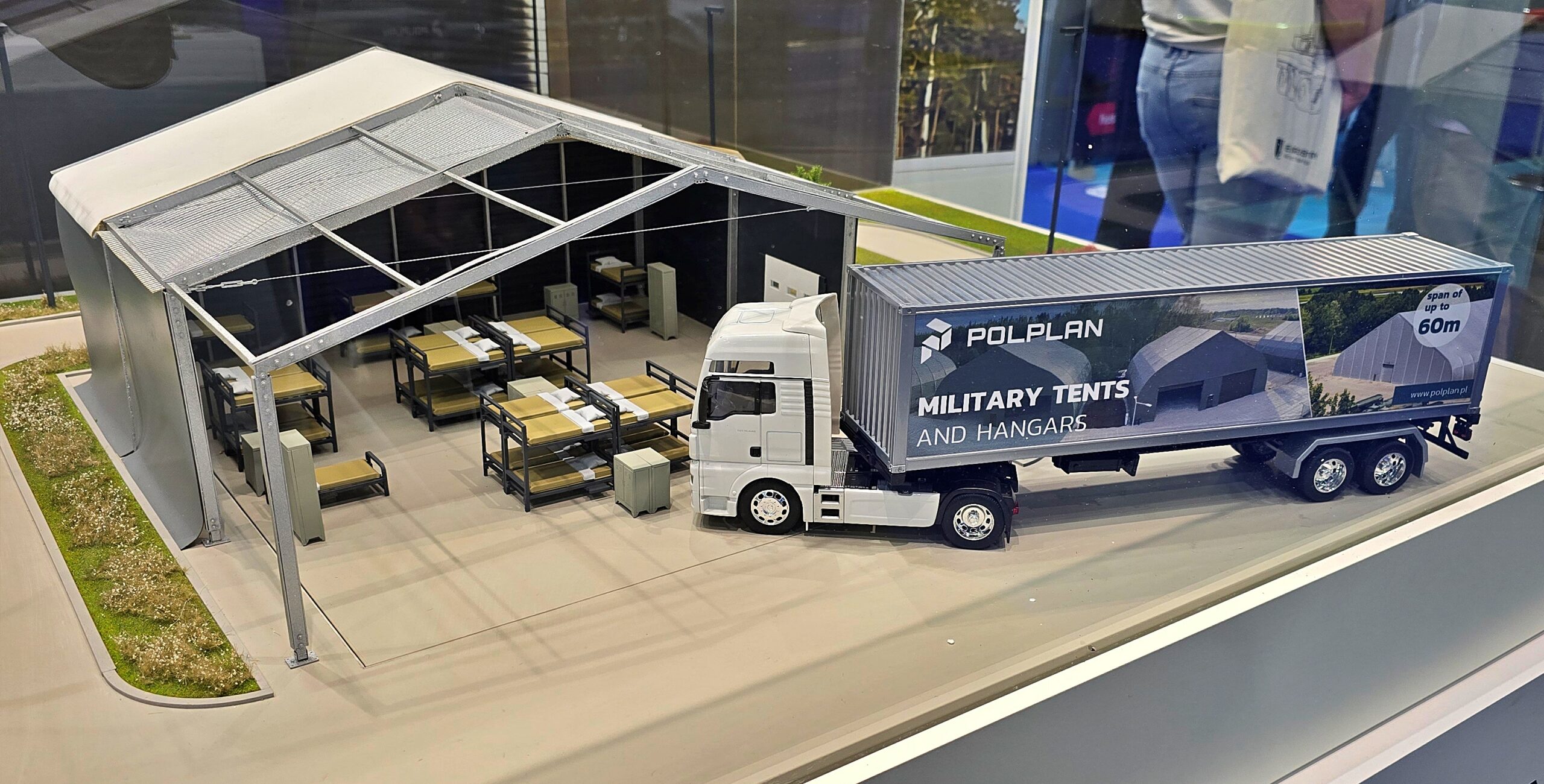 Modular structures enable comfortable personnel accommodation, and hall components can be transported in standard containers / Photos: Jakub Link-Lenczowski, MILMAG
Jakub Link-Lenczowski: Finally, I have one more question – does erecting these halls require specialized equipment, or is what engineering units typically have at their disposal generally sufficient?
Benedykt Bródka: Engineering units are fully equipped for construction. These are simple cranes with a lifting capacity of twenty to two hundred tonnes, and various types of equipment for unloading and handling on the construction site.
Jakub Link-Lenczowski: I understand that all components can be transported on standard flatbeds or in containers?
Benedykt Bródka: Of course – in containers, on unified vehicles, up to the capacity of a forty-foot or forty-five-foot container.
Thank you for the interview.
This material was produced in cooperation with POL-PLAN.
Czytaj także:
