


















During the 29th edition of Eurosatory 2026, the international defense industry trade show organized by Coges Events and taking place June 15-19 of this year in Paris-Nord Villepinte near Paris, German group Rheinmetall AG presented the MV-8 Komodo, an unmanned breaching system (UBS).
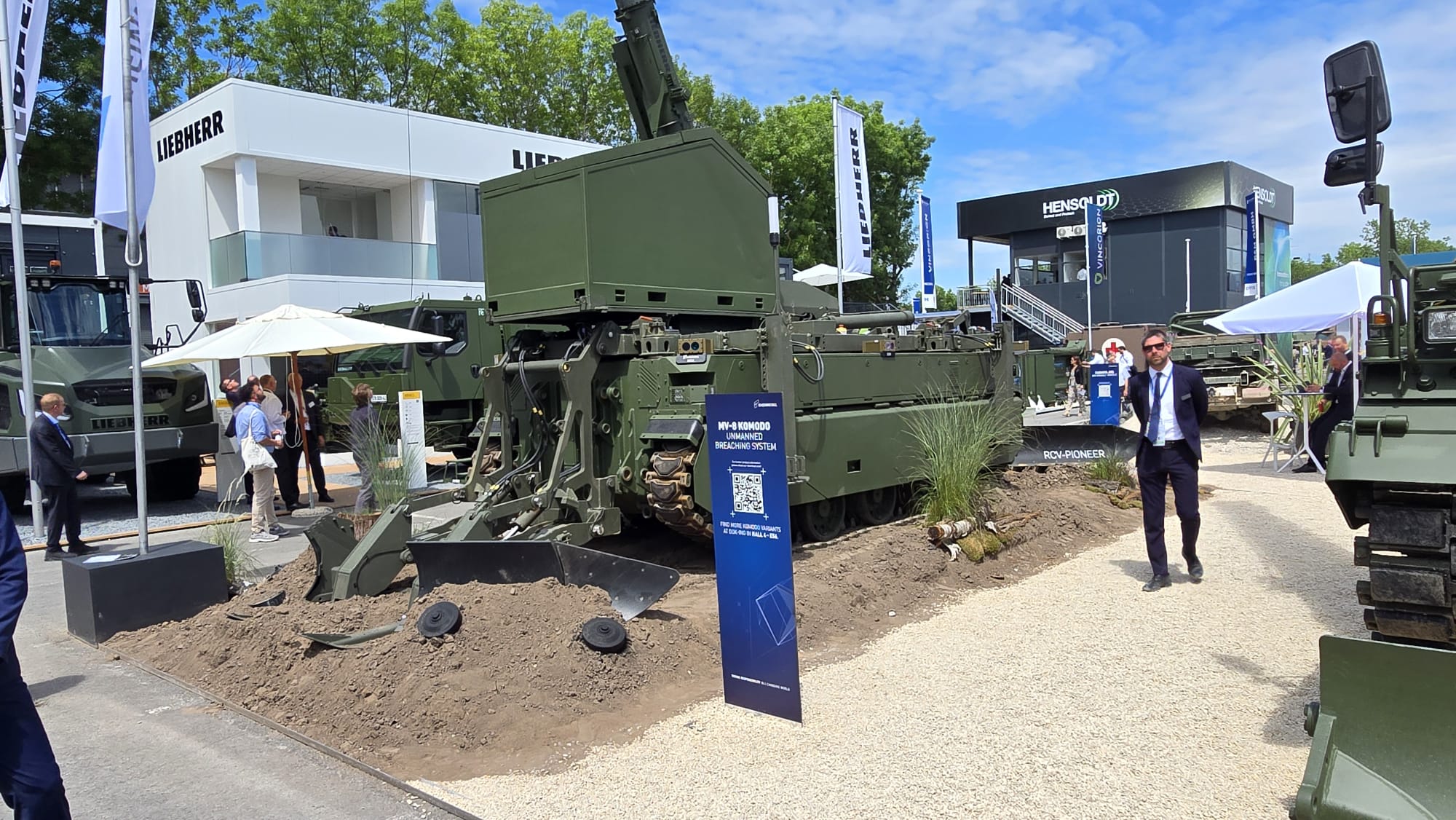 Photo: Jakub Link-Lenczowski, MILMAG
The vehicle was developed in cooperation with Croatian subsidiary DOK-ING, responsible for the tracked platform, and British company Pearson Engineering, responsible for the combat engineering equipment.
On October 28, 2024, Rheinmetall AG and DOK-ING established a partnership initially focused on the joint development of unmanned ground vehicles for various purposes, including scatterable minelaying and support for counter-mobility and combat operations. DOK-ING has been part of the German group since March of this year.
The Komodo, developed by the Croatians, is a modular, heavy, hybrid unmanned platform with a payload capacity of over 8.5 metric tons. The prototype was presented on June 29, 2021, following three years of development carried out in cooperation with the Faculty of Electrical Engineering and Computing at the University of Zagreb, and with EU financial support through the Permanent Structured Cooperation (PESCO) initiative under the European Defence Agency (EDA). The Komodo was designed primarily for chemical, biological, radiological, and nuclear (CBRN) reconnaissance on the battlefield and toxic industrial waste operations in civilian applications. In its baseline version it was equipped with an automated decontamination system for vehicles, personnel, and surfaces, including itself, the Cristaninio system, as well as Smith Detection and Bruker sensor systems. The robot can collect gas, liquid, and solid samples, grasp and push objects, extinguish fires, and cool surfaces. The robot had a mass of 17 t, a length of 7.3 m, a width of 2.3 m, and a hybrid drivetrain consisting of a diesel engine, electric motors developing 350 kW, and a battery pack, providing a road speed of up to 30 km/h. The maximum control range from the operator station is 1,500 m. It can also autonomously follow another vehicle and avoid obstacles.
Now in Paris, the first variant resulting from the international cooperation initiated by Rheinmetall AG has been presented. The MV-8 is intended to enable remote demining while significantly reducing risk to friendly forces and increasing their mobility and effectiveness on the battlefield. In the new configuration, combat weight has been reduced to 15.5 t and speed increased to 55 km/h.
Rheinmetall’s contribution to the MV-8 is the planned integration of the PATH autonomous kit (A-kit), which, through sensors mounted on the platform, controls it and relieves the operator of most tasks, enabling semi-autonomous or autonomous operation.
The British contribution from Pearson Engineering is the Track Width Mine Plough (TWMP) integrated at the front of the vehicle, notably also procured for Polish Abrams tanks, which neutralizes land mines by mechanically displacing soil. The clear and safe corridor thus created is marked by the Lane Marking System (LMS). Survivability can be further enhanced through the use of a magnetic signature duplicator, which causes the premature detonation of magnetically triggered mines.
Optionally, the MV-8 Komodo can be fitted with a rocket-assisted Plofadder explosive line charge demining system. This system fires a ladder of explosive charges across a minefield and detonates mines within its effective range. In this way, the Plofadder can clear a lane 160 m long and 9 m wide.
The MV-8 Komodo’s design enables integration into a combat formation of manned vehicles, supporting armed forces in executing missions faster, more safely, and with reduced risk to their own personnel.
In the next phase of system development, the MV-8 will be equipped with the aforementioned PATH (A-Kit) package. This capability will enable autonomous waypoint navigation with real-time obstacle avoidance, follow-me and resupply modes in convoy operations, leader-follower functions with cooperative control of up to 10 vehicles, and AI-assisted sensor fusion and situational awareness. This will ensure mission safety and reliability under all conditions, including in environments without GNSS satellite navigation signal coverage.