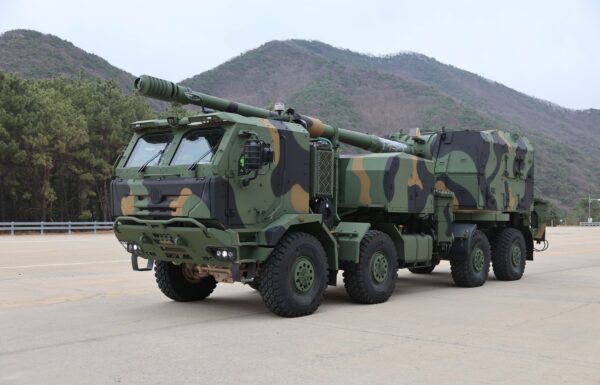
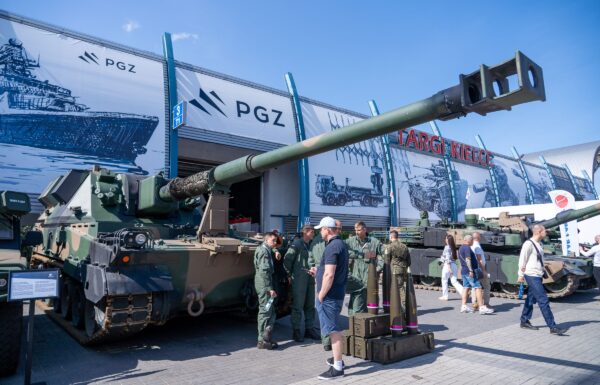
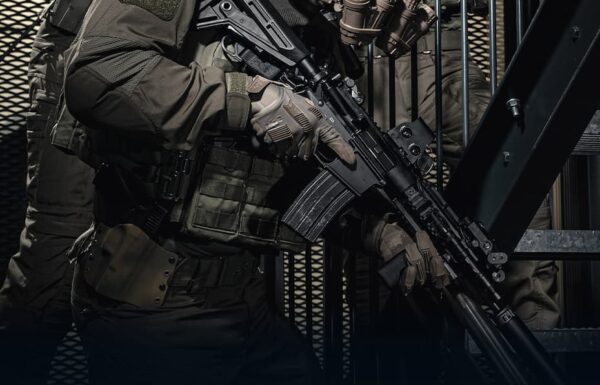
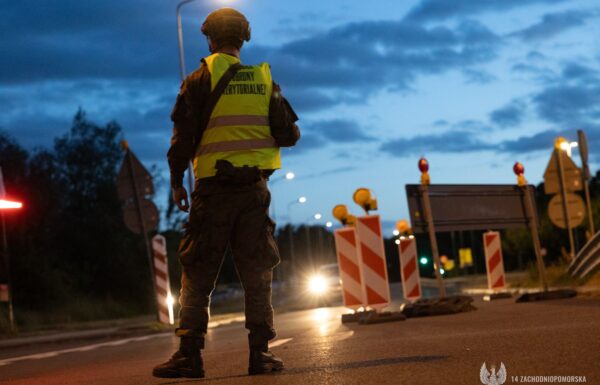
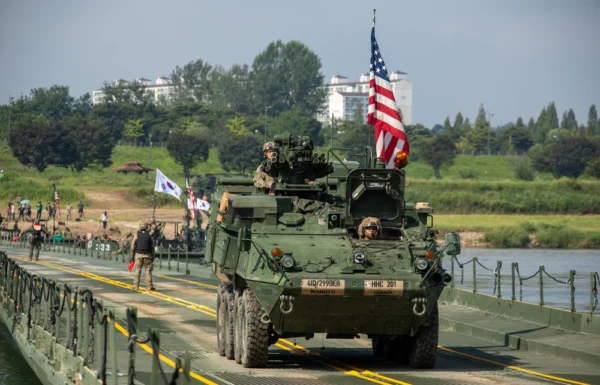

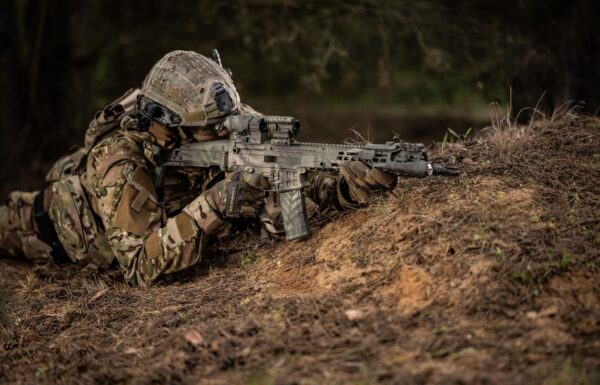
The objective of the exercise is to prepare subunits for redeployment and the conduct of defensive operations in cooperation with NATO allies, as well as the planning of tactical operations, reconnaissance activities, and offensive operations. The Presidents of Poland and Lithuania observed a dynamic exercise demonstration and then familiarized themselves with the equipment and armament.
Photos: Mikołaj Bujak, KPRP
“NATO’s eastern flank has become a theatre of intensive Alliance exercises. This shows how seriously both Poland and Lithuania take threats and how the Allies get ready to deal with them,” President Karol Nawrocki emphasized during a press conference with his Lithuanian counterpart.
Karol Nawrocki thanked President Gitanas Nausėda, the leadership of the Lithuanian Ministry of National Defence, the commanders, and everyone who contributed to the successful conduct of the exercise. “I congratulate our Lithuanian hosts on the successful organization of this event, the culmination of which is reflected in today’s concluding exercises,” he noted.
He also observed that he had watched with great satisfaction the Polish component taking part in the maneuvers – the 17th Wielkopolska Mechanized Brigade.
“The ability to cooperate with partners from Lithuania, the efficient deployment to the operational area beyond our national borders, and the achievement of the synergy so urgently needed today—along with the combination of our two armies’ experiences—these achievements deserve high praise and recognition, and I am very pleased with the results,” he said.
“Poland and Lithuania identify the same threat, which seems obvious—the enduring threat posed by the Russian Federation and Belarus. We experience this virtually every month as this hybrid war unfolds, and we are fully aware of it,” Karol Nawrocki said.
He emphasized that Poland and Lithuania are jointly implementing a deterrence initiative on NATO’s eastern flank. He mentioned that, together with the Lithuanian partner, Poland is creating a unified defense system along our border – the fortification system under the East Shield is integrated with Lithuania’s Baltic Defence Line.
“Maintaining a high level of defense spending and exerting pressure on other Allies in this regard is also an important aspect,” the President of the Republic of Poland stressed.
He noted that both Poland and Lithuania are setting an example of responsibility for regional security, allocating 5 percent, and even more than 5 percent, of GDP to defense. “This is one of the highest levels within NATO. These actions not only strengthen Poland’s security, but also Lithuania’s security and that of the entire region,” he argued.
Full Address by the President of the Republic of Poland
Dear Mr. President, Dear Friend,
First of all, I would like to begin by expressing my thanks to President Gitanas Nausėda. I would like to thank the entire leadership of the Ministry of National Defence, the commanders, and everyone who contributed to the successful conduct of the exercise. I congratulate the Lithuanian hosts on the successful organization of the exercise that is concluding today.
I watched with great satisfaction the Polish component taking part in the maneuvers, the 17th Wielkopolska Mechanized Brigade. I observed its ability to cooperate with partners from Lithuania, its efficient redeployment to an area of operations beyond the borders of our country, the achievement of the much-needed effect of synergy, and the combination of our experience. The experience of both armies deserves high marks and positive assessments. I am very pleased about this.
NATO’s eastern flank has become a theater of intensive Alliance exercises, which demonstrates the serious approach of both Poland and Lithuania to threats and the preparation by allies of an adequate response to those threats.
Above all, Poland and Lithuania identify the same threat, which seems obvious to us. It is the constant threat posed by the Russian Federation on the one hand and Belarus on the other. We experience this practically every month in the course of hybrid warfare, and we are aware of it. Both Poland and Lithuania are therefore aware of the threats that unite us in a sense of responsibility for Poland, for Lithuania, for the Baltic states, for the entire eastern part of the North Atlantic Alliance, and indeed for all of Europe.
Ladies and Gentlemen, Mr. President, we in Poland – and also in Lithuania – are deeply aware that, first, we are bound to one another by what the President mentioned a moment ago: our history, the shared values that prevail in our societies, and the fulfillment of our bilateral, mutual commitments. Second, both Poland and Lithuania are loyal members of the North Atlantic Alliance – allies within what is currently the strongest alliance in the world.
But third, and I also want to emphasize this, as the Polish public is aware, a threat to the Baltic states and a threat to Lithuania itself – whether through hybrid attacks or a potential war – is a direct threat to the Republic of Poland. Therefore, on these three foundations, we remain allies who today confirmed their readiness for defense during the exercise.
Poland and Lithuania are jointly implementing a deterrence initiative on NATO’s eastern flank. Together, especially with our Lithuanian partner, we are creating a unified defense system along our border, a system of fortifications – and this is something I also discussed with the President as part of the East Shield – which is, after all, integrated with Lithuania’s Baltic Defence Line. Important elements also include maintaining a high level of defense spending and applying pressure on the remaining allies in this regard. Both Poland and Lithuania are setting an example of responsibility for regional security, allocating 5 percent, and even, as the President mentioned, more than 5 percent of GDP to defense. This is one of the highest levels within NATO. These actions strengthen not only the security of Poland and Lithuania, but also the security of the entire region.
We are not only fulfilling our allied commitments, but also, through exercises such as these – for which I thank you once again – proving that we are fulfilling all our obligations related to the security of Poland, Lithuania, the Baltic states, and all of Europe.
Soon, together with the President, we will also have the opportunity to share our perspective and our achievements to date at the Bucharest Nine summit. We will, of course, be seeking and effectively completing the entire strategic alliance of NATO’s eastern flank. I deeply believe – and this is something I also discussed with the President – that the Bucharest Nine, in line with our plans, will be expanded to include the Nordic countries, and that at some point we will be able to speak of a B11 Group or even a B12 Group, because among our countries on NATO’s eastern flank, this special responsibility for the security of all of Europe in the face of the Russian and Belarusian threat is particularly strongly felt and perceived.
We are therefore fulfilling these commitments, on the one hand, not only through declarations, but also through financial expenditure; on the other hand, through the modernization of our Armed Forces; third, through allied, diplomatic, and partnership matters; but also – as today’s exercise proves – through the involvement of our Armed Forces in training for real scenarios of potential threat.
What certainly unites us, and will continue to unite us with President Gitanas Nausėda, is our focus on the interoperability of our forces, modernization development, dual-use infrastructure between Poland, Lithuania, and the Baltic states, the development of the potential of our armed forces, and the loyal fulfillment of our alliances within the North Atlantic Alliance.
All of this is done with a safe Poland, a safe Lithuania, safe Baltic states, and a safe Europe in mind – and this will certainly continue to unite us in the coming years of our presidencies. Thank you, Mr. President. Thank you, Ladies and Gentlemen.
Questions from Journalists
I have a question about the Strait of Hormuz. President Donald Trump recently said that “Project Freedom” would be suspended. Will Poland join this safe shipping initiative, and if so, how?
First of all, I would like to emphasize that the United States is a strategic ally of the Republic of Poland – economically, commercially, militarily, and in defense terms. Nearly 10,000 soldiers from the United States are stationed in Poland and, together with Polish soldiers, they guarantee the security of Polish citizens. Therefore, every initiative of the President of the United States, Donald Trump, is naturally treated by Poland very seriously and with great attention.
What is happening in the Strait of Hormuz has an international dimension in economic, commercial, and military terms. Let me emphasize once again: the United States is Poland’s strategic ally, and Iran, as we know, is an ally of the Russian Federation. Therefore, for us, this initiative, and Poland taking responsibility also for economic and commercial issues around the world, is a matter of fulfilling certain allied commitments. Of course, the full legislative procedure for every proposal that comes to Poland, just as to Lithuania, must be completed. However, we view the resolution of this matter positively – for the good of Poland, the region, and the entire world.
Katarzyna Kajdasz, Polsat News: My question concerns Donald Trump’s recent decision to withdraw some U.S. troops from Germany. Will reducing the number of U.S. troops in Germany translate into a reduction in the number of troops on NATO’s eastern flank, or the opposite? Which of these scenarios is currently the most likely, also bearing in mind President Nawrocki’s recent conversation with Donald Trump?
Madam Editor, Ladies and Gentlemen, Mr. President, there are few issues that represent a truly cross-party and cross-political consensus within the Republic of Poland itself, but also, I think, among communities and political circles across Europe, especially in Central and Eastern Europe. The presence of U.S. troops is certainly one such issue. Regardless of political views, everyone is aware that the presence of U.S. troops – whether in Poland or in other countries of Central and Eastern Europe – raises the level of security.
Therefore, it is in the interest of the Republic of Poland, and I care for that interest as President of Poland, and it is in the interest of the security of the Baltic states, Central Europe, and Eastern Europe, that the presence of U.S. soldiers be as large as possible. So if, for reasons that are being discussed and are publicly known, President Donald Trump decides to reduce U.S. troop components in Germany, we in Poland are ready to receive American soldiers. We have the infrastructure ready for this.
And it is in the interest of Poland, Lithuania, and the Baltic states that the largest possible number of American soldiers be stationed here. President Nausėda said this just a moment ago: if this relocation from Germany takes place, Lithuania is also ready to receive American soldiers, who, together with our national soldiers, guarantee security for our part of the world. So I confirm once again that Poland is ready to receive American soldiers.
Following the Editor’s question, I would also like to draw attention in a few words to a geopolitical and strategic matter. Over the past few decades, the center of gravity of security for all of Europe has shifted. I am referring to what happened after 1989, with the fall of the Berlin Wall and the end of the Cold War. Today, responsibility for all of Europe lies on NATO’s eastern flank. So if this is to be a tactical, strategic shift of soldiers from Germany toward Poland or the Baltic states, we will only feel safer. And I think this is a task for the President of Poland, out of concern for Poland, but also out of concern for all of Europe: to persuade President Donald Trump, once he makes such a decision regarding the components in Germany, that these soldiers should remain in Europe, that is, in Poland or in one of the Baltic states, or elsewhere in the region. That decision is, of course, President Donald Trump’s. I will encourage him to make the decision that they remain in Europe.


