
























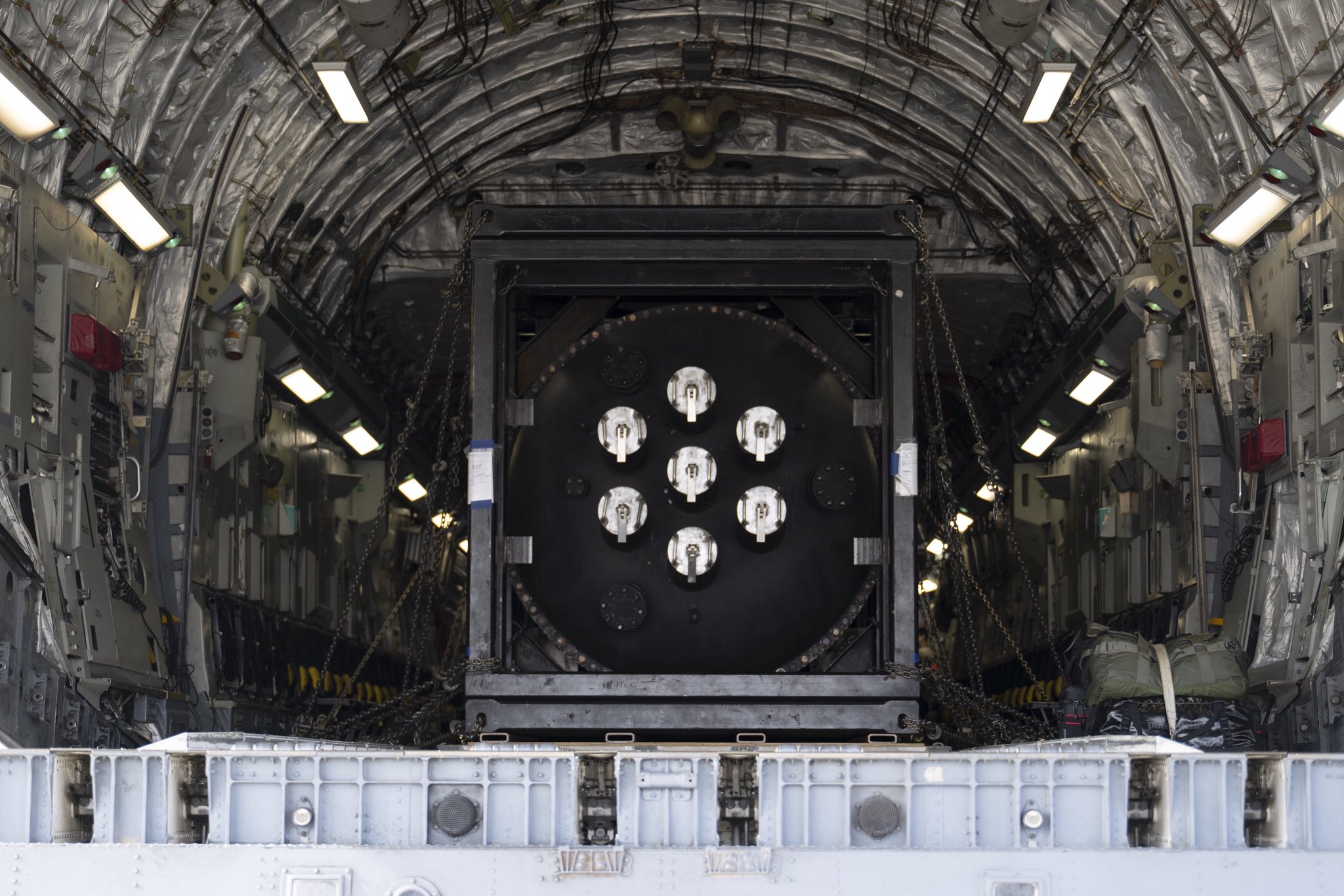
On Monday, February 16, 2026, the U.S. Department of Defense announced that, in cooperation with the Department of Energy, it had conducted the first air transport operation the day before of the 5 MW Ward 250 portable nuclear microreactor developed by Valar Atomics. The operation was carried out under the Nuclear Reactor Pilot Program, which aims to ensure energy independence for military bases and reduce reliance on the civilian power grid.
 Photos: Navy Petty Officer 1st Class Eric Brann, US Navy
The reactor was loaded at March Air Reserve Base in California, and the aircraft delivered it to Hill Air Force Base in Utah. From there, it will be transported to the Utah San Rafael Energy Lab for testing and evaluation. According to the Department of Defense, the Ward 250 is capable of supplying power to approximately 5,000 households.
In military applications, such a reactor could provide energy security for a military base, ensuring that mission operations do not depend on the civilian power grid. In overseas operations, reactors of this type would allow U.S. armed forces to operate without concern that fuel supplies could be cut off by an adversary.
A reactor such as the Ward 250 also represents enhanced energy security for the entire United States. This aligns closely with executive orders issued by Donald J. Trump aimed at transforming and modernizing the U.S. nuclear energy sector.
On May 23, 2025, the President signed four executive orders intended to strengthen U.S. nuclear energy policy:
- Reinvigorating the Nuclear Industrial Base,
- Reforming Nuclear Reactor Testing at the Department of Energy,
- Ordering the Reform of the Nuclear Regulatory Commission,
- Deploying Advanced Nuclear Reactor Technologies for National Security.
Michael P. Duffey, Under Secretary of Defense for Acquisition and Sustainment, said that the partnership between the Department of Defense and the Department of Energy is crucial to advancing the President’s nuclear energy initiatives.
“It’s clear to me that advancing President Trump’s priority on nuclear energy depends on close coordination between the Department of Energy and the Department of War,” Duffey said. “This partnership ensures advanced nuclear technologies are developed, evaluated and deployed in ways that strengthen energy resilience and national security.”
He emphasized that the future of warfare is energy-intensive and includes AI data centers, directed-energy weapons, as well as space and cyber infrastructure. The civilian power grid was not designed for such demands, which is why the Department of Defense will have to build its own energy infrastructure.
“Powering next generation warfare will require us to move faster than our adversaries, to build a system that doesn’t just equip our warfighters to fight, but equips them to win at extraordinary speed,” Duffey said. “Today is a monumental step toward building that system. By supporting the industrial base and its capacity to innovate, we accelerate the delivery of resilient power to where it’s needed.”
Secretary of Energy Chris Wright said that, thanks to small reactors such as the one transported from March to Hill, the United States is striving for a renaissance of nuclear energy.
“The American nuclear renaissance is to get that ball moving again, fast, carefully, but with private capital, American innovation and determination,” Wright said. “President Trump signed multiple executive orders that have unleashed tremendous reform of all the things that stopped the American nuclear industry from moving.”
Part of that effort, he said, will mean that by July 4, the administration expects three small reactors will be critical – or running smoothly. “That’s speed, that’s innovation, that’s the start of a nuclear renaissance,” Wright said.
Not only Ward 250
The Department of Defense has been investing in nuclear energy for a considerable time. Recently, nine potential locations were announced where miniaturized nuclear reactors will be deployed as power sources under the Janus program. It is worth noting that this is also an initiative of the Donald J. Trump administration.
However, these are not the first such initiatives. In 2019, a project was announced to deploy an experimental mini nuclear reactor for energy purposes under a pilot program of the United States Air Force at Eielson Air Force Base, scheduled to become operational by the end of 2027.
Also in 2019, the Small Mobile Nuclear Reactor (SMNR) program, codenamed Project Pele (formerly Project Dilithium), was launched. The system is intended to weigh under 40 tons and deliver an output of 1–5 MW, based on an Advanced Gas Reactor (AGR) design. On March 24, 2021, two contractors were selected to build prototypes: BWX Technologies of Lynchburg, Virginia, and X-energy of Greenbelt, Maryland.
On May 23, 2025, President Donald Trump signed an executive order to deploy advanced nuclear reactor technologies for national security purposes.
Yesterday, we took the next step toward achieving this historic mission. pic.twitter.com/hIEd1nlnmf
— Department of War 🇺🇸 (@DeptofWar) February 16, 2026
See also: