



















Interestingly, when SAFE was still at the development stage, it was difficult to find assessments within the PiS camp as harsh as those that appeared later. The dominant view was rather that Europe was finally beginning to take security issues seriously, and that Poland should take advantage of the emerging opportunity.
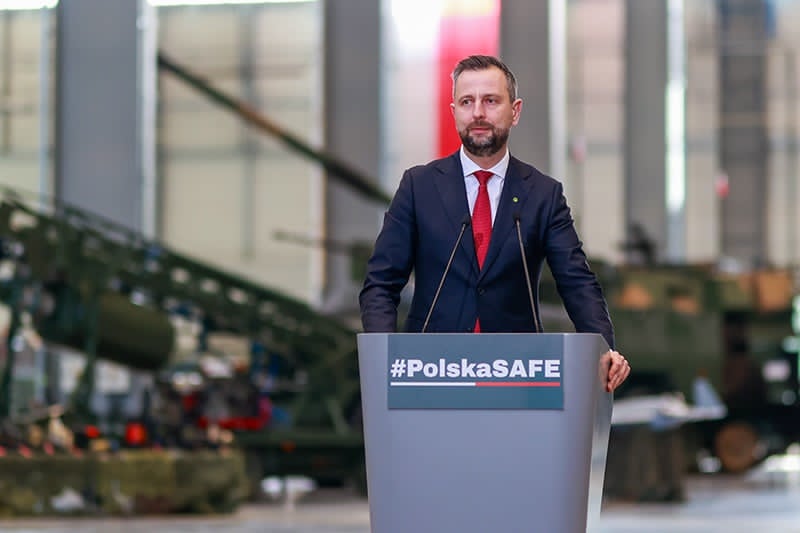 Photo: Krzysztof Niedziela/Ministry Of National Defence
In September 2025, Mariusz Błaszczak wrote: “The SAFE fund is an opportunity to develop the Polish Armed Forces. We cannot allow these funds to be wasted or directed to foreign defense industries.”
It was an entirely accurate point. It is hard to find an armed forces modernization specialist who would disagree with such a statement. Every billion euros spent in Polish plants means new production capacity, jobs, taxes, and the ability to replenish losses more quickly in a crisis.
A few months later, however, the same politician began presenting SAFE as a threat to Poland’s procurement sovereignty. Warnings emerged that the funds would not be used by Poland, and that the ultimate beneficiary of the program would be the German defense industry.
The problem is that events unfolded differently.
Facts instead of propaganda
At the end of May, the first major contracts implemented under SAFE were signed. Instead of German factories, Polish defense plants appeared. The funds were directed to the domestic defense industry. It was Polish companies that received orders related to the expansion of production capacity, the manufacture of weapons, and equipment for services responsible for state security.
The biggest problem for critics of the SAFE program is the fact that the first widely reported foreign contract implemented under it did not turn out to be Poland’s purchase of German weapons, but the sale of Polish systems to another European Union member state. This refers to Romania’s order covering Warmate loitering munitions and elements of the Gladius system produced by WB Group. The event is far more significant than the value of the contract itself. It shows that SAFE can become not only a source of financing for purchases for the Polish Armed Forces, but also a tool supporting the export of domestic defense technologies.
>>>Polish Armament Agency on the details of SAFE agreements under the single procurement procedure<<<
For many months, the public heard warnings that European funds would be captured by the largest Western defense corporations. Meanwhile, the first widely reported example of the program’s use points in exactly the opposite direction. It is a Polish company that has become a supplier of weapons financed under the new mechanism. This is worth remembering in the debate on SAFE, because a difference has emerged between political forecasts and the program’s actual effects that can no longer be ignored.
Of course, this does not mean that all funds will go exclusively to Polish companies in the future. Such a scenario would be unrealistic. From the outset, the program has been based on international cooperation and joint projects. However, the loudest warnings about the immediate takeover of funds by German corporations have not been confirmed.
Silence after the signing of the contracts
What happened after the first contracts were signed is also interesting. In the period preceding the procurement decisions, SAFE was one of the European programs most frequently criticized in statements by opposition politicians. After specific agreements were announced and beneficiaries from the domestic industry were identified, the intensity of that criticism clearly declined.
The reason is not difficult to understand. It is hard to convince the public that the money is going to German factories when successive reports concern Polish companies. It is hard to warn of the marginalization of the domestic industry when that very industry is becoming one of the program’s main beneficiaries.
The entire discussion around SAFE shows one more thing. For years, Poland has financed the modernization of its armed forces through foreign credits and loans. This applies both to purchases from the United States and from South Korea. The mechanism of obtaining financing itself is therefore nothing new.
What is new, however, is the possibility of using European funds to expand Poland’s own industrial capabilities and to finance purchases carried out by domestic companies. If SAFE funding supports projects for the armed forces, the ammunition industry, manufacturers of unmanned systems, or plants responsible for military equipment, then it strengthens the state’s capabilities. One can debate the details of the program, its structure, or its financing rules. It is difficult, however, to ignore the fact that the first results have brought tangible benefits to Polish entities.
Reality has verified politics
The most interesting aspect of the whole story is that the initial assessment of SAFE presented by Mariusz Błaszczak in autumn 2025 proved to be the most accurate. At the time, he spoke of an opportunity to develop the armed forces and the domestic industry. Today, after the signing of the first agreements, this is precisely the picture that is beginning to emerge.
The debate on national security should be based on facts, not political forecasts. The facts, however, are that the first major SAFE contracts went to the Polish defense industry. The German factories that were supposed to be the program’s main beneficiaries remain, above all, an element of a political narrative. And narratives, as the experience of recent months has shown, do not always survive a collision with reality.
See also: