






















Passive Location System (PET/PCL)
The first category includes the winner of this year’s Defender award, the Passive Location System (PLS), also commonly known by the acronyms of the detection methods used in it, PET/PCL. The Armament Agency announced the successful completion of its qualification tests on December 15, 2023.
The research and development program for the PLS began in 2012 as part of a project funded by the National Center for Research and Development titled “Development of a passive radar system for air defense missile systems (ZROP),” aimed at the new short-range Narew and medium-range Wisła missile programs. It was assumed that the new system would operate using data obtained through two methods:
- Detection and tracking of electromagnetic radiation emitted by aircraft, known as PET (Passive Emitter Tracking). This includes subsystems such as:
- detection of communication systems in the 20 MHz-6 GHz range,
- detection of onboard radar stations in the 500 MHz-18 GHz range,
- detection of interrogation and response signals from Identification Friend or Foe (IFF) systems.
- Detection of airborne objects using electromagnetic radiation reflected off them from external sources, known as PCL (Passive Coherent Location). These sources, also referred to as “opportunistic transmitters,” can include::
- radio stations broadcasting in the VHF band (88-108 MHz),
- transmitters of terrestrial digital TV (DVB-T) or digital radio (T-DAB) (174-230 MHz, 470-790 MHz),
- cellular phone transmitters (GSM from 900 MHz).
Both methods are, of course, well-known and used worldwide (especially emission source location, which has been in practice since World War I). However, the uniqueness of the solution used in the Polish system lies in the fusion of data provided by both methods. This allows for an increased probability of detection, greater precision in locating the object, more stable target tracking, and the ability to identify the type of airborne target through the analysis of its emissions.
A complete PLS set in its full configuration consists of four identical passive radar stations, identical in terms of both equipment and software. One of these is designated as the master unit (Master radar), where data fusion occurs, combining its own data with the data from the remaining stations, which operate as subordinate devices (Slave). Any passive radar station in the set can serve as the master, and the choice depends on which configuration provides the highest quality of output data, as well as which station ensures the best communication with its command systems, whether through a fiber optic or radio link. Combining data from the four stations deployed in the field allows for the control of a larger area and more precise determination of detected target coordinates. It is also possible to operate with a reduced configuration of three, two, or even a single station, but any setup smaller than the full configuration results in limitations in using PET subsystem data and reduces the system’s operational area.
After the successful completion of qualification tests, changes are being made to the technical documentation for the production version, incorporating the recommendations provided by the commission during testing. For instance, it is already known that the chassis in the production vehicles will be changed from the current four-axle Jelcz P882D.53 to a five-axle Jelcz P112.57. The electronic components of the station will also be modernized, which is not surprising given that the PLS prototype was developed in 2017, and technological progress in this field is known to be exceptionally rapid.
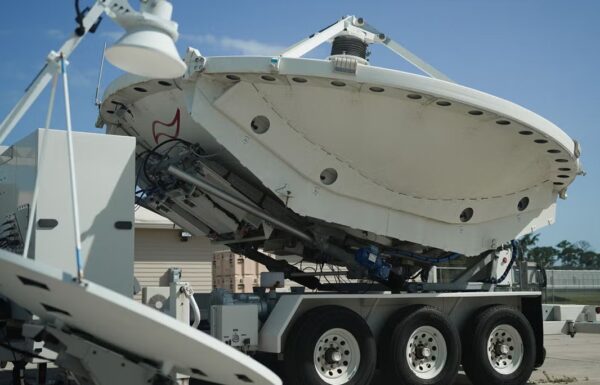
 One of the four PCL/PET stations in the PLS system with deployed antenna masts / Photos: Przemysław Gurgurewicz, MILMAG.
 Both antenna masts in the folded position. On the left is the front mast, which contains only the antennas of the PET subsystem, and on the right is the rear mast, which houses all the antennas of the PCL subsystem as well as an antenna of the PET subsystem
Warta
Another design presented by PIT-Radwar at Kielce is the long-range airspace control radar station, Warta. This mobile station operates in the L-band (1-2 GHz) decimetric waves. In terms of operational parameters, it falls into the same category as the seven NUR-12ME and three NUR-12M radars currently used by the Polish Air Force, making it a natural successor. Compared to its predecessors, it is, of course, a much more modern device, featuring an active electronically scanned array (AESA) antenna, where each antenna row has its own semiconductor transmit-receive module, creating a so-called distributed transmitter. Airspace scanning in azimuth is performed mechanically by rotating the antenna, while elevation scanning is done through electronic beam steering.
The radar features high anti-jamming capabilities thanks to its low side-lobe antenna, reduced peak transmitter power, rapid frequency switching, adaptive signal processing techniques, and advanced radar resource management. The radar has an instrumental range of 470 km, the same as the stationary NUR-12M, and greater than the mobile NUR-12ME (350 km). The maximum altitude for target detection is 30,500 meters.
Additionally, the Warta radar is equipped with a helicopter detection channel, which is a small radar operating in the S-band (2-4 GHz).
Warta, unlike its predecessors, is a fully mobile system, capable of quickly changing positions and beginning operations at a new location within minutes of arrival. To achieve this, the entire radar system is distributed across five vehicles: three Jelcz P882D.53 trucks and two Autosan 495 trailers. These are as follows:
- Antenna unit on a Jelcz P882D.53 truck, which includes the antenna assembly and the signal processing block,
- Indicator-technical unit housed in a 20-foot container on an Autosan 495 trailer, containing three workstations for the operators and the station commander,
- Uninterruptible power supply unit in a 20-foot container on an Autosan 495 trailer, which holds two power generators – primary and backup – each with a power of 85 kW, along with batteries to maintain uninterrupted radar operation in case both generators fail (e.g., due to fuel shortage),
- Logistics equipment unit on a Jelcz P882D.53 truck, which carries a set of spare parts and both summer and winter Berberys camouflage nets for the entire system,
- Electromagnetic decoy unit on a Jelcz P882D.53 truck, which transports four emitters simulating radar antenna operation. These emitters are placed in the field up to several hundred meters away from the actual antenna, making it difficult to determine the real location of the antenna and, in case of an attack, potentially drawing enemy missiles away from the actual target.
Warta is currently undergoing qualification tests, which are expected to be completed by the end of this year, with the completion protocol anticipated to be signed in January 2025. This will allow the next phase of work to begin, which includes implementing feedback from the tests and revising the technical documentation, expected to be completed by the end of March 2025. At that point, negotiations for the execution contract can begin. It is worth noting that there has been talk of the Polish Air Force’s need for 17 Warta radar units. Lastly, it’s important to mention that Warta was already presented in Kielce in 2017, but at that time, it was essentially a different device – a demonstrator antenna on a stabilized platform.

Front view of the Warta radar’s antenna unit. The division of the main antenna and the IFF system antenna into three parts is visible, allowing for quick folding
 The Warta antenna assembly viewed from the rear. A supplementary radar for the helicopter detection channel can be seen mounted on the antenna column
 The Autosan 495 trailer with the uninterruptible power supply unit housed in a 20-foot container. Behind it is a second, similar container on the same type of trailer, which contains the indicator-technical unit, providing workstations for the operators and the station commander
Sajna
The next two radar systems presented by PIT-Radwar in Kielce were developed by the company’s Gdańsk branch and were absolute premieres. The first is Sajna, a multifunction fire control radar for the Narew short-range air defense systems, and the second is Tuga, the latest development from the branch—a small fire control radar designed for very short-range air defense (VSHORAD) systems, such as the SA-35 anti-aircraft gun, also offered by the company, with a caliber of 35 mm.
The research and development program for the Sajna radar began in 2012 as part of a project approved by the National Center for Research and Development on December 19, 2012, titled “Development of a prototype multifunctional fire control radar with phased array beam scanning in two planes for the short-range air defense missile system (ZROP-KZ), codename Narew.” The device being developed within the program is capable of detecting and tracking all types of airborne targets, including not only conventional ones such as manned and unmanned aircraft and helicopters but also various categories of missiles, from short-range ballistic missiles to artillery shells, including mortar rounds.
The radar, operating in the centimeter wave band (C-band, 4-8 GHz), is equipped with a semiconductor active antenna cooled by liquid, significantly reducing its infrared signature. Azimuth scanning is performed traditionally through the mechanical rotation of the antenna, which is mounted on a retractable mast, while in elevation, the beam is electronically steered. For detecting artillery shells, a sectoral mode with a stationary antenna is used. The radar has a maximum instrumental range of 180 km, and the information refresh rate is 2 seconds.
The Sajna radar is mounted on a five-axle Jelcz P112.57 truck. The entire three-person crew is accommodated in the vehicle’s cabin, where the operator stations are also located in the rear section. As with other PIT-Radwar radars, there is the option to use portable operator stations and operate the system remotely.
The prototype of Sajna shown in Kielce is currently undergoing factory tests, which are expected to be completed in the fall. All functional parameters have already been verified, but Sajna still needs to undergo tests such as off-road driving and electromagnetic compatibility checks. The next stage, qualification tests, should be completed by mid-next year, allowing the project to move to the technical design verification phase, which will incorporate any feedback from the commission, and initiate purchase negotiations. The demand for this station will be significant, as the procurement plans under the Narew program call for 23 missile batteries, each equipped with two systems (fire units). This results in a total of at least 46 Sajna fire control radars (at least, as additional needs for training should be considered, such as a unit for the Air Force Training Center in Koszalin).
 The Sajna radar in operational position with the antenna mast extended
 Sajna with the mast lowered…
 ……and during the process of folding it into the transport position
Tuga
The smallest of the offered radars is Tuga. This radar is still under development and is approaching the stage of its first field tests. It is a fully digital, software-controlled device that operates in continuous wave mode in the centimeter wave band (X-band, 8-12 GHz).
The antenna block, measuring 700×700 mm, consists of two antennas – one for transmission and one for reception. These provide coverage of 33° in elevation and 90° in azimuth. Its primary purpose is detecting small unmanned aerial vehicles (UAVs). Targets with a radar cross-section of 0.01 m² can be tracked from a distance of 3-4 km. Thanks to the radar’s flat panel design, it can be utilized in various applications.
The simplest solution is to use a single antenna block as a fire control radar, for example, for the SA-35 gun. It can be installed either on its own or together with optoelectronic devices within a fire control head, an example of which was also presented at the exhibition.
Another proposed solution is to use the device as a target detection radar. In a simpler variant, this can be achieved by mechanically rotating the antenna, while a more comprehensive solution involves using multiple antennas, for instance, four, to create a system capable of continuous 360° azimuth surveillance.
 Tuga at the PIT-Radwar stand. The two separate antennas – transmission and reception – are clearly visible
 The Tuga radar integrated with optoelectronic devices in a single head.