
























On Tuesday, April 21, 2026, US company Lockheed Martin announced that it had received a contract from the US Department of Defense to develop, integrate, and test PAC-3 MSE (Patriot Advanced Capability-3 Missile Segment Enhancement) interceptor missiles with the US Navy’s shipborne Aegis Combat System. This will add the Navy to the global community of PAC-3 MSE users, which already includes the US Army and 16 partner nations, providing US warships with a highly effective missile defense capability.
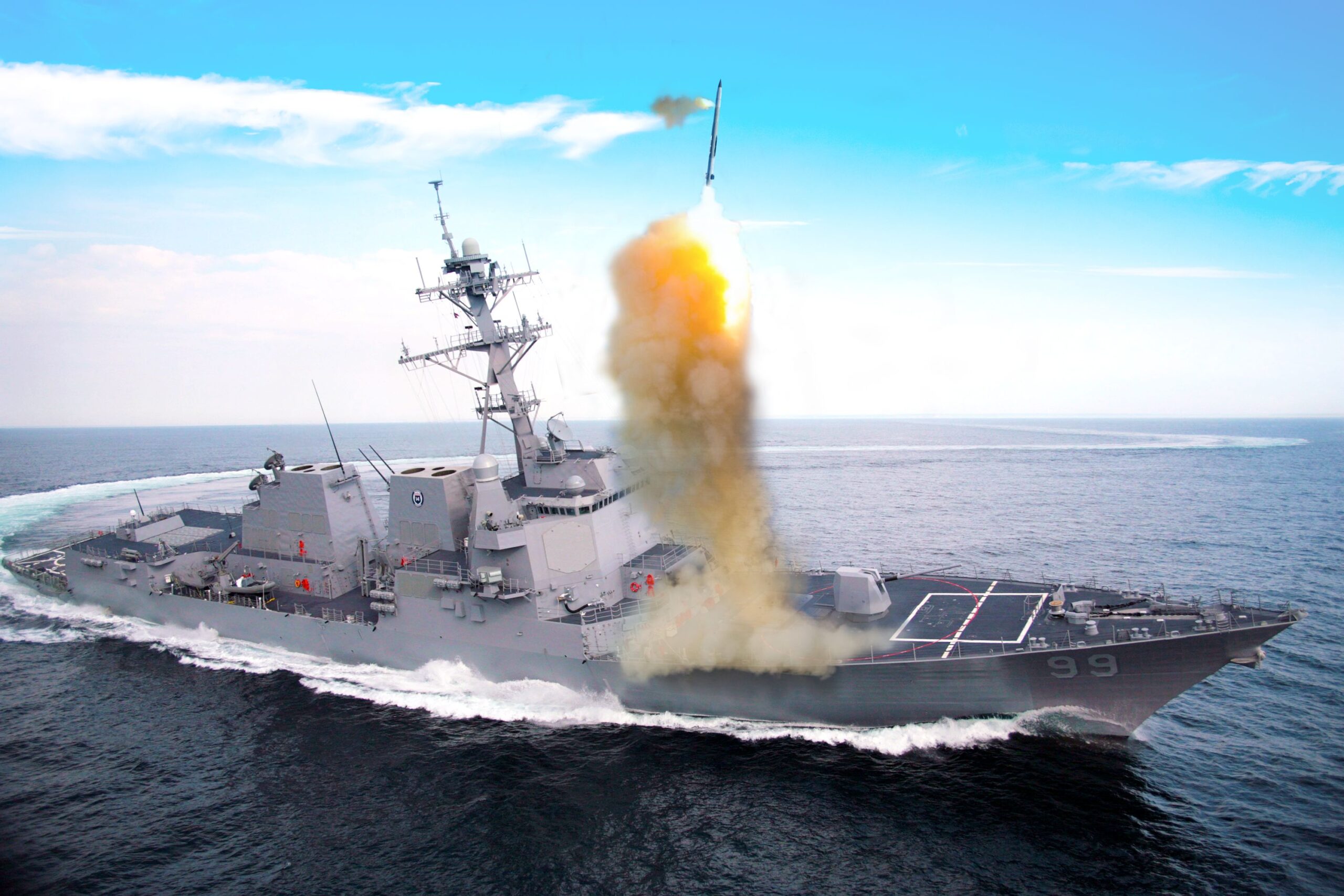 Image: Lockheed Martin
“By integrating PAC‑3 MSE’s capabilities into Aegis, the Navy is taking a decisive step forward in defending America’s fleet and our global interests against the most advanced threats,” said Jason Reynolds, vice president and general manager, Lockheed Martin IAMD. “Lockheed Martin is driving the innovation behind this effort—bringing together advanced, combat‑proven systems in new ways to accelerate capability and deliver a decisive advantage in maritime defense.”
“This integration further expands the capability of Aegis to engage missile threats at multiple layers, enabling a more comprehensive and effective defense against evolving threats, ensuring the warfighter has the strategic advantage,” said Chandra Marshall, vice president, Lockheed Martin Multi-Domain Combat Solutions.
It is worth adding that the draft FY2027 National Defense Authorization Act (NDAA) includes a proposal to fund the US Navy’s purchase of a batch of 405 PAC-3 MSE missiles for Arleigh Burke-class guided-missile destroyers. Germany is also interested in acquiring these missiles; in that case, they would be fitted to the planned F127 air-defense frigates, or destroyers, which are also to receive the Aegis Combat System.
It should be recalled that on January 10, 2023, during the Surface Navy Association conference and symposium in Northern Virginia, Lockheed Martin presented a mock-up of a PAC-3 MSE missile adapted for the Mark 41 Vertical Launching System. Work to adapt the missile for naval applications began back in 2017.

On July 10 of the same year, Lockheed Martin reported the integration of the PAC-3 MSE missile with the Aegis Combat System, during which the missile communicated for the first time with the AN/SPY-1 air and surface search radar. The integration first required modifying the missile’s radio-frequency data link so that it could communicate with the radar, which operates in the S band. This involved converting the existing PAC-3 MSE dual-band data link into a tri-band data link capable of communicating in that frequency band.
The PAC-3 MSE was developed as an evolution of the PAC-3 CRI (Cost Reduction Initiative) missile to enhance the MIM-104 Patriot air and missile defense system’s ability to intercept ballistic missiles. As part of the program, the missile received a more powerful rocket motor, while its performance was also improved, including intercept range and altitude.
PAC-3 MSE missiles can also be used to destroy maneuvering targets, such as cruise missiles, as well as crewed and uncrewed aircraft. They do not have a conventional explosive warhead, instead destroying targets through kinetic energy in a hit-to-kill engagement.
Meanwhile, on January 6 this year, the US Department of Defense ordered a tripling of complete PAC-3 MSE missile production from the current level of around 600 to 2,000 missiles per year. On April 1 this year, Boeing also signed a contract to triple production of seeker assemblies for these missiles.
Notably, multiple Polish Armaments Group (PGZ) companies are involved in the PAC-3 MSE missile production program: WZE, WZL-1, and WZU.
The @USNavy has awarded @LockheedMartin a contract to develop, integrate and test the PAC‑3 Missile Segment Enhancement (MSE) into the Aegis Combat System, joining the @USArmy and 16 partner nations in the PAC‑3 MSE user community. Click 🔗below:
— Lockheed Martin News (@LMNews) April 21, 2026
See also: