























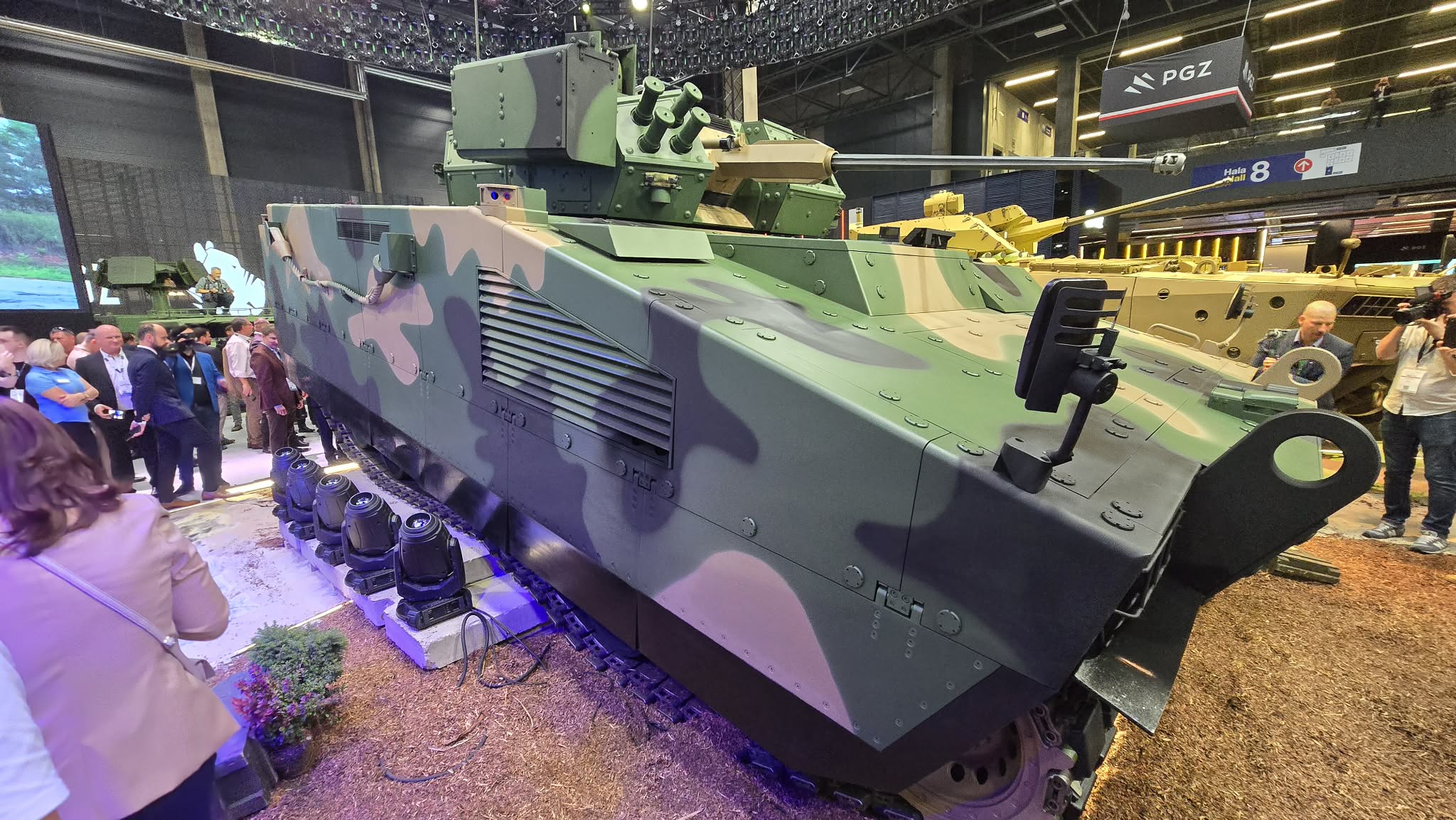
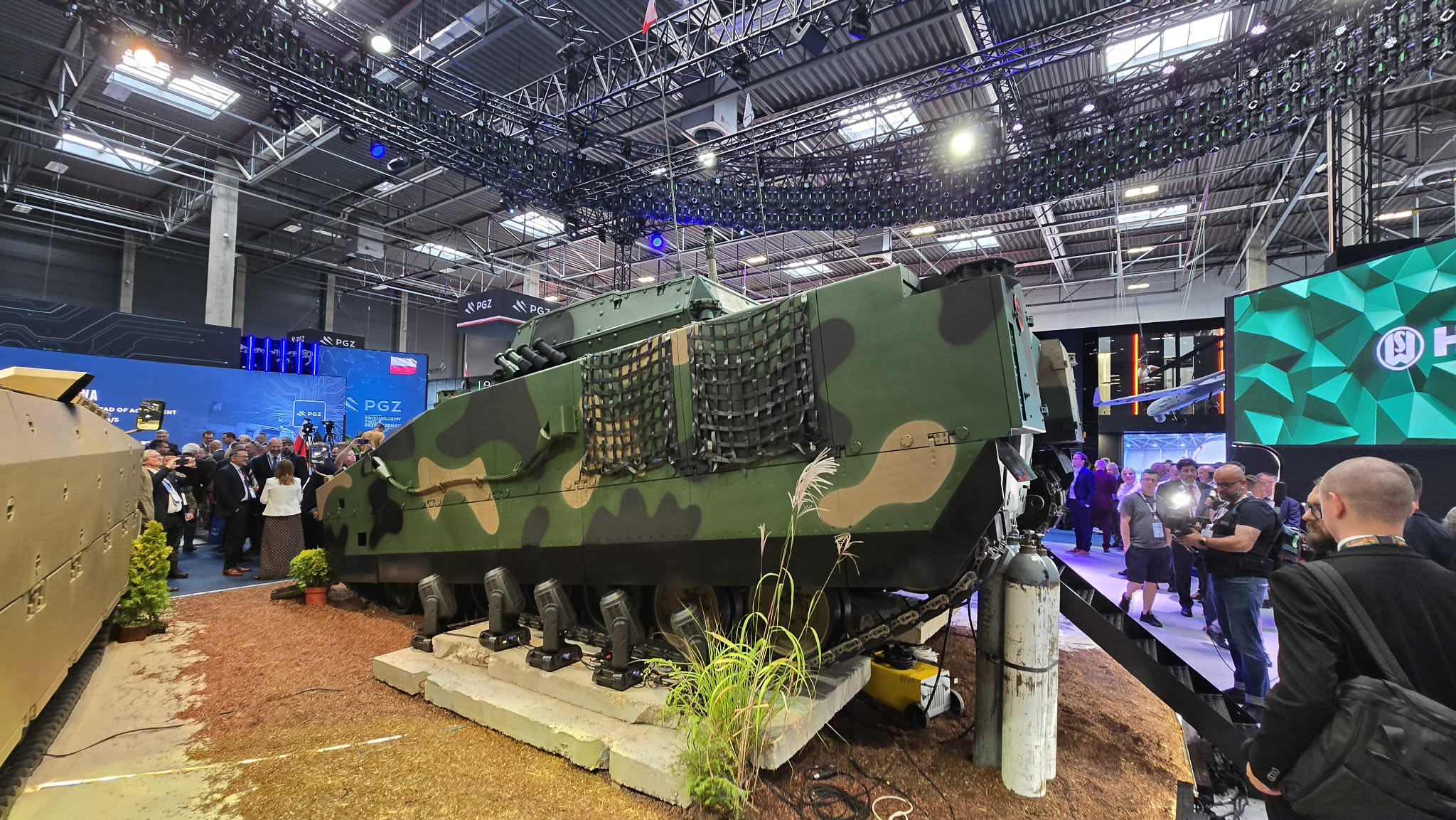
During the 34th International Defence Industry Exhibition MSPO 2026 at Targi Kielce, the Polish Armaments Group (PGZ) presented a full-scale Heavy Infantry Fighting Vehicle technology demonstrator developed by Huta Stalowa Wola (HSW). It was PGZ’s most important debut at this year’s exhibition.
 Photos: Jakub Link-Lenczowski, MILMAG
During the previous edition of MSPO, the project was presented in the form of a 1:4 scale model under the name Ratel. This year, PGZ is showcasing a full-scale vehicle, illustrating both the pace of development work and the growth of domestic capabilities in the design and production of modern armored platforms. The Heavy Infantry Fighting Vehicle combines Huta Stalowa Wola’s experience in designing heavy military equipment with solutions intended to meet the requirements of the future battlefield.
“The debut of the Heavy Infantry Fighting Vehicle marks an important moment both for the Polish Armaments Group and for the entire domestic defense industry. The demonstrator presented today confirms that Polish companies possess the capabilities needed to design and develop advanced combat platforms meeting the requirements of the modern battlefield. The Heavy Infantry Fighting Vehicle is an example of effective cooperation and integration of capabilities accumulated across Polish Armaments Group companies. By combining the experience of our facilities, engineering expertise, and domestic production capabilities, we are developing solutions that address the current needs of the Polish Armed Forces. Today’s debut demonstrates that PGZ is not only developing proven technologies, but is also laying the groundwork for future generations of modern armament systems manufactured in Poland,” said Adam Leszkiewicz, President of the Management Board of the Polish Armaments Group.
With a combat weight exceeding 40 metric tons, the Heavy Infantry Fighting Vehicle is a comprehensive system designed for combat operations on the modern battlefield. The vehicle’s design is based on three key principles: high firepower, maximum protection for the crew and dismounts, and high tactical mobility. It is intended to transport, protect, and provide fire support to mechanized infantry units, including in difficult terrain and demanding climatic conditions. Thanks to advanced observation and targeting systems, it is designed to detect and engage threats before they can directly affect friendly forces. Despite the significant increase in weight compared with the 28-tonne Borsuk infantry fighting vehicle, the designers intend to retain a high power-to-weight ratio, allowing the vehicle to maintain the mobility required for operations alongside armored and mechanized formations.
“The Heavy Infantry Fighting Vehicle is the result of the knowledge, experience, and commitment of Huta Stalowa Wola’s designers, who have been developing modern platforms for the Polish Armed Forces for years. Drawing on the expertise gained during the Borsuk program, we have created a design that meets the requirements of the modern battlefield, providing a high level of protection, mobility, and firepower. Today’s debut confirms that Huta Stalowa Wola remains one of the pillars of the development of Poland’s domestic capabilities in the field of armored and mechanized forces,” said Barbara Cena, President of the Management Board of Huta Stalowa Wola.
The Heavy Infantry Fighting Vehicle uses an extended tracked chassis and an 800 kW powerpack, providing a top speed of up to 65 km/h and a range of up to 500 km. The vehicle retains a high ability to negotiate terrain obstacles and operate in demanding operational environments. The Heavy Infantry Fighting Vehicle is designed to provide maximum protection for the crew and dismounts. Its design incorporates advanced ballistic and mine protection solutions compliant with stringent STANAG standards. The protection suite can be supplemented by an optional Active Protection System (APS), designed to defeat incoming projectiles and missiles. The vehicle is also equipped with laser warning receivers, such as the OBRA-3, integrated with smoke grenade launchers, as well as an NBC protection system with a high-performance filtration and ventilation system. Additional protection is provided by specialized mine-resistant seats designed to reduce the effects of underbody blasts.
The vehicle is armed with the ZSSW-30 unmanned turret, fitted with a 30 mm cannon capable of firing programmable airburst munition (ABM) and Spike anti-tank guided missiles. This configuration enables effective engagement of both ground and aerial targets and allows precise fire by day and night. The vehicle accommodates a three-person crew and six to eight dismounts. An auxiliary power unit (APU) provides independent power for onboard systems, improving operating efficiency and increasing the platform’s potential for further technological development.
To reduce costs and simplify logistics, a number of components common with the Borsuk infantry fighting vehicle have been used, while the modular design allows for future upgrades. The technology demonstrator presented at MSPO 2026 forms the basis for the development of the final prototype of a next-generation heavy infantry fighting vehicle. Further development will include integration of the powertrain and comprehensive survivability and reliability testing.
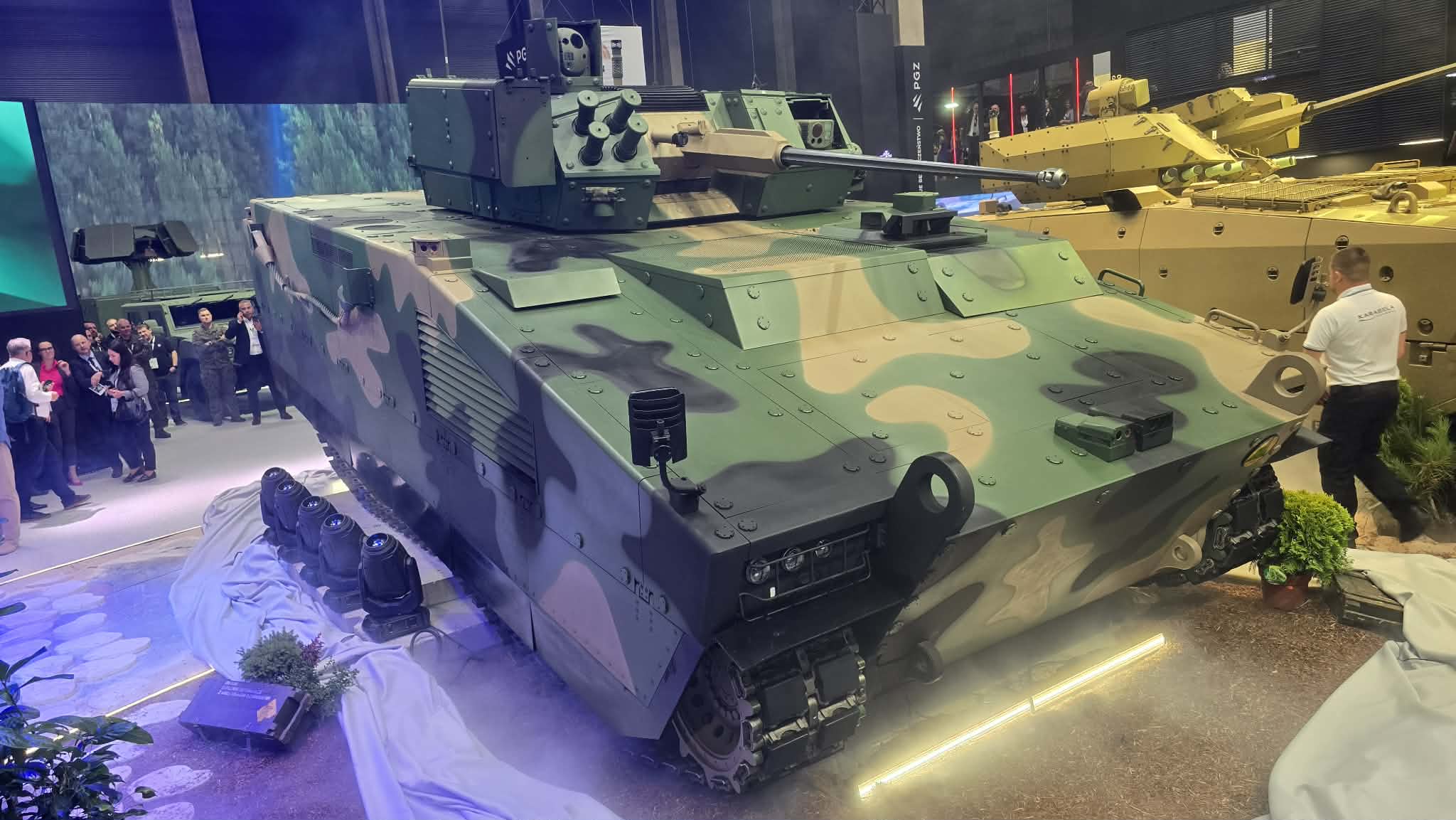 To optimize costs and logistics, the Heavy Infantry Fighting Vehicle incorporates a commonality strategy based on proven components from the Borsuk infantry fighting vehicle platform, including the APU, filtration and ventilation system, heating system, periscopes, and lighting components.
The Heavy Infantry Fighting Vehicle is an advanced technology demonstrator that provides the foundation for the development of a new generation of heavy combat vehicles. It is a tangible demonstration of the direction in which Polish engineering capabilities in the field of land systems are developing.
The project is now entering a key phase of development, encompassing advanced analytical and computational work intended to turn the concept into a complete prototype. The priority in the upcoming stages will be full integration of the powerpack and a series of rigorous tests under real-world conditions. Particular emphasis will be placed on full-scale testing of armor protection and mine protection systems, with the aim of delivering a final product offering the highest possible level of protection and capable of carrying out the most demanding missions on the modern battlefield.
The demonstrator is intended to showcase the key functional features of the future vehicle, while its final configuration will remain subject to further development work and consultation with the future user. Options allowing the transport of either six or eight dismounts are being analyzed, with the final layout to be tailored to the requirements of the Polish Armed Forces. The next stage of the program will involve the construction of prototypes intended for testing and qualification trials. The current project schedule envisages the completion of prototypes in 2027 and readiness to launch serial production in 2029. The priority in the upcoming stages will be full integration of the powerpack and a series of rigorous tests under real-world conditions. Particular emphasis will be placed on full-scale testing of armor protection and mine protection systems, with the aim of delivering a final product offering the highest possible level of protection and capable of carrying out the most demanding missions on the modern battlefield.
Following the unveiling, Deputy Prime Minister and Minister of National Defence Władysław Kosiniak-Kamysz said:
“We have something to be proud of. Congratulations to the entire PGZ and Huta Stalowa Wola team. A moment ago, Canada’s Minister of National Defence, David McGuinty, was here with us and said that it was unbelievable that you had been able to produce this within a year and that, as President Adam Leszkiewicz said, serial production could begin in the coming years. Compared with the twelve years spent waiting for the Borsuk infantry fighting vehicle, this is a world record. Congratulations! I would also like to thank those cooperating with PGZ. These are also thousands of private companies that enable us to build Poland’s brand in the defense market.”
Deputy Minister of State Assets Konrad Gołota, who is responsible for overseeing state-owned companies in the Polish defense industry, added with regard to the Heavy Infantry Fighting Vehicle platform:
“Most of the turret systems available on the market can be installed on this platform, which opens up additional markets for us. Today is a time for satisfaction and pride in our engineers from the Polish Armaments Group and the defense industry, which, as we can see, is achieving not only technologically advanced things, but things that seemed impossible (…) Over the past three months, more than 1,500 people have been hired across the PGZ Group.”
💥 OTO ON. CIĘŻKI BOJOWY WÓZ PIECHOTY. 🇵🇱
Po dniach odliczania i pokazywania tylko fragmentów odsłaniamy najważniejszą premierę PGZ na #MSPO2026.
CBWP to nowa ciężka platforma opracowana przez Hutę Stalowa Wola – z wysokim poziomem ochrony, dużą mobilnością i siłą ognia… pic.twitter.com/kazs4ciGMj
— Polska Grupa Zbrojeniowa🇵🇱 (@PGZ_pl) September 8, 2026
