


























At BEDEX 2026 (Brussels European Defence Exhibition), held on March 12–14 in Brussels, the American company Lockheed Martin presented a scale model of the Vectis unmanned combat aerial vehicle, a so-called Loyal Wingman. It was promoted primarily for the Air Component of the Belgian Armed Forces (Luchtcomponent), which is set to operate 45 F-35A Lightning II multirole combat aircraft.
 Photo: Jakub Link-Lenczowski, MILMAG
The BEDEX exhibition provides opportunities to promote products more broadly in Western Europe, and it is worth noting that the NATO countries interested in acquiring so-called Loyal Wingman systems include the Kingdom of the Netherlands, which has announced its intention to join the American CCA program, as well as Denmark.
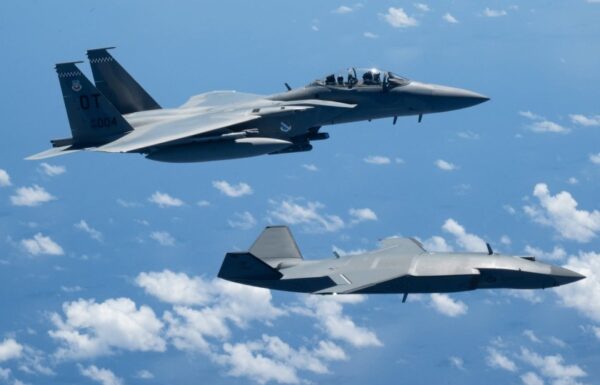
The Vectis concept, an unmanned system in the CCA (Collaborative Combat Aircraft) class, was developed by the Skunk Works design bureau and revealed by Lockheed Martin on September 21 last year. It is possible that the concept had been developed for the U.S. Air Force (USAF) program of the same name, although the Increment 1 phase ultimately selected proposals from Anduril Industries with the YFQ-44A Fury and General Atomics Aeronautical Systems Inc. (GA-ASI) with the YFQ-42A Dark Merlin.
Shortly before presenting the concept, Lockheed Martin also announced its participation in developing a joint control system for the U.S. Navy’s own CCA initiative.
According to available information, Vectis will be equipped with the MDCX (Multi-Domain Combat System) autonomous control system together with the UMCS (Unmanned Carrier Aviation Mission Control Station), developed by Skunk Works. According to information released on November 7, 2024, these systems were tested by the U.S. Navy and GA-ASI on the MQ-20 Avenger unmanned aircraft.
It has been emphasized that Vectis will be able to cooperate with 5th- and 6th-generation multirole combat aircraft in the Loyal Wingman role, likely including current platforms such as the F-22A Raptor and F-35 Lightning II, as well as the future F-47 NGAD. The system is intended to specialize in air-to-air and air-to-ground combat missions, electronic warfare (EW), and intelligence, surveillance, and reconnaissance (ISR) tasks.
Although the platform’s technical and tactical parameters have not been disclosed, it has been noted that the aircraft will belong to the Group 5 UAS category. In the U.S. Department of Defense classification, this refers to the largest unmanned aircraft, with a maximum takeoff weight above 600 kg (1,320 lb) and an operating altitude above 5,486 m (18,000 ft). Examples include systems such as the MQ-9 Reaper strike UAV and the RQ-4 Global Hawk reconnaissance UAV. It is only known that Vectis is smaller than the F-16, but larger than the family of low-cost subsonic CMMT cruise missiles.