




























On Monday, January 5, 2026, the German group Rheinmetall AG announced that, together with MBDA Deutschland (part of the European MBDA consortium), they plan to establish a joint venture that will focus on the development of naval high-energy laser weapon systems (High-Energy Laser Weapon System, HELWS).
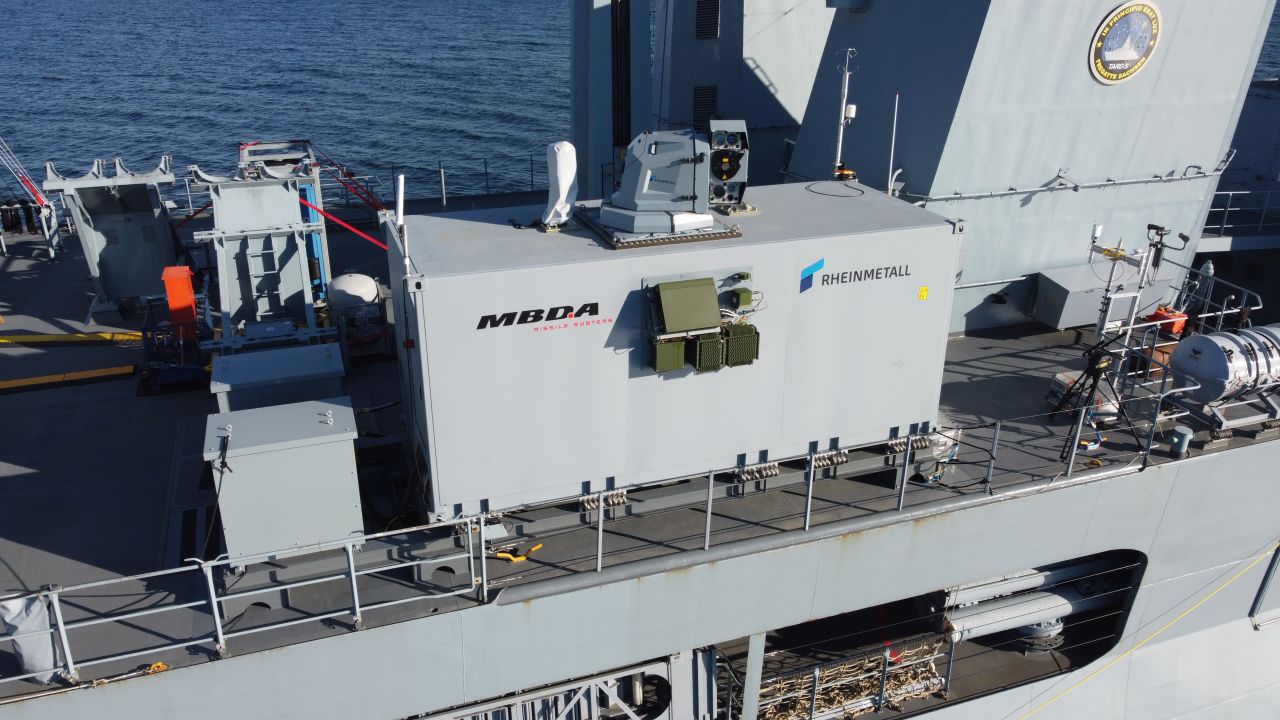 HELWS aboard the guided-missile frigate FGS Sachsen (F219), F124 Sachsen class / Photos: MBDA Deutschland
The new German limited liability company (GmbH) will be established to develop a highly innovative naval laser weapon system, with subsequent applications also envisaged for land-based use. The company is set to begin operations in the first quarter of this year. It will build on cooperation ongoing since 2019 (an agreement extending the cooperation was signed on September 20, 2024) and on the successful implementation of a naval laser weapon system demonstrator (Rheinmetall and MBDA naval laser weapon closer to operational readiness).
The German Navy (Deutsche Marine) is expected to receive an operational laser weapon system to complement its artillery systems and guided missiles, currently projected as early as 2029. The system is particularly effective against drones and other highly maneuverable targets at short and very short ranges. MBDA and Rheinmetall AG are ideally positioned to deliver this capability, as they previously jointly developed a demonstrator that has already been integrated with the guided-missile frigate FGS Sachsen (F219) of the F124 Sachsen class and successfully tested under operational conditions for one year (tests were conducted from late August 2022 to late September 2023 – ed. note). All necessary capabilities for precise, rapid, and minimal engagement of targets were confirmed.
Even when facing the most challenging targets and adverse environmental conditions, the system demonstrated its ability to track a target the size of a €1 coin from a long distance with stability and to focus the laser weapon’s energy precisely on that target. This level of precision prevents overshoot, ensuring maximum safety.
Within the existing partnership, both companies have developed a system that meets all customer requirements.
“This step demonstrates the potential of determined industrial and technological cooperation in Germany in order to produce cutting-edge technology“, said Roman Köhne, Head of Rheinmetall’s Weapons and Munitions division. “From the very beginning, both partners have been focussing on their strengths. Hence, this has enabled us to offer a unique product in a short period of time to the Bundeswehr. And from the beginning, nationalising the technology was the main object. One of the goals is to maintain, create and expand jobs in Germany in the long term, as well as ensuring national sovereignty and security of supply in times of crisis“.
“With this GmbH (private limited company under German law), we are setting new standards in the development and production of state-of-the-art military laser weapon systems, designed and made in Germany“, explains Thomas Gottschild, CEO of MBDA Germany. “This accentuates the benefits of many years of collaboration and highlights the dedication of both companies to bringing the tried-and-tested maritime product to the market swiftly, and providing the Bundeswehr with additional drone defence capabilities. By combining our complementary, innovative core competencies, we can offer the German Navy a laser weapon system that is technologically advanced, qualified and operational“.
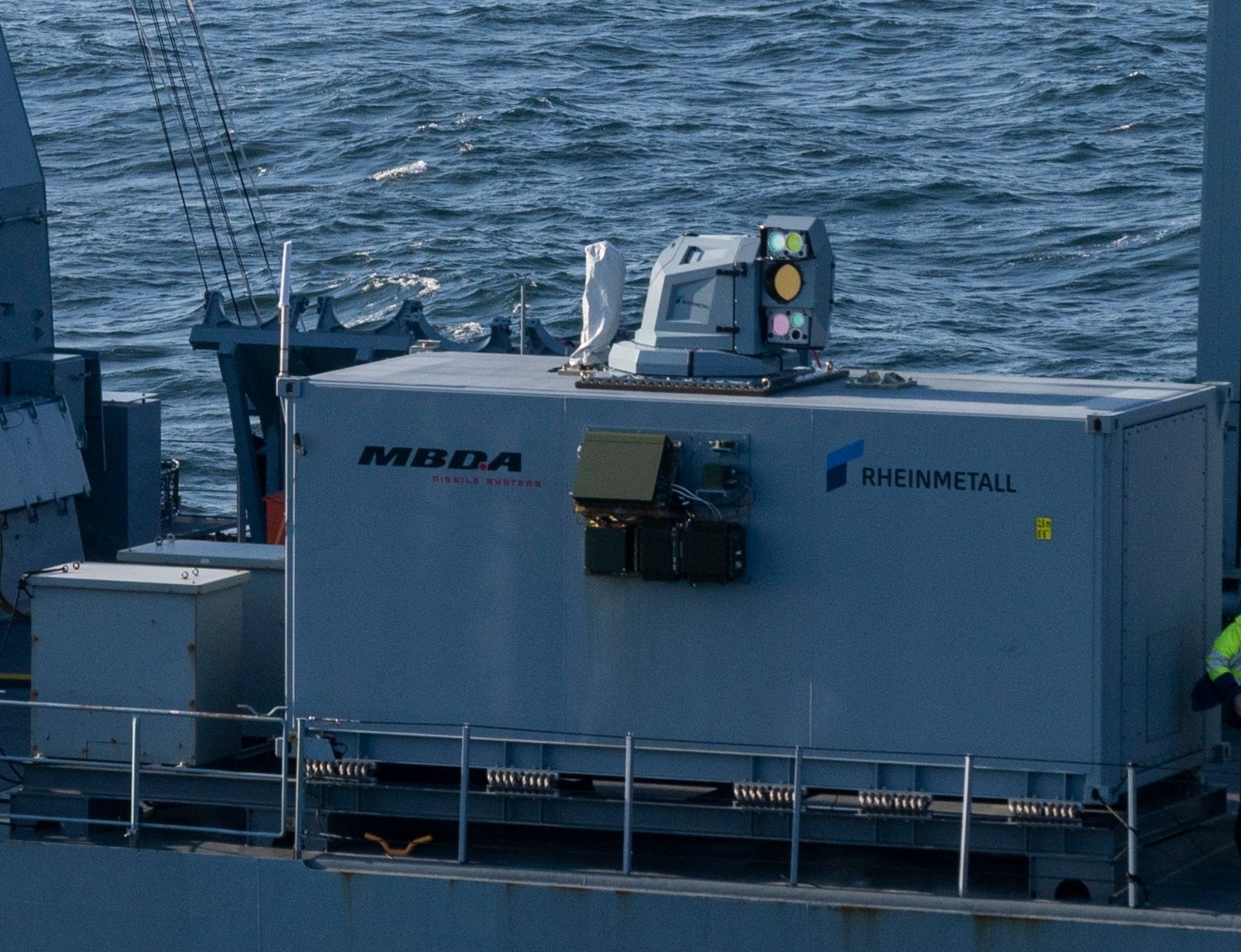
Following a successful one-year sea trial period, during which more than 100 firing and tracking tests were conducted against various targets, including against the sky background without using terrain to capture the beam, the laser demonstrator was transferred to the Laser Competence Center at the Bundeswehr Technical Center for Weapons and Ammunition (Wehrtechnische Dienststelle, WTD) 91 in Meppen for further testing. The weapon system, integrated into a standard 20-foot ISO container, was recommissioned and is also being used for additional land-based counter-drone defense tests.
Within the HELWS cooperation, MBDA Deutschland was responsible for the detection and target-tracking subsystems, the control console, and connecting the laser weapon demonstrator to the ship’s command and control system. Rheinmetall AG’s responsibilities included the aiming system, beam guidance system, and the demonstration container, as well as the mechanical and electrical integration of the demonstrator aboard the frigate FGS Sachsen (F219) and, ultimately, the high-energy laser source itself, including its peripheral equipment.
The laser demonstrator is based on spectral beam combining technology and is therefore a fiber laser with a maximum output power of 20 kW (with scalability). It consists of twelve identical 2 kW laser modules, whose beams are combined into a single beam using dielectric grating technology. Compared to geometric beam combining, spectral beam combining is less complex, highly modular, and demonstrates growth potential in output power up to the 100 kW class.
▶️ Rheinmetall and MBDA: Joint venture will efficiently combine development and production of state-of-the-art laser weapon systemhttps://t.co/vrAjd7pYPF pic.twitter.com/plS0AL0BHE
— Rheinmetall (@RheinmetallAG) January 5, 2026
