




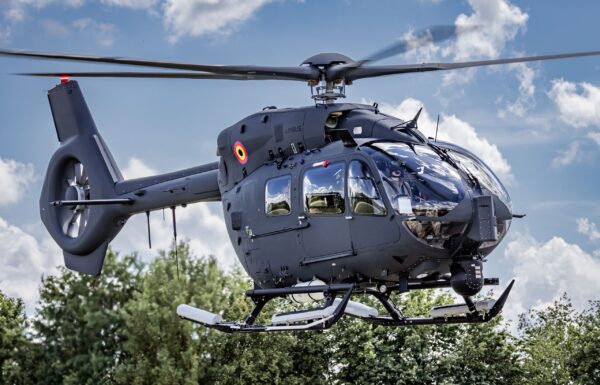














Among all the unmanned aerial platforms presented by FlyFocus, the U-HeMiT helicopter attracted the greatest interest. It was developed under a program of the National Centre for Research and Development (NCBR) as an unmanned transport platform for special forces (BPT WS – KURIER). The project was based on the proven Escape ultralight helicopter produced by the Italian company Lamanna Helicopters. From its design, elements such as the fuselage structure, landing gear, tail boom, power unit, transmission system, main rotor, and tail rotor were retained. The fuselage was rebuilt to remove the pilots’ cabin, and an automatic flight control system and avionics enabling autonomous mission execution were added. The helicopter’s payload capacity is expected to exceed 200 kg. It is powered by a Rotax 915 iS piston engine with an output of 105 kW (141 hp).

The U-HeMiT unmanned helicopter, developed under an NCBR program as an unmanned transport platform for special forces (BPT WS – KURIER).
The mission of the U-HeMiT unmanned helicopter is the air transport of cargo. It is intended to provide logistical support during Special Forces operations. According to the assumptions of the NCBR program under which it is being developed, the unmanned helicopter is to be quiet and difficult to detect by radar. Thanks to the use of a unique communications and navigation system, its range is expected to reach up to 200 km. Five working teams participated in the project, including three from the Institute of Fundamental Technological Research of the Polish Academy of Sciences and two from FlyFocus. The U-HeMiT program was implemented from February 13, 2024, to February 13, 2026, with a total value of 20,825,976 PLN. The program was fully financed from national funds.
Striker
Although the U-HeMiT helicopter was the largest exhibit at the FlyFocus display, visitors could also learn about other equally interesting solutions offered by the Warsaw-based company. At DRONE World Expo 2026, the Striker unmanned system was also presented. The Striker is an unmanned aerial vehicle with a maximum take-off weight of 140 kg, powered either by a small piston engine or, optionally, a jet engine. It can carry warheads weighing 40 or 60 kg, either high-explosive fragmentation or thermobaric. With a 40-kg payload, the Striker has a range of 1,000 km, while the piston-engine version operates at speeds between 90 and 180 km/h. A jet-powered version is also available, capable of reaching speeds in the 95–325 km/h range.

Unmanned Striker can carry 40 and 60 kg payloads, with range of up to 1000 km
Target guidance can be carried out in one of two modes: guidance to a pre-programmed target based on its coordinates or guidance using a video seeker with a satellite data link. Communication with the unmanned aircraft is encrypted. The Striker is launched from a pneumatic launcher. The Striker can also be used as a reconnaissance UAV or a flying target. In such cases, it can land either conventionally or by parachute.
Strikers are being used in combat operations in Ukraine. They are very often employed in cooperation with Polaris reconnaissance UAVs, which are also produced by FlyFocus.
Tethered CabelGuard
A very unusual solution presented by FlyFocus during DRONE World Expo 2026 was the CableGuard quadrotor UAV. Its distinctive feature is that its electric propulsion system is powered primarily through an electrical cable. The solution was developed with the aim of conducting persistent surveillance for the protection of fixed infrastructure. Thanks to the external power supply, the CableGuard can hover near the protected facility for many days, with the only practical limitation being the service life of the propulsion system. The UAV is connected to a ground station via a combined power cable and fiber-optic line, through which imagery from the electro-optical observation payload is transmitted. The cable is 120 m long. Depending on the equipment installed, the CableGuard has a maximum weight of up to 25 kg. In addition to the electro-optical payload, it can also carry SIGINT electronic intelligence sensors or a radio relay. The UAV is also equipped with an encrypted radio communication system.

The CableGuard UAV, powered via a cable from a ground-based power source, is an interesting solution for protecting fixed infrastructure or for use as a radio relay / Photos: Grzegorz Sobczak, MILMAG
The CableGuard operator can remotely disconnect the power cable from the UAV while it is hovering. In that case, the onboard battery allows the drone to continue flying for about 30 minutes.
The UAVs described above represent only part of FlyFocus’s offering. The company provides a complete unmanned systems ecosystem, ranging from observation and reconnaissance platforms to loitering munitions capable of striking detected targets.