






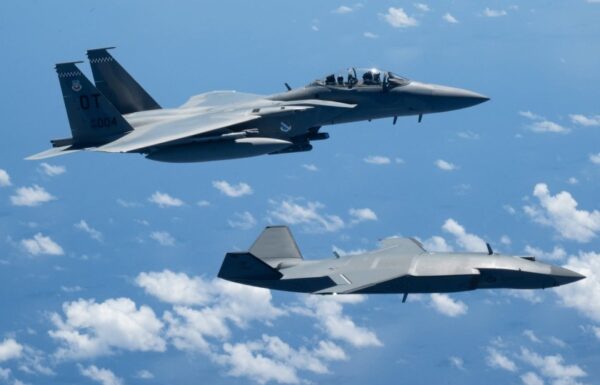
















On Thursday, February 12, 2026, the American company General Atomics Aeronautical Systems Inc. (GA-ASI) announced that it had conducted the first semi-autonomous flight of one of the YFQ-42A combat unmanned aircraft prototypes under the Collaborative Combat Aircraft (CCA) Increment 1 program for the United States Air Force (USAF).
 Photo: GA-ASI
During the flight test conducted earlier this month, mission autonomy software provided by Collins Aerospace (a subsidiary of RTX) was used to pilot one of the three YFQ-42A prototypes built to date.
The Sidekick Collaborative Mission Autonomy software was seamlessly integrated with the YFQ-42A flight control system using the Autonomy Government Reference Architecture (A-GRA). This integration enabled robust and reliable data exchange between the autonomy software and the aircraft’s mission systems, ensuring precise execution of mission autonomy commands.
During the latest tests, autonomy mode was activated via a ground control station (GCS). Once enabled, a human autonomy operator on the ground transmitted various commands directly to the YFQ-42A, which executed the instructions with high accuracy for more than four hours. The test highlights the effectiveness of Sidekick’s advanced mission autonomy capabilities and the flexibility of the A-GRA standard in supporting complex operational requirements.
“We are excited to collaborate with Collins to deliver enhanced autonomous mission solutions,” said David R. Alexander, president of GA-ASI. “The integration of Sidekick with our YFQ-42A demonstrates our commitment to innovation and operational excellence in unmanned aircraft technology.”
This achievement underscores General Atomics Aeronautical Systems Inc.’s commitment to advancing autonomous systems for defense applications. The integration of Sidekick autonomy software with the YFQ-42A’s mission systems, connected via the Autonomy Government Reference Architecture (A-GRA), sets new standards in combat system autonomy, mission flexibility, operator control, and system reliability.
“The autonomy capabilities showcased in this flight highlight our dedicated investment to advance collaborative mission autonomy,” said Ryan Bunge, vice president and general manager for Strategic Defense Solutions, Collins Aerospace, an RTX business. “The rapid integration of Sidekick onto this General Atomics platform and its immediate ability to support a broad spectrum of combat-relevant behaviors underscores the strength and flexibility of our open systems approach.”
This first autonomous mission flight continues the YFQ-42A development timeline, which began on August 17, 2025, with the maiden flight of the first prototype (“Tail One”). In less than six months, General Atomics Aeronautical Systems Inc. (GA-ASI) built and flew two additional aircraft. GA-ASI is competing in the Collaborative Combat Aircraft (CCA) program against Anduril Industries and its YFQ-44A platform.
The CCA program is part of the broader Next Generation Air Dominance (NGAD) initiative. Long-term plans call for the acquisition of up to 200 sixth-generation NGAD multirole aircraft and at least 1,000 CCA unmanned systems. On March 21, 2025, it was announced that Boeing had been selected to build the crewed F-47 as the successor to the fifth-generation F-22 Raptor.
GA-ASI has been building and flying jet-powered unmanned aircraft for nearly two decades, beginning with the company-funded MQ-20 Avenger in 2008. Ongoing investments in the Avenger continue to yield results, as the aircraft routinely serves as a CCA surrogate for advanced autonomy development and testing in both government programs and company-funded research and development.
For example, in June 2025, a company-funded demonstrator version of the Avenger simultaneously hosted GA-ASI’s proprietary TacACE autonomy software and Shield AI’s Hivemind software during a single flight, with the MQ-20 seamlessly switching between AI pilots while airborne. Later, in November of the same year, GA-ASI—together with Lockheed Martin and L3Harris Technologies—conducted another demonstration, integrating the MQ-20 with an F-22 Raptor in an advanced manned-unmanned teaming mission that allowed the fighter pilot to command the Avenger as an autonomous CCA surrogate via a tablet in the cockpit.
On February 29, 2024, GA-ASI flew the jet-powered XQ-67A under the Off-Board Sensing Station (OBSS) program, developed in cooperation with the Air Force Research Laboratory (AFRL). This early CCA prototype validated the concept initiated by AFRL under the Low-Cost Attritable Aircraft Platform Sharing (LCAAPS) program, which focuses on building multiple aircraft variants from a shared core chassis.
The Gambit series envisions multiple variants (currently six) built on this common core concept. The XQ-67A has already integrated sensors, while the YFQ-42A is intended for air-to-air combat missions. By leveraging this innovative production approach, GA-ASI can rapidly adapt to diverse mission requirements with lower time and cost burdens than developing a single highly specialized aircraft.
GA-ASI integrates 3rd-party mission autonomy into YFQ-42A Collaborative Combat Aircraft to conduct first semi-autonomous airborne mission.
Read the news: https://t.co/vr4gJUyCuc#YFQ42A #UCAV pic.twitter.com/zqkkF80iHI
— General Atomics Aeronautical Systems, Inc (GA-ASI) (@GenAtomics_ASI) February 12, 2026
See also: