

























On Tuesday, February 10, 2026, the Air Force Life Cycle Management Center (AFLCMC), part of the Air Force Materiel Command, acting on behalf of the United States Department of Defense, published a notice on the System for Award Management (SAM) platform announcing the start of negotiations with Boeing to resume serial production of GBU-57A/B Massive Ordnance Penetrator (MOP) penetrator bombs.
 Mock-up of the GBU-57A/B Massive Ordnance Penetrator inside the bomb bay simulator of a B-2A Spirit / Photo: United States Air Force
The contracting authority wants deliveries to begin by January 10, 2028. The justification for the selected procedure states that Boeing is the sole manufacturer, and selecting another supplier would cause unacceptable delays and weaken operational readiness. The procurement is intended to restore the full combat capability of strategic aviation under Air Force Global Strike Command (AFGSC) and ensure the ability to execute the United States Department of Defense’s strategic plans. The contract is expected to cover both All-Up-Round (AUR) bomb components and tail kits.
The decision to resume production and acquire a new batch is directly linked to the events of the night of June 21–22, 2025, when, during Operation Midnight Hammer, B-2A Spirit strategic bombers dropped 14 GBU-57A/B Massive Ordnance Penetrator bombs on nuclear targets in Iran, including 12 on the Shahid Ali Mohammadi Nuclear Facility in Fordow and two on the Shahid Ahmadi Roshan Nuclear Facility in Natanz. This marked the combat debut of the weapon, as earlier reports of its alleged use against pro-Iranian Houthi forces were not confirmed.
The value of the future contract is not publicly known and is difficult to estimate, as the unit cost of the GBU-57A/B MOP has never been disclosed. It is only known that the contract value will exceed 123 million USD. Procurement plans for these bombs were first outlined in August 2025.
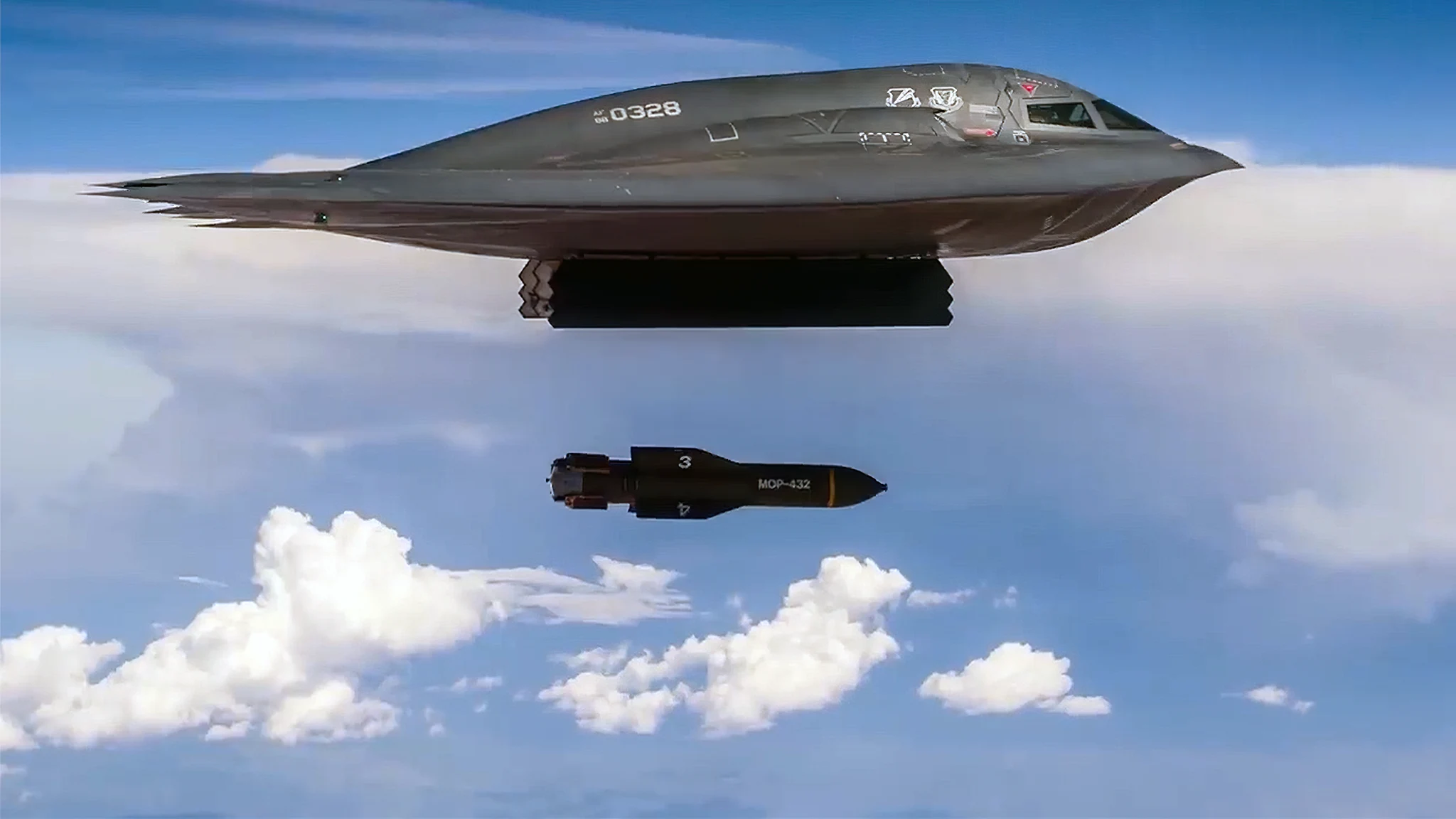 B-2A Spirit drops bomb during tests / Photo: USAF
GBU-57A/B MOP
The GBU-57A/B Massive Ordnance Penetrator (MOP), commonly referred to as a “bunker buster,” is a U.S. deep-penetration bomb designed to destroy heavily fortified and deeply buried targets such as underground bunkers, nuclear facilities, and command centers. Work on the weapon began in the early 2000s in response to lessons learned during the 2003 Iraq War, when bombs such as the GBU-28 proved insufficient against deeply buried targets.
In 2002, Northrop Grumman and Lockheed Martin began work on a 30,000-pound-class bomb known as “Big BLU.” The project encountered difficulties but was revived in 2004 under the auspices of the Defense Threat Reduction Agency (DTRA). Initial tests were conducted in 2007 in a tunnel at White Sands Missile Range. Between 2008 and 2010, drop tests were carried out from the B-52H Stratofortress, while integration with the B-2A Spirit began in 2009. The bomb entered service in 2011. The program was funded by DTRA, and in 2009 Congress accelerated its development. In 2011, the unit cost was approximately 3.5 million USD. In 2012, 82 million USD was invested to enhance the bomb’s penetration capability. By 2015, at least 20 bombs had been produced; a fourth upgrade was completed in 2018, and additional units were ordered in 2019.
The GBU-57A/B MOP weighs approximately 12,304 kg (about 27,000 lb), measures 6.2 meters in length with a diameter of 0.8 meters, and carries a BLU-127 warhead weighing 2,423.5 kg. The explosive fill consists of 2,083 kg of AFX-757 and 340.5 kg of PBXN-114, a mixture of HMX and aluminum powder. The high-strength steel alloy casing accounts for roughly 80% of the bomb’s total weight. Guidance is provided via GPS (GNSS), supported by inertial navigation, achieving accuracy within a few meters. Grid fins ensure stabilization and trajectory correction. The weapon is fitted with a programmable Large Penetrator Smart Fuze (LPSF) featuring time-delay and void-sensing functions. The MOP is capable of penetrating up to 61 meters of 34 MPa concrete, up to 8 meters of 69 MPa concrete, or 40–100 meters of solid rock.
The only certified carrier is the B-2A Spirit strategic bomber, which can carry two bombs simultaneously, although the weapon was also tested on the B-52H Stratofortress. In the future, the B-21 Raider is expected to assume the role of carrier.
The GBU-57A/B MOP is the most powerful conventional penetrator in the U.S. arsenal and is critical for holding deeply buried strategic targets at risk. It is often confused with the GBU-43/B Massive Ordnance Air Blast (MOAB), which is designed for surface targets. The MOAB measures 9,190 mm in length, 1,028 mm in diameter, and weighs 9,850 kg, including an 8,482 kg H-6 warhead filled with tritonal (80% TNT and 20% powdered aluminum), with a blast yield equivalent to approximately 11 tons of TNT. The GBU-43/B was first used on April 13, 2017, in Achin District, Nangarhar Province, eastern Afghanistan.
UPDATE
On Tuesday, February 24 of this year, the Attack Division of the Armament Directorate at Eglin Air Force Base, acting on behalf of the United States Department of Defense, awarded a 61,548,900 USD contract to Boeing for this effort.
The contract covers Wing Drop Ship Kits, KMU-612E/B tail guidance kits, GBU-57G/B fuze wiring, separation nuts, and bomb transport containers. Work will be performed in St. Louis, Missouri, and is scheduled for completion between September 2028 and May 2030. Full funding was obligated at the time of contract award.