



























On Monday, April 20, 2026, Secretary of the U.S. Air Force Dr. Troy E. Meink announced on social media that Fairchild Republic A-10C Thunderbolt II close air support attack aircraft will remain in service longer than planned, until 2030.
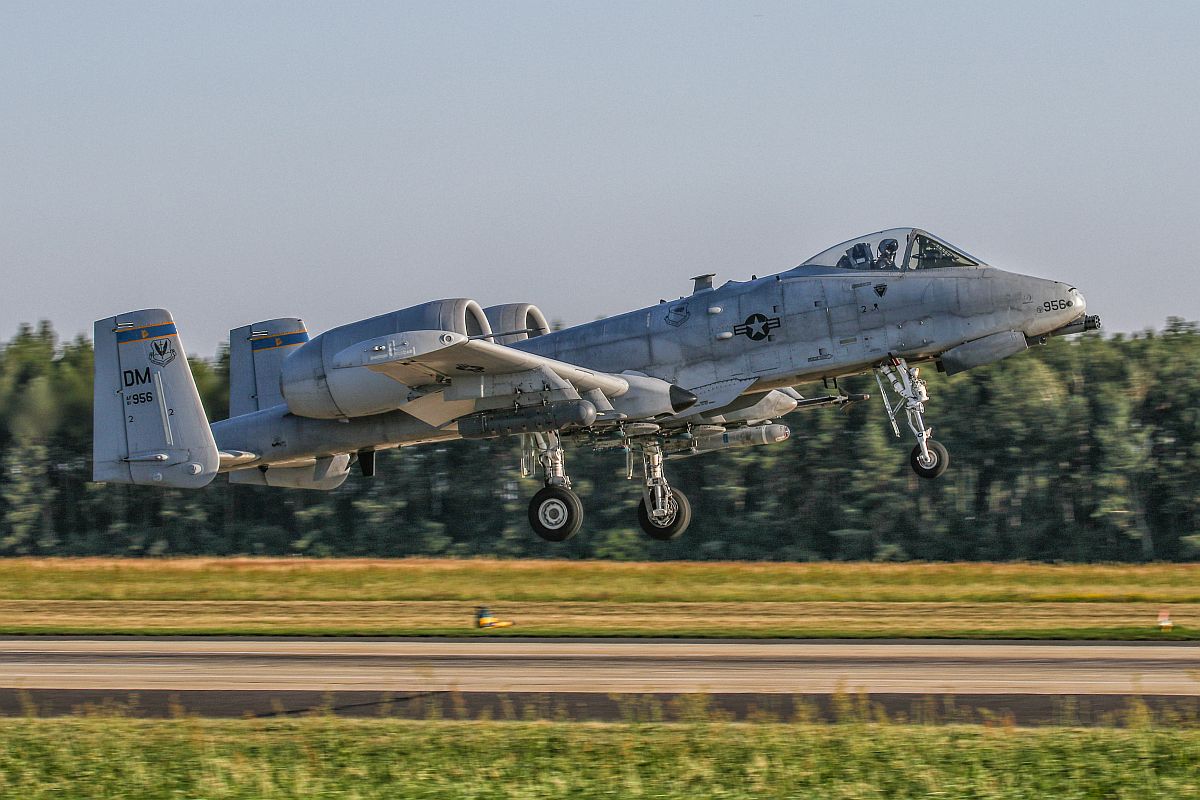 Photo: Michał Adamowski, MILMAG
As he stated, the decision was supposedly made by the Department of Defense, although in reality Congress blocked the USAF’s request in the draft National Defense Authorization Act (NDAA) for fiscal year 2026, which called for the complete retirement of the fleet. Lawmakers demanded that the military keep at least 103 aircraft in service.
According to reports from specialist media outlets (The Aviationist), two squadrons equipped with A-10C aircraft will be retained until 2030, while one will be disbanded a year earlier. According to Aviation Week, these will be one active-duty squadron at Moody Air Force Base in Georgia and one reserve squadron at Whiteman Air Force Base in Missouri, both until 2030, while the second squadron from Moody will operate until 2029.
Under the previous administration, when the Department of Defense was headed by Lloyd Austin, it was proposed in 2025 to retire 56 aircraft and the entire fleet by 2029.
It is worth noting that in 2019 the A-10 Enhanced Wing Assembly program was completed, involving the replacement of the wings on 173 of the 281 aircraft then in service in order to extend their service life – theoretically even into the 2040s. However, on April 10 this year, it was reported that a week earlier the last group of pilots from the USAF’s 357th Fighter Squadron at Davis-Monthan Air Force Base in Arizona had completed A-10C training.
In previous years, Ukraine sought a donation of the aircraft (former Defense Minister Oleksii Reznikov asked the U.S. side in late 2022 for 100 of these aircraft to support the defensive war against Russia, but it was concluded that A-10Cs would not be useful to Ukraine without achieving air superiority), while the U.S. wanted to offer them to Jordan (in 2003, Colombia was interested in leasing 18 aircraft).
Meanwhile, A-10Cs took part in the U.S. and Israeli war with Iran. As part of Operation Epic Fury, they mainly attacked positions of pro-Iranian Shiite militias in Syria and Iraq. However, one of the aircraft was fired upon by Iranian forces over the Persian Gulf, but the pilot managed to fly it to Kuwait, where he ultimately ejected.
In early April this year, tests were also reported of an adapter for a new probe for aerial refueling from a flexible fuel hose, as A-10Cs are currently dependent on the KC-135 Stratotanker’s rigid boom.
Introduced into USAF service in 1976 as the successor to the A-1 Skyraider, the A-10 is the only aircraft providing close air support for ground units in the U.S. Armed Forces. In 2015, a plan was presented to develop a successor under the A-X program. The A-10C was to be supplemented – and, in a sense, bridged – by a new light attack aircraft developed under the Light Attack/Armed Reconnaissance (LAAR) program, under which three AT-6E Wolverine and three A-29 Super Tucano aircraft were ordered for testing in 2020.
In consultation with @SecWar, we will EXTEND the A-10 “Warthog” platform to 2030. This preserves combat power as the Defense Industrial Base works to increase combat aircraft production.
Thank you to @POTUS for your unwavering support of our warfighters and quick, decisive… pic.twitter.com/zn1l3OshdY
— Office of the Secretary of the Air Force (@SecAFOfficial) April 20, 2026
