









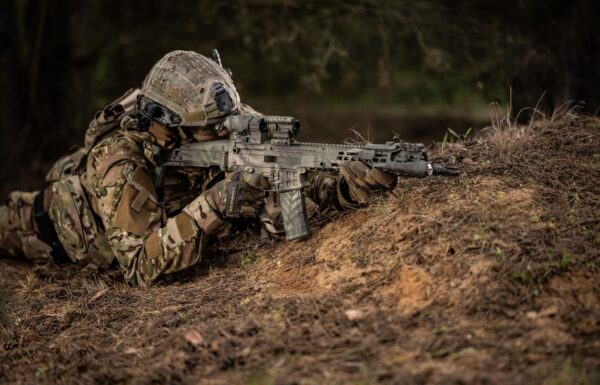












Force Protection is a solution based on the FlyEye UAV and X-Fronter, designed to enhance the protection of troops and critical infrastructure. It is worth mentioning here WB Group’s latest product, which debuted a few weeks ago at the POLSECURE 2026 trade fair: the newest micro-class UAV, the X-Fronter H (WB Group to supply the Polish Armed Forces with additional unmanned systems under the SAFE program).
 X-Fronter H is a micro-UAV built in a quadcopter configuration
X-Fronter H is a micro-class unmanned aerial system designed for short-range aerial imagery reconnaissance. The design reflects the growing demand among armed forces and uniformed services for small, easy-to-use observation platforms that can be deployed almost immediately in the field and provide reconnaissance both by day and at night. Carried by a single soldier, the system is intended primarily for target identification and reconnaissance, battle damage assessment, force protection, and support for operational and information activities.
X-Fronter H belongs to the micro-UAV category, meaning unmanned aircraft with low weight and compact dimensions. According to the specifications presented, its maximum takeoff weight, or MTOW, is 2.5 kg, its flight endurance is around 30 minutes, and its minimum communications range is specified at 1,000 m. The UAV, built in a classic quadcopter configuration, can reach a maximum speed of 50 km/h, is powered by a replaceable battery, and is hand-launched. These parameters indicate a system intended for direct operations at the level of small subunits, where mobility, rapid preparation for use, and the ability to conduct observation without any launch infrastructure are crucial.
 WB Group’s Force Protection system includes FlyEye and X-Fronter UAVs
The most important task of the X-Fronter H is imagery reconnaissance. The quadcopter is designed to conduct observation in the visible spectrum and in infrared, enabling it to be used both by day and at night, as well as in various weather conditions. The observation payload includes an electro-optical EO camera and an IR camera. The EO camera is to offer 10x zoom, while the IR thermal imaging camera has been described as a fixed-focal-length device. This allows the pilot to conduct conventional daytime observation and, after dark or in conditions of limited visibility, use the thermal imaging channel.
 X-Fronter H observation payload
An important element of the system is its set of operating modes and automatic functions. These include automatic flight to a designated point, including Return to Home, or RTH, route-following flight with the option to modify the route during the mission, manual control mode, orbiting around a designated object or point, and automatic tracking of the observed object in the frame. From the operator’s perspective, this means being able to focus fully on the mission, as control of the unmanned aircraft is automated to a large extent.
A notable feature is the navigation system, which allows the UAV to operate without support from satellite positioning, such as GNSS or GPS. On the modern battlefield, where satellite signal jamming has become widespread, the ability to operate without conventional GNSS positioning is highly significant. This is complemented by Return to Home mode, meaning automatic return in the event of loss of radio communication, as well as the ability to fly autonomously along a designated route without communication with the base station. Such functions increase the chances of completing the mission or recovering the platform in the event of jamming, loss of transmission, or temporary loss of control over the aircraft.
The X-Fronter H system consists of the air platform itself, the observation payload, a command-and-control console, a power supply system, and an optional tethered power station. The console is a ruggedized tablet with a controller, making it a mobile and easy-to-use solution. The power supply system includes replaceable batteries and a charging station. An additional option is flight using a tethered power station. This mode may be useful during prolonged observation of a selected area, when maneuvering is not the priority, but rather keeping the sensor airborne for an extended period. This is particularly useful for protecting friendly installations, such as Wisła or Narew system batteries.
 Control console / Photos: Jakub Link-Lenczowski, MILMAG
WB Group emphasizes that X-Fronter is based on its own proprietary solutions. The UAV’s main components are to be based on technologies developed and manufactured within the Group. As with the larger FlyEye UAVs, it uses WB Group’s own secure radio communication system, designed to be difficult to jam. X-Fronter can operate within the broader UAV ecosystem. It provides data that can be processed by the TOPAZ system and used by other networked, compatible reconnaissance or combat assets, such as Warmate loitering munitions or Gladius.
According to WB Group, the observation payload has also been developed and is manufactured within the company. The same applies to the control software. This is intended to ensure full control over the supply chain, production stability, and secure operation. The manufacturer also points to local technical and service support, including warranty and post-warranty servicing without intermediaries. In practice, this may shorten maintenance times, facilitate modernization, and reduce the user’s dependence on foreign suppliers.
X-Fronter H is the latest micro-UAV presented as part of this system. A lightweight observation quadcopter of conventional design, it is intended for rapid use by small teams. Its key features include low weight, hand launch, EO/IR observation, day and night operation, autonomous functions, resistance to jamming and interception, and the ability to operate without GNSS. Undoubtedly, one of its most important distinguishing features is its proprietary, secure radio communication system with very high resistance to jamming. Moreover, these are not merely marketing claims. WB Group systems have been in service in Ukraine since 2015, where Russian electronic warfare systems have repeatedly attempted to disrupt their operation. Despite the use of modern, high-power EW systems, Polish UAVs have continued to carry out their assigned tasks, both by providing reconnaissance data and by destroying designated targets.
See also: