

























On Friday, August 21, 2026, the Swedish Air Force (Svenska flygvapnet) announced on social media that, together with the Swedish Defence Materiel Administration FMV (Försvarets materielverk) under the Ministry of Defence, it had conducted the first flight test of a Taurus KEPD 350 cruise missile launched from a Saab JAS 39C Gripen multirole combat aircraft.
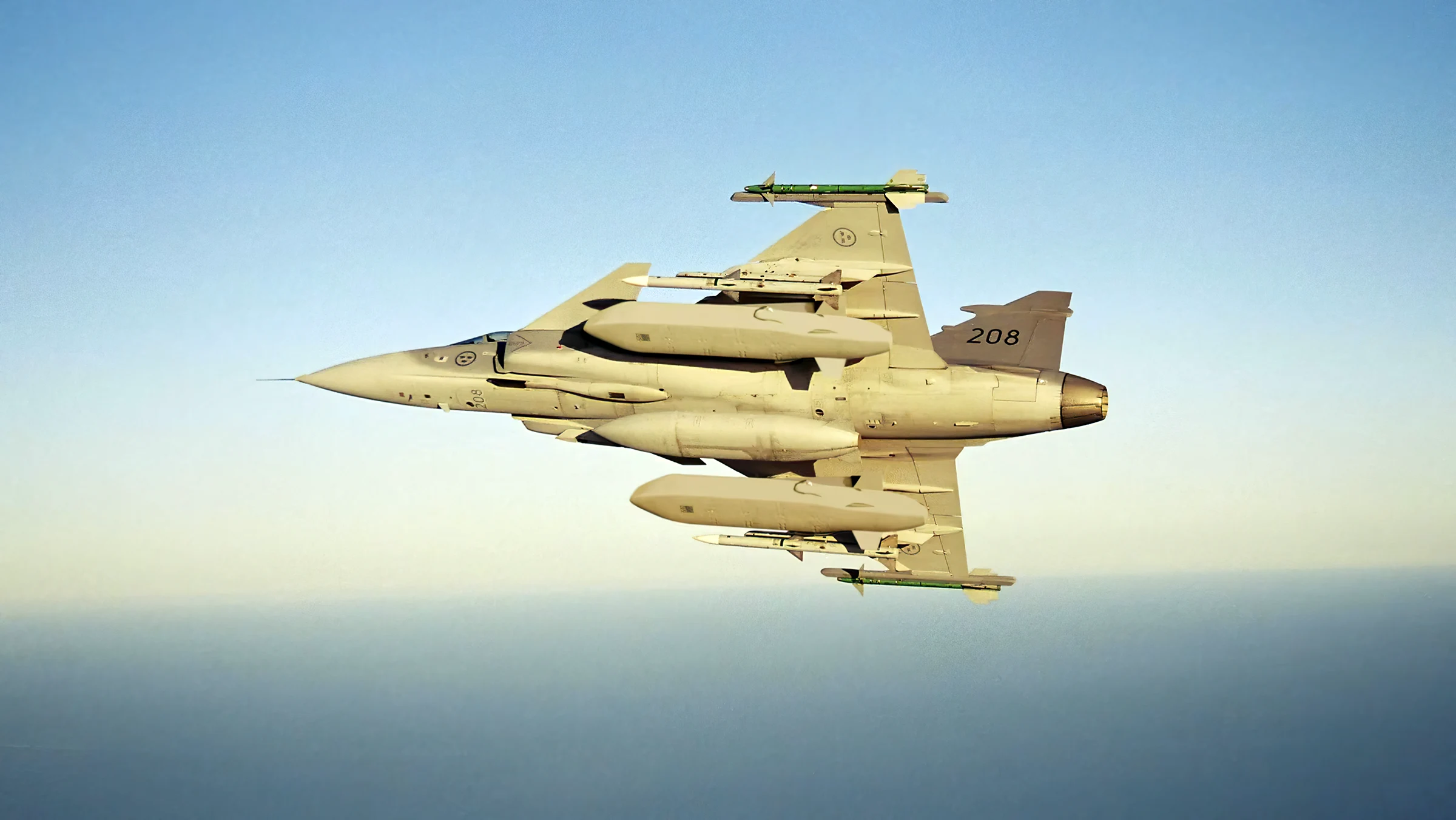 Undated photograph from earlier integration tests: two Taurus KEPD 350 missiles carried by a Swedish Gripen, together with AIM-9 Sidewinder and AIM-120 AMRAAM missiles and an external fuel tank / Photo: Saab Defence and Security
The test was conducted at the FMV Vidsel test range in the Norrbotten region of northern Sweden. A video recording was attached to the announcement.
Reports of Sweden’s plans to procure these missiles first emerged on February 24, 2025, based on a Swedish Air Force planning document. The original target for achieving Initial Operational Capability (IOC) was set for 2028 for the currently operated JAS 39C/D Gripen in the MS20 Block 4 configuration, while future integration with the JAS 39E Gripen is planned under the MS23 configuration. However, on December 22, 2025, Swedish Air Force Commander Maj. Gen. Olof Jonas Wikman said in an interview with Defense News that the integration effort had been reorganized and the schedule accelerated, although the exact date was not disclosed due to the sensitive nature of the program.
It is worth noting that on November 4, 2025, FMV signed a contract worth approximately 1 billion SEK with domestic company Saab Defence and Security for serial deliveries of new UML (Universal Missile Rail Launcher) universal weapon rails for Gripen aircraft, both C/D and E variants.
The UML weapon rails will be mounted on underwing and underfuselage hardpoints and, thanks to advanced mechanical and electronic interfaces, will enable the integration of current and future aircraft armament, including missiles, bombs, flares and chaff (Development of IRIS-T Block II missiles for four countries).
The JAS 39C/D will remain in service into the 2030s alongside their successors, the JAS 39E Gripen. On January 17, 2013, Sweden ordered a total of 60 single-seat JAS 39Es, with an option dated March 3, 2014, for 10 additional aircraft, to replace the single-seat JAS 39C and two-seat JAS 39D, of which 71 remain in service out of 204 originally acquired. Deliveries began on October 20, 2025. In the future, all of them are to be replaced by next-generation manned and/or unmanned combat aircraft developed under the KFS (Konceptprogram Framtida Stridsflygsystem) program, codenamed Vägval.
Taurus KEPD 350
The Taurus KEPD 350 (Target Adaptive Unitary and dispenser Robotic Ubiquity System – Kinetic Energy Penetration Destroyer) low-observable cruise missile was developed by the Taurus Systems joint venture formed by LFK-Lenkflugkörpersysteme, now MBDA Deutschland, and Bofors Missiles, now Saab Bofors Dynamics, part of Saab Defence and Security.
The missile is 5.1 m long and 1.015 m in diameter, with a fuselage 0.63 m wide and 0.32 m high, a wingspan of 2.065 m and a launch weight of 1,400 kg. It is powered by a Williams F121-WR-115 turbofan engine generating 6.67 kN of thrust, providing a range of more than 500 km, a minimum flight altitude of 30–40 m and a speed of Mach 0.6–0.95.
It is armed with a two-stage tandem MEPHISTO (Multi-Effect Penetrator, HIgh Sophisticated and Target Optimised) warhead weighing 481 kg, with a precursor charge designed to penetrate the target wall and a main charge detonating inside, as well as a programmable PIMPF intelligent multipurpose fuze using SHAFT (Smart Hard target Attack Fuzing Technology).
The missile uses a combined Tre-Tec navigation system consisting of dead-reckoning navigation, 12-channel GPS satellite navigation, a radar altimeter and the TERPROM electro-optical image-matching system, which compares satellite images stored in the missile computer with the actual image of the target. The sensor is based on indium antimonide and operates in the 3–5 µm band. Accuracy is approximately 3 m.
The first user was Germany, which acquired 600 missiles for 570 million EUR, with deliveries between 2005 and 2010. Germany has also planned to procure the Taurus Neo, although the current status of that program is unclear. The missile was also exported to South Korea in the Taurus KEPD 350K variant equipped with Rockwell Collins SAASM-enabled GPS navigation, with 280 missiles acquired, and to Spain, which purchased 43 missiles. Turkey has also expressed interest. A smaller Taurus KEPD 350MR variant, also known as KEPD 350K-2, was developed with its range reduced to 300 km.
Ukraine unsuccessfully requested donations of the missiles from Germany, although Friedrich Merz’s current government has made any such transfer dependent on the position of its allies. It is worth noting that integration with Swedish Gripens would remove the technical obstacle to such deliveries, leaving only the political barrier, as Ukraine is set to become an operator of 16 used JAS 39C/D aircraft donated by Sweden, with deliveries beginning next year, followed later by 16 new JAS 39E.
🇸🇪 TAURUS LAUNCH
Today a TAURUS KEPD 350 cruise missile was launched from a Swedish JAS 39 Gripen for the first time. The test was conducted at the Vidsel Test Range in Norrbotten.
Today TAURUS is a long-range cruise missile that introduces a new deep-strike capability.
📷 FMV pic.twitter.com/vYcL75Lu4p— Flygvapnet (@flygvapnet) August 21, 2026
