



















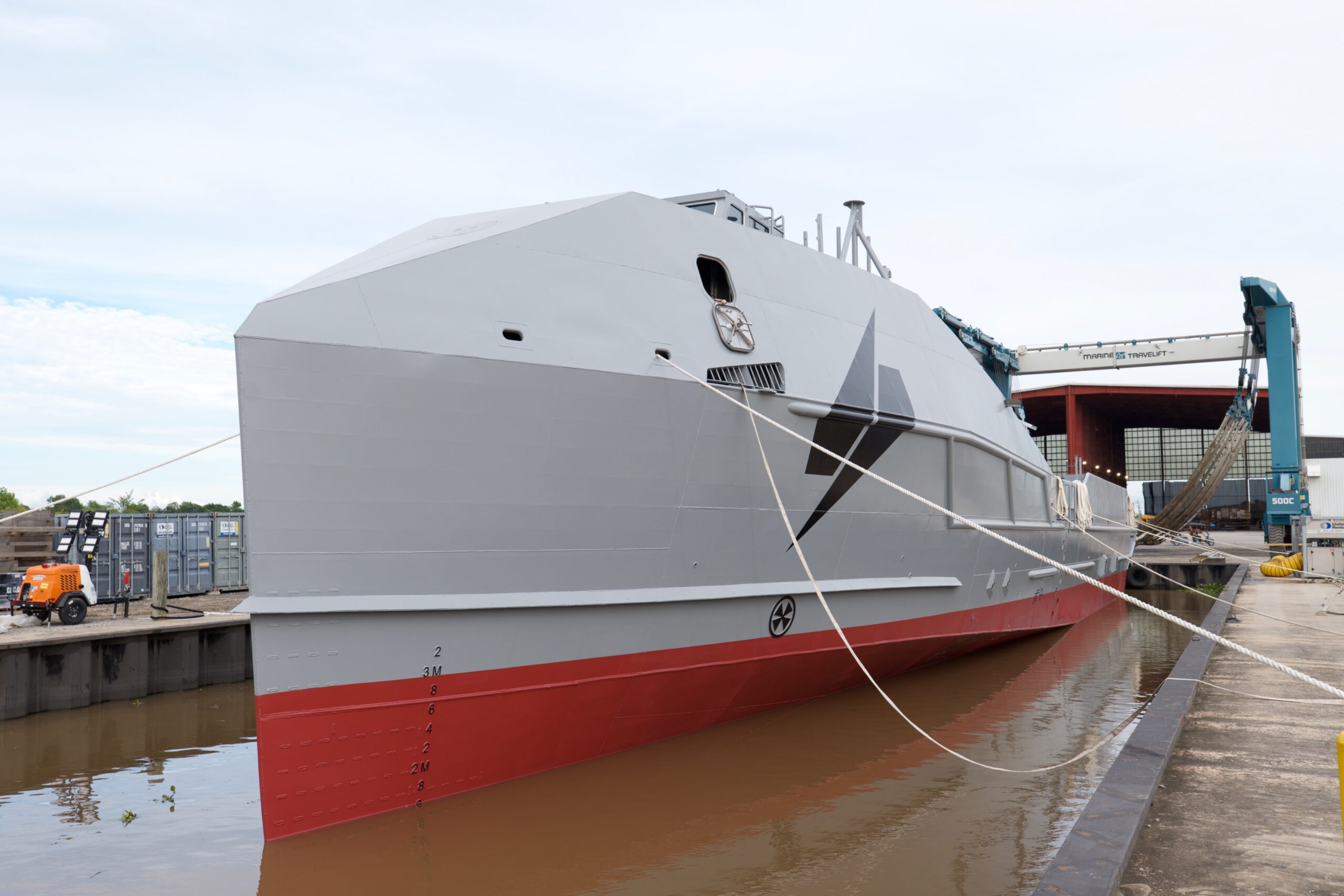
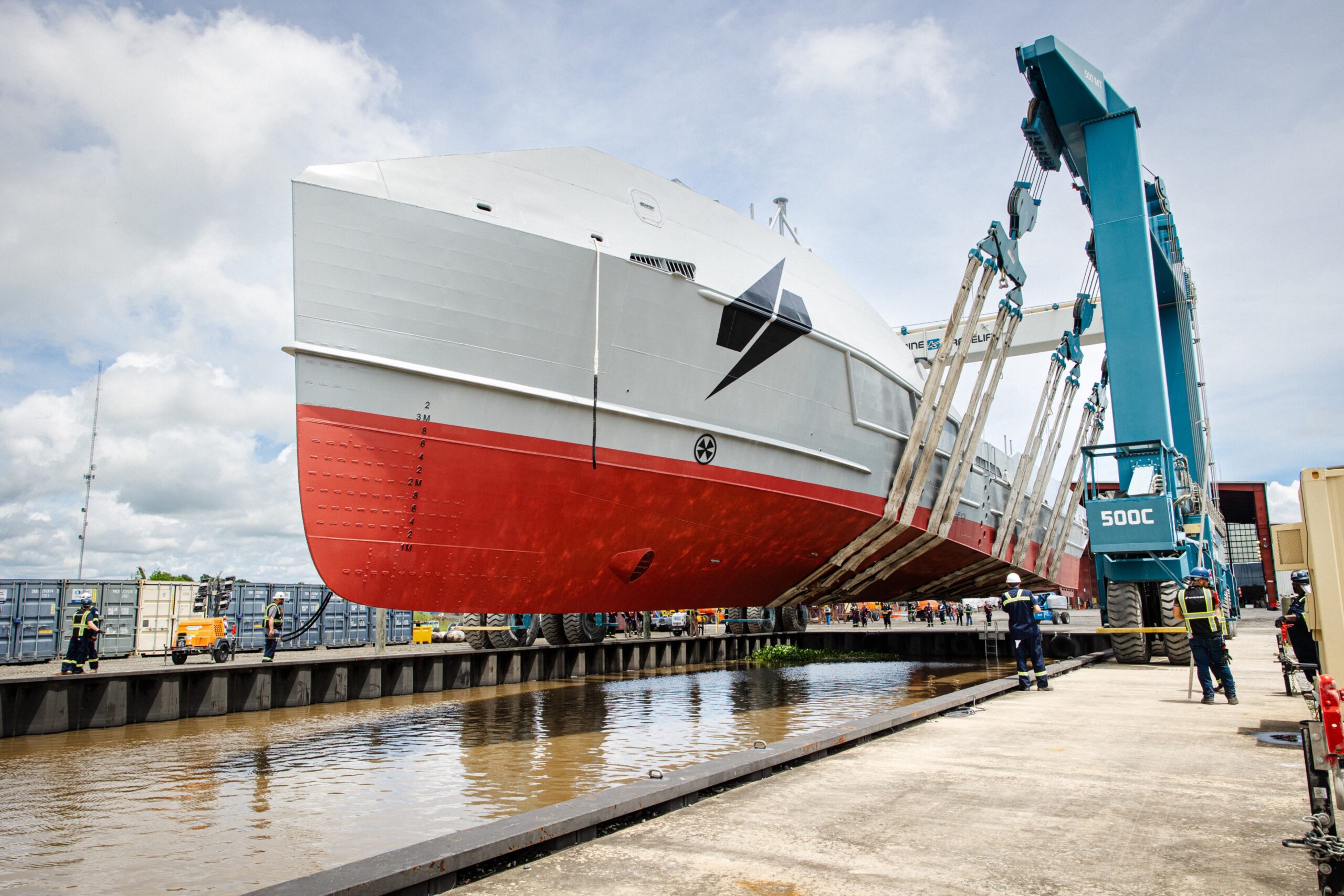
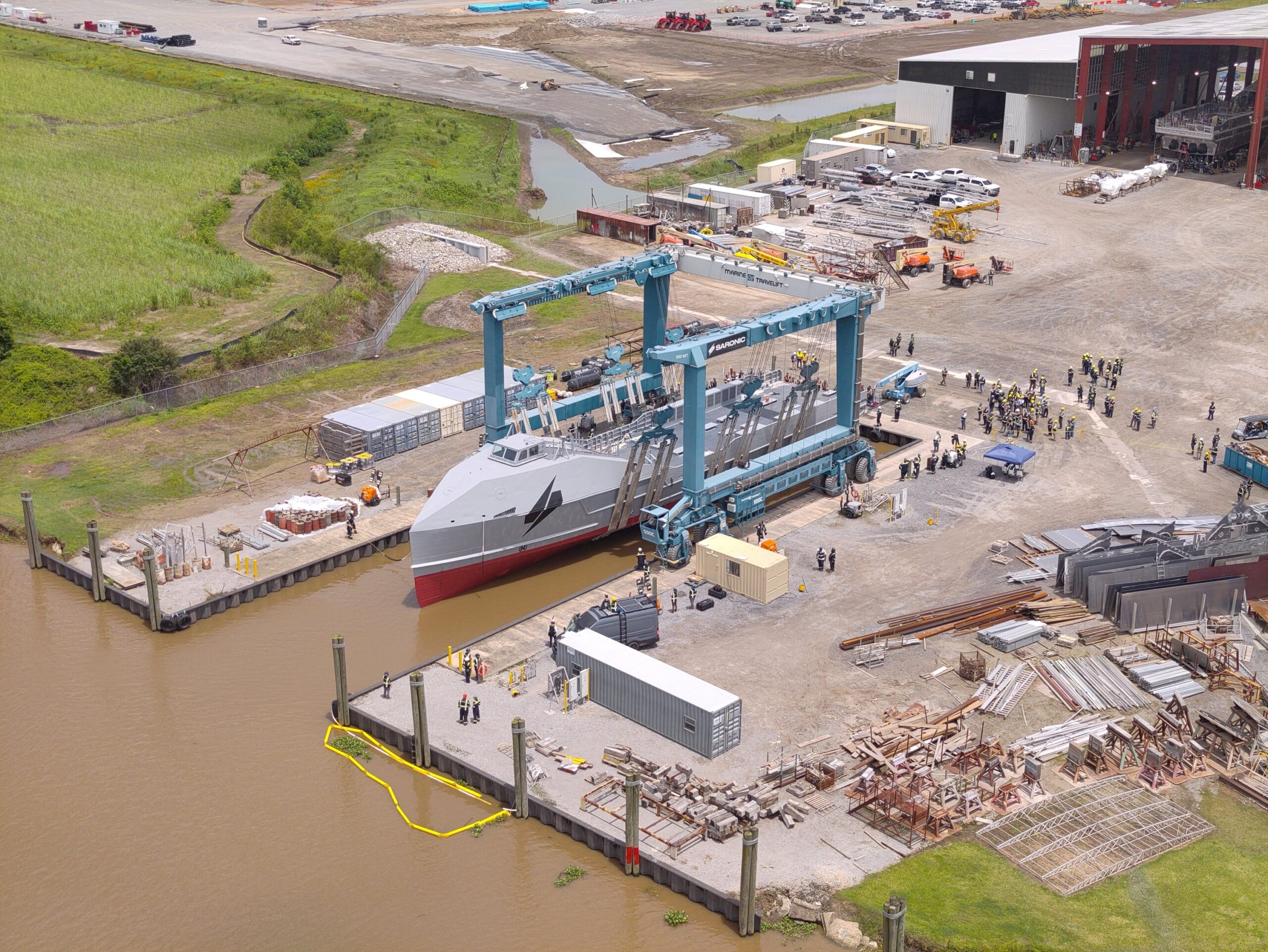
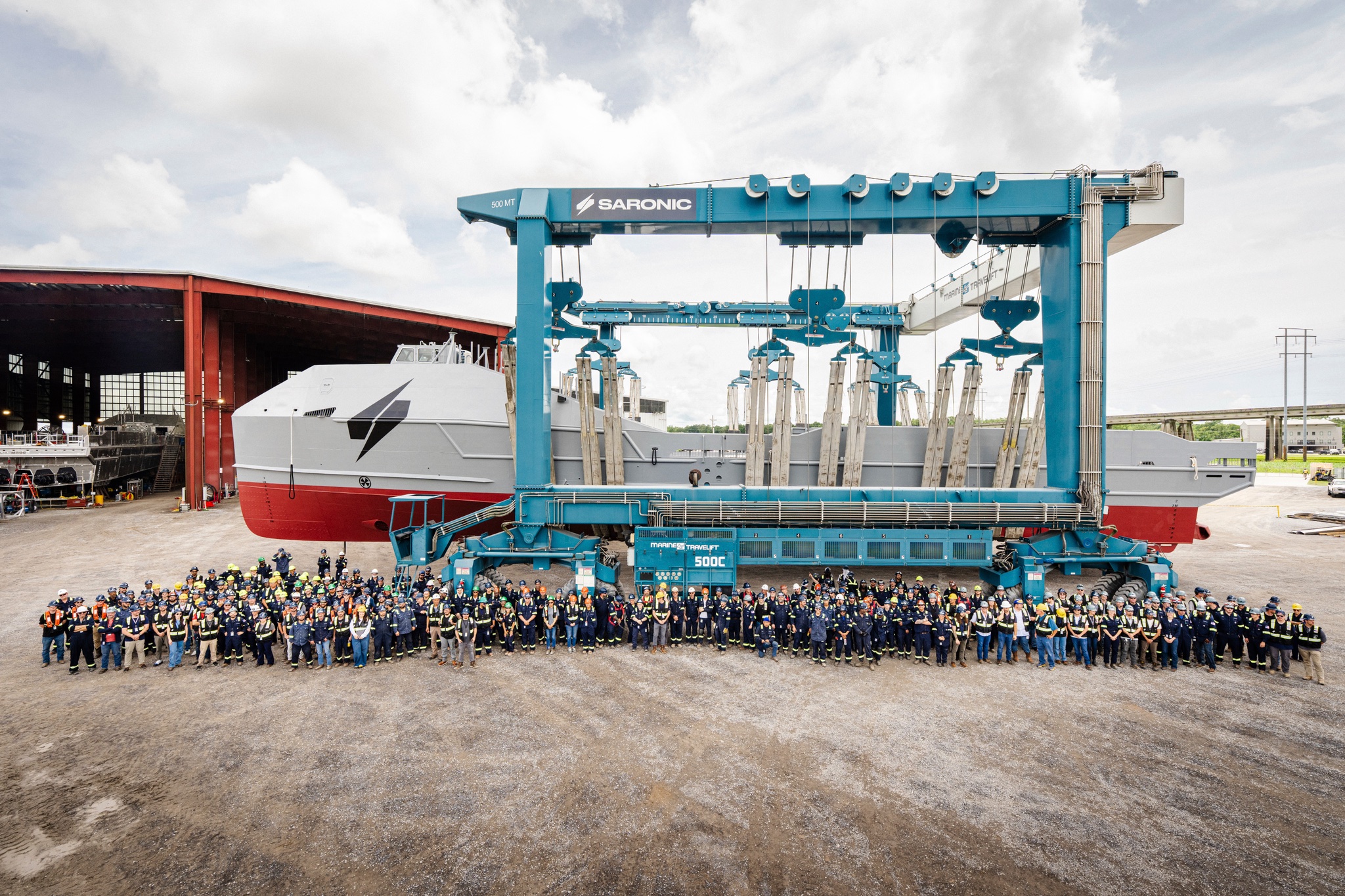
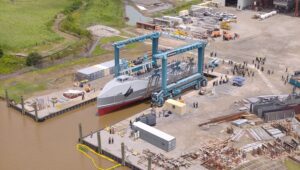
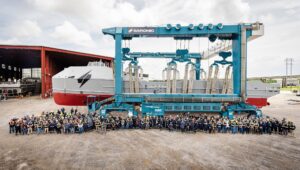
On Friday, May 29, 2026, US company Saronic Technologies announced that it had launched Marauder, a self-funded prototype medium unmanned surface vessel (MUSV), at its shipyard in Franklin, Louisiana.
Photos: Saronic Technologies
The 54.86 m, or 180 ft, Marauder was designed to provide autonomous offshore operational capability across the full range of military and commercial applications. The first Marauder hull went from preliminary design to water trials in less than a year, a pace unseen in the US shipbuilding industry since World War II, confirming both the validity of Saronic’s development approach and the integrated production model on which it was built.
„I’m incredibly proud of our team for achieving this milestone. Designing, building, and launching an entire new class of ships in under a year is a feat the American shipbuilding industry hasn’t seen in generations,” said Dino Mavrookas, Co-Founder and CEO of Saronic. „It’s what happens when design, production, and manufacturing are fully integrated under one roof. With multiple hulls already underway and our shipyard continuing to grow, this is what revitalizing American shipbuilding actually looks like — autonomous ships delivered at speed and scale, with the production capacity to back it up.”
Marauder: MUSV for the future of maritime and commercial operations
Marauder was designed for long-duration, long-range missions that place the greatest demands on any maritime vessel and pose the greatest risk to any crew. Operating fully autonomously or under remote human supervision, Marauder was designed to operate offshore for extended periods without the added complications of supporting a full crew or putting one in harm’s way.
With a top speed of more than 25 knots and a range of up to 5,400 nautical miles, Marauder can rapidly reposition and conduct operations across vast ocean areas. Its 150-ton payload capacity, configurable to carry up to four 40 ft or eight 20 ft ISO containers, gives users the flexibility to tailor the mission profile to diverse needs, including logistics, research, maritime surveillance, persistent intelligence, surveillance, and reconnaissance (ISR), or other payloads, without modifying the platform itself. This modularity across different applications is critical to serving a broad customer base that needs a vessel capable of adapting to changing mission requirements.
Marauder addresses a key challenge: providing persistent, autonomous capability at scale, on a timeline that enables real fleet integration. With planned production capacity expansions scheduled for completion by the end of 2026, Saronic’s Franklin shipyard will be able to produce up to 20 Marauders per year. It is this production pace that moves autonomous vessels from the prototype stage to the program stage.
It is worth adding that Saronic Technologies already has a major contract from late 2025 with the US Navy worth approximately 392 million USD, but it mainly concerns smaller, 24-meter Corsair-type vessels. Marauder vessels are being built ahead of time, in anticipation of future orders.
Saronic Technologies was founded in September 2022 by, among others, Dino Mavrookas, a former US Navy SEAL operator from 2004 to 2015, who spent the last five years of his service in SEAL Team Six, with backing from investors from Vista Equity Partners. In just over three years, the company has grown to around 1,000 employees across six locations in the United States and two international offices, in Australia and the United Kingdom.
The company has announced Port Alpha, a 5 billion USD investment aimed at building the world’s largest and most advanced shipyard. According to its highly ambitious plans, its goal is to produce the displacement equivalent of 10 million gross tons annually.
Designed, built, and launched in under a year – our dual-use Marauder MUSV is officially entering on-water trials and validating a new model for modern shipbuilding. 1/3 pic.twitter.com/xMgvsFwkOu
— Saronic (@Saronic) May 29, 2026
Read more here: https://t.co/TKXZLARkD5
— Saronic (@Saronic) May 29, 2026
See also:
