































On Wednesday, July 8, 2026, the General Staff of the Armed Forces of Ukraine said on social media that drone strikes had been carried out against two Russian oil refineries, six tankers, Borisoglebsk Air Base, and bridges used by the Armed Forces of the Russian Federation.
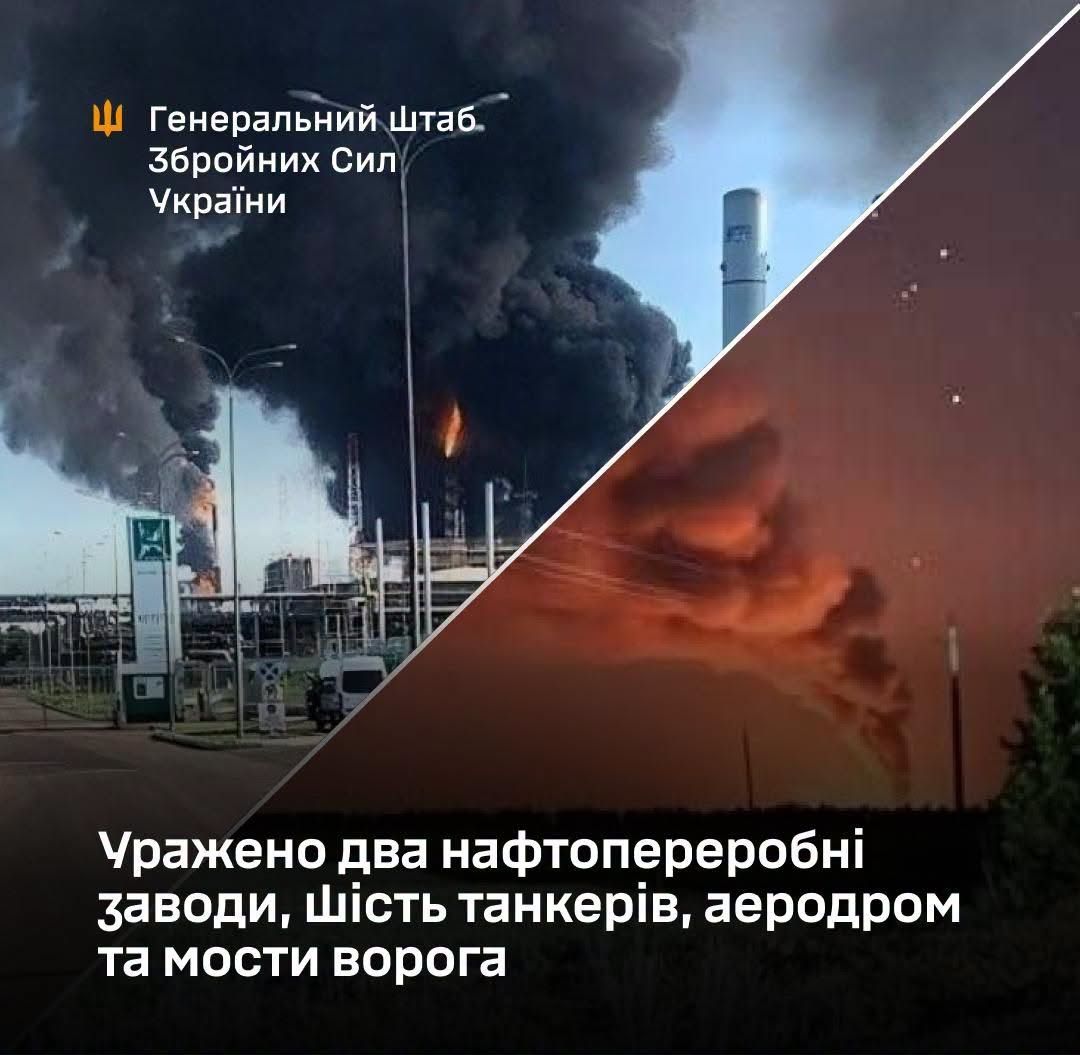 Photo: General Staff of the Armed Forces of Ukraine
On the night of July 7–8, as part of efforts to reduce the military and economic potential of the Russian aggressor, units of the Armed Forces of Ukraine struck the Saratov Oil Refinery in Saratov Oblast. Explosions and a fire were recorded at the facility. The extent of the damage is still being assessed.
The Saratov Oil Refinery is part of PAO Rosneft and is one of the key refining enterprises in the Volga region. Its designed production capacity is around 7 million tonnes of crude oil per year. The facility produces gasoline, diesel fuel, and aviation fuel, which are used in particular to sustain Russian military logistics (The United States Imposes Sanctions on the Russian Oil Sector).
The TAIF-NK oil refinery in Nizhnekamsk, in the Republic of Tatarstan, was also hit. Explosions and a fire were recorded at the facility. The extent of the damage is still being assessed.
TAIF-NK is one of the largest refining complexes in the Russian Federation, comprising a refinery, a crude oil rectification and distillation unit for gasoline production, and a deep conversion complex for heavy residues such as fuel oil. The refinery’s designed production capacity exceeds 7 million tonnes per year, and, taking all types of feedstock into account, more than 8 million tonnes. The facility’s products include diesel fuel, gasoline, aviation fuel, and other petroleum products used to support the Russian Federation’s economy and military logistics.
Six Shadow Fleet tankers were hit, one of them in the Black Sea and five in the Sea of Azov. These vessels were involved in logistics for the Russian Armed Forces, providing supplies to occupation forces operating in Ukraine’s southern regions. In total, over the past 72 hours, units of the Unmanned Systems Forces have attacked 21 Russian vessels: 19 tankers, one cargo ship, and one ferry in Kerch.
USF Operators Struck 9 Tankers of russia’s Shadow Fleet in the Sea of Azov Overnight
On the night of July 8, operators of the Kairos Battalion of the @414magyarbirds , the @Raid_413 , and the @1usc_army struck nine more tankers of russia’s shadow fleet in the Sea of Azov.
In… pic.twitter.com/kL8SsXwCcf
— 🇺🇦 Unmanned Systems Forces (@usf_army) July 8, 2026
n addition, Borisoglebsk Air Base in Voronezh Oblast, Russian Federation, was hit. The scale of the damage and the effects of the attack are currently being clarified. Before the full-scale war against Ukraine, the 160th Training Aviation Regiment was stationed there, and the base also hosts the 786th Aviation Training Center for Flight Personnel Training, equipped with Su-25 Grach attack aircraft, known in NATO reporting as Frogfoot, and Yak-130 combat trainers, known in NATO reporting as Mitten. After the outbreak of the full-scale conflict on February 24, 2022, training aviation was gradually moved out in favor of combat aircraft, including Su-34 frontline bombers, known in NATO reporting as Fullback, and Su-35S and Su-30SM multirole fighters, known as Flanker-E and Flanker-H, respectively. The base is located about 330 km from the front line.
In addition, yesterday, road bridges were struck in the areas of Urazovo and Shelayevo in Belgorod Oblast, Russian Federation. These facilities are used by the Russian military for logistics, including the transfer of personnel, weapons, ammunition, and materiel.
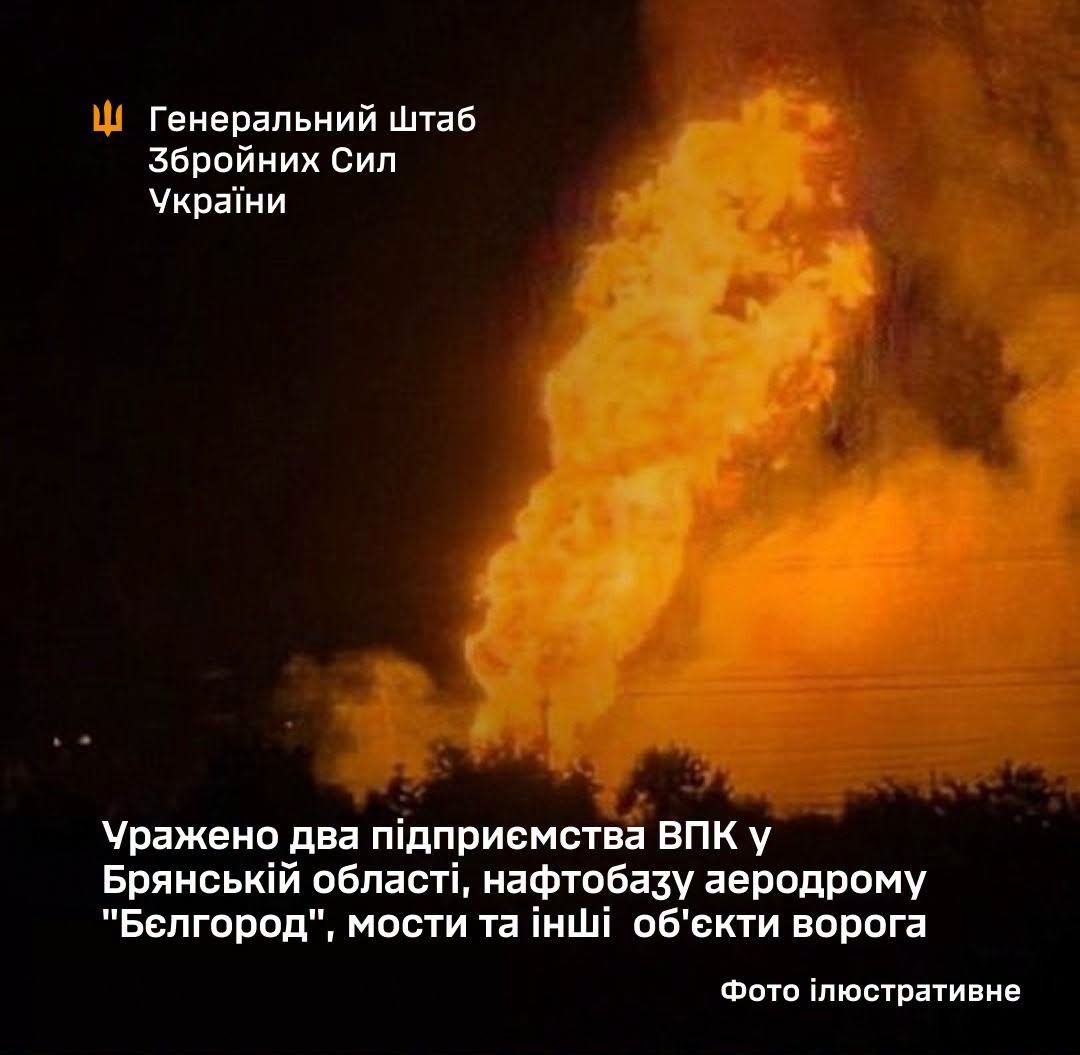
Yesterday, the General Staff of the Armed Forces of Ukraine reported strikes on two defense-industrial enterprises in Bryansk Oblast, a fuel depot at the airport in Belgorod, bridges, and other facilities.
On the night of July 6–7, the Kremniy EL plant in Bryansk was attacked. It is one of Russia’s largest manufacturers of integrated circuits, microprocessors, semiconductors, and precision electronics. The company, under US and EU sanctions since 2022, produces components for Russia’s military-industrial complex, including components for electronic units used in control, communications, electronic warfare, and complete weapons systems such as the Iskander-M and Pantsir-S1. The extent of the damage and the effects of the strike are currently being assessed by Ukrainian intelligence.
The Bryansk Chemical Plant in the city of Seltso, Bryansk Oblast, was also hit. Four explosions were recorded in the area of the facility. The consequences of the attack are still being clarified. The Bryansk Chemical Plant is an important element of Russia’s military-industrial complex. The enterprise produces gunpowder, explosives, and rocket fuel components used in the manufacture of ammunition and missiles.
Ukrainian forces also struck a fuel depot at the airport in Belgorod, and the scale of the damage is currently being assessed. Two railway bridges were also damaged near the settlements of Rozdolne and Ichki in the occupied Autonomous Republic of Crimea. These facilities are used by Russia for military logistics, including the transfer of personnel, weapons, and ammunition. Finally, Russian materiel warehouses were damaged near Volnovakha and Yasynuvata in the occupied part of Donetsk Oblast.
⚡️⚡️ Уражено два нафтопереробні заводи, шість танкерів, аеродром „Борисоглебск” та мости ворогаhttps://t.co/benRC0xW1z pic.twitter.com/klYM3v4sRo
— Генеральний штаб ЗСУ (@GeneralStaffUA) July 8, 2026
⚡️Уражено два підприємства ВПК у Брянській області, нафтобазу аеродрому „Бєлгород”, мости та інші об’єкти ворогаhttps://t.co/w9e1UHzxrX pic.twitter.com/sWheU9P05c
— Генеральний штаб ЗСУ (@GeneralStaffUA) July 7, 2026
