

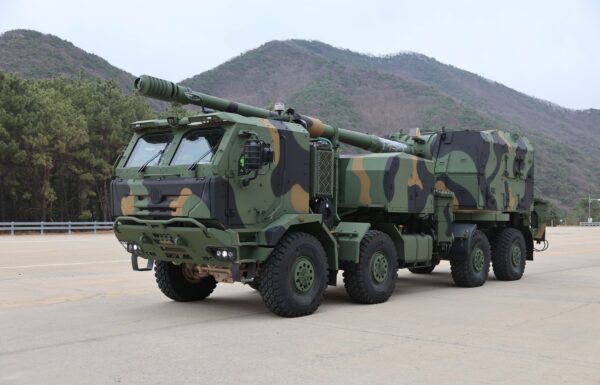

















During the BEDEX defense industry exhibition, held March 12–14 this year, the South Korean company Hanwha Aerospace presented the L-SAM ABM air defense system designed to counter ballistic missiles. A battery of the system consists of four six-cell launchers mounted on trailers, the L-SAM MFR multifunction radar, a C2 (Command and Control) center, and a battery command post. Representatives of Hanwha Aerospace emphasize that all technical solutions used in the system have been developed by the South Korean defense industry. As a result, there is no risk that a third country could block modernization efforts or export sales (Hanwha to Showcase Integrated Air and Missile Defense Capabilities at BEDEX 2026).
 L-SAM system launcher with six launch canisters
The system’s interceptor is a three-stage missile equipped with a hit-to-kill warhead. The first stage provides the initial acceleration, with the missile controlled at this stage by movable control surfaces. The second stage is powered by a pulse motor, and control is achieved through thrust vectoring. The stages are separated using pyrotechnic charges. The total length of the interceptor is 7 m, and during flight the missile reaches Mach 9.
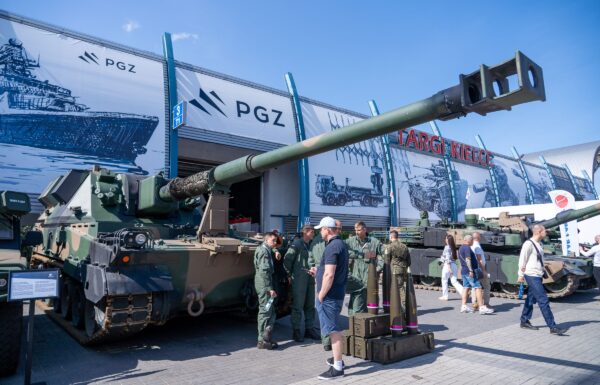
 L-SAM launcher and radar system with a model of the three-stage ballistic missile interceptor
The third stage also serves as the kill vehicle that strikes the target. It homes in on the heat emitted by the incoming enemy missile. The infrared sensor operates sequentially in search, target designation, and target tracking modes. For most of the flight, the sensor is covered by a protective nose cone forming the front section of the missile. At the appropriate moment, the nose cone is jettisoned, allowing the seeker head to freely search for or track the target. This solution protects the infrared sensor from damage. The final stage of the missile is equipped with an advanced control system using additional rocket thrusters. This allows the kill vehicle to maneuver precisely at altitudes where the atmosphere is thin.
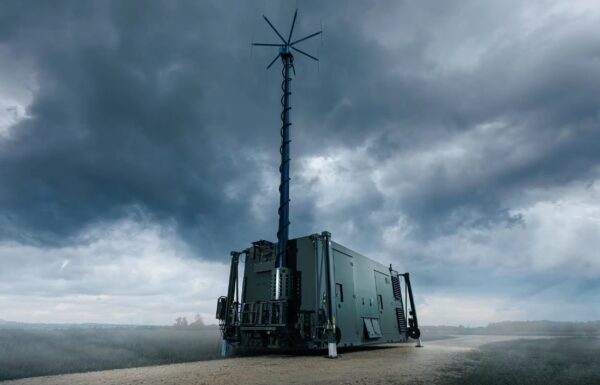
 Trailer-mounted L-SAM MFR AESA radar / Photos: Grzegorz Sobczak, MILMAG
The system component responsible for target search and designation is the L-SAM MFR radar. It is an AESA radar with a synthetic aperture, using sensors based on gallium nitride (GaN) technology. The radar operates in the S-band. Communication between system components is ensured through the Link-16 data link. In search mode, the radar covers ±45° in azimuth and from 3° to 85° in elevation. In tracking mode, these ranges increase to ±60° in azimuth and from 3° to 90° in elevation.
Representatives of Hanwha Aerospace state that the ranges of the missile stages and the operational range of the radar are currently classified. The system is expected to enter service with the Armed Forces of the Republic of Korea soon. According to the Korean manufacturer, the first battery will be delivered as early as 2028 (Hanwha Aerospace Secures Contract to Deliver the L-SAM Missile Defense System).
See also: