














On Monday, April 27, 2026, the Main Directorate of Intelligence of the Ministry of Defense of Ukraine (HUR MO) published a 3D model and details, along with a list of component suppliers, about Russia’s new S-71K Kover cruise missile on the War & Sanctions information website.
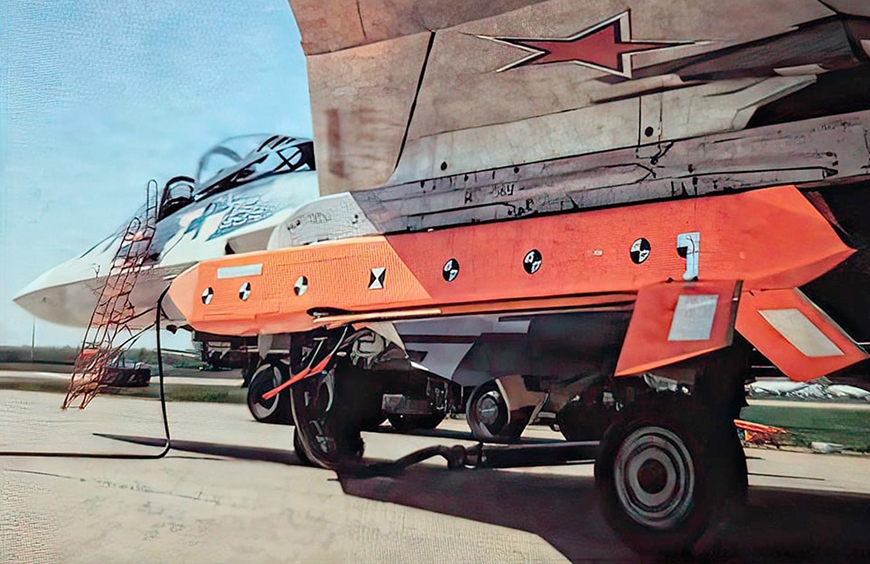 Photo: Russian Internet
It is a missile intended for Su-57 multirole aircraft (NATO reporting name: Felon), about which HUR MO published information on April 20 this year in the context of component suppliers and contractors involved in the development program.
According to analyses, the missile, approved for serial production at the Sukhoi Company in August 2024 by the Ministry of Defense of the Russian Federation, is expected to have a range of up to 300 km while carrying a 250-kilogram warhead – de facto an OFAB-250-270 high-explosive fragmentation aerial bomb. Importantly, foreign components are reportedly used in its production: American, Chinese, Swiss, Japanese, German, Taiwanese, and Irish, obtained in circumvention of sanctions as dual-use components.
Three prototypes of the system underwent testing from November 2024 at the research center in Akhtubinsk, Astrakhan Oblast, and at the end of last year it was used in combat operations against Ukraine. As a result, HUR MO specialists had access to wreckage in order to conduct analyses. According to them, the missile body is made of a multilayer composite material based on fiberglass with additional reinforcement, while the internal structural elements are made of aluminum alloys. The missile’s architecture is characterized by a reduced radar cross-section. The onboard control system includes a flight controller, an inertial navigation system based on basic sensors, and a power supply system.
Propulsion is provided by an R500 turbojet engine manufactured by Reynolds LLC, which, despite its Anglo-Saxon name, is a company within the structure of the United Aircraft Corporation (UAC), part of the state-owned Rostec holding. It is fed from the main fuel tank and two auxiliary tanks.
HUR MO believes that the missile will enter service with S-70 Okhotnik-B unmanned combat aerial vehicles, although since the missile was disclosed, no progress has been made in weapons integration beyond the concept itself.
According to earlier analyses, the design of the S-71K Kovyór blurs the line between a drone and a cruise missile — with distinctive swept wings of large span, twin-fin, all-moving tail control surfaces with negative sweep, advanced optical and navigation sensors, and onboard systems including automatic target recognition and artificial intelligence-based decision-making processes.
It is worth adding that a variant of a remotely controlled, autonomous unmanned system, designated S-71M Monokhrom, has also been developed. The first captive-carry flights with the Su-57 began in April 2024. While the S-71K Kovyór is carried on underwing hardpoints, the S-71M Monokhrom can also be carried in the internal weapons bay. It is also worth noting that both variants were developed under the enigmatic Unmanned Transport Module project.
This is another aviation weapons system developed in recent years and used in operations against Ukraine about which HUR MO is collecting information. These include the Izdeliye 30 (Product 30) and S8000 Banderol cruise missiles, as well as the Geran-5 combat drone.
❗War&Sanctions: DIU has published an interactive 3D model, along with information on the components and electronic parts of the enemy's new S-71K "kovyor" air-launched cruise missile.
🔗 https://t.co/LE3mnNcUu0 pic.twitter.com/NbEktBy9eX
— Defence Intelligence of Ukraine (@DI_Ukraine) April 27, 2026