





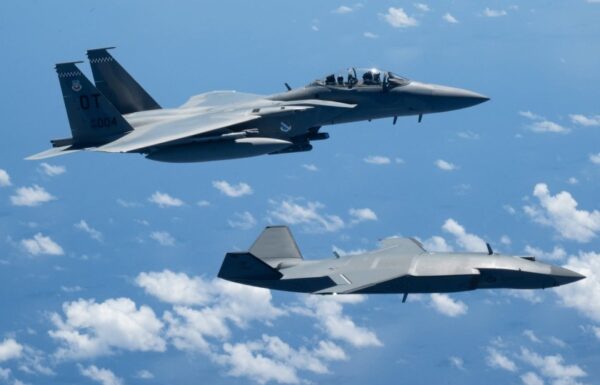








On Monday, March 2, 2026, the Main Intelligence Directorate of the Ministry of Defense of Ukraine (HUR MO) reported that, according to an analysis by its specialists, the recently recovered wreckage of a missile used in a massive drone-and-missile strike represents a new self-guided system carried by aircraft, designated Izdeliye 30 (Product 30).
 Image and photos: HUR MO
A detailed analysis of the design, components, and electronic component base has been published in the “Strike Assets” section of the War & Sanctions information portal. The site has previously featured analyses of other new weapons systems, including the Geran-5 combat UAV and the S8000 Banderol cruise missile.
According to the analysis of the debris, the missile contains components from both Russian and foreign entities. Based on markings and design features, its main manufacturer and integrator has been identified as OKB Zvezda, which is part of Tactical Missiles Corporation (KTRV), headquartered in Korolyov near Moscow.
The missile has a wingspan of 3 meters, carries a heavy 800 kg warhead, and is assessed to have an operational range of at least 1,500 km. Its first recorded combat use against a target on Ukrainian territory took place at the end of last year.
Photographs of the recovered wreckage:


The integration of these subsystems is carried out using an interface manufactured by Arzamas Research and Production Enterprise Temp-Avia, based in Arzamas in the Nizhny Novgorod region, a company known for producing flight control units for guided aerial bombs.
Another component, the standalone BUBS-30 warhead control unit, was built using Russian-made subsystems. Its key element is a 32-bit ARM 1986VE1AT microcontroller manufactured by AO PKK Milandr, headquartered in Zelenograd, Moscow region.

As mentioned, the Ukrainians also identified foreign-manufactured components — which is not the first such discovery in relation to Russian weapons systems:
- an eight-bit register 23121554IR22T from OAO Integral (Belarus);
- an RS-485/RS-422 transceiver (MAX3491ESD 2146+) from Maxim Integrated (part of Analog Devices; USA);
- an ISSI IS62WV102416BLL-25TLIDW0215Y1 2309 memory chip from Integrated Silicon Solution Inc. (USA);
- a 07 ALO16J70BF101 235BB441L THA 72188T memory chip from Spansion (USA);
- a 3N502PQSU clock multiplier from ON Semiconductor (USA);
- an RS-232 line driver/receiver ADM3202A #220 from Analog Devices (USA);
- a 32-bit binary counter DS1374C-33 2313A3 3CHW8A1 from Dallas Semiconductor (part of Maxim Integrated and Analog Devices; USA);
- a TSR 1-2433SM DC/DC converter from Traco Power (Switzerland);
- a TxDAC AD9753 #2424 digital-to-analog converter from Analog Devices (USA);
- an AD9253 BCPZ 105 no. 2505 6826438 PHIL analog-to-digital converter from Analog Devices (USA);
- an M10050-KB A0103A 09107824 2337A3 GNSS module from u-blox (Switzerland);
- an LTM DC/DC module from Linear Technology Corporation (part of Analog Devices; USA);
- a MON Vs 011N10MC 972K18 transistor from Vergiga Semiconductor (China);
- a KF50 GK21Q204 voltage regulator from STMicroelectronics (Switzerland);
- a four-channel ABT125 1E58601 TnD22 36A buffer from Nexperia (Kingdom of the Netherlands);
- an RS-232 line driver/receiver ADM3251E ARWZ no. 2123 5357279.1 from Analog Devices (USA).
Other Russian-made components, not previously mentioned, include:
- a 220N Z250B10AB 4R9 filter from NII Kulon;
- a K50-93IV capacitor from ELEKOND;
- a 2T881A transistor from Kremniy EL;
- a 2322 5559 IN13U2 465 transceiver from NPO Fizika;
- an SNTs132B electrical connector from Ural Electrical Connectors Plant Isiet;
- a D13-14V 2207 throttle valve from Strela Production Association.