

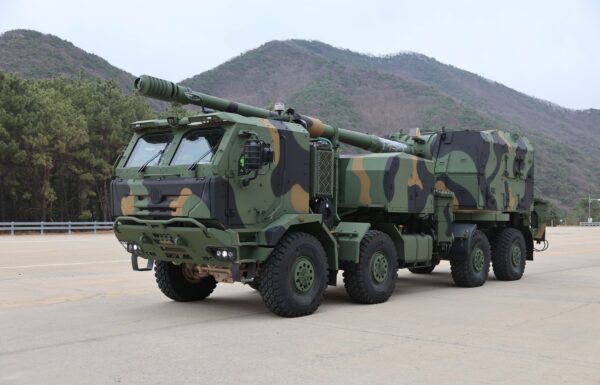
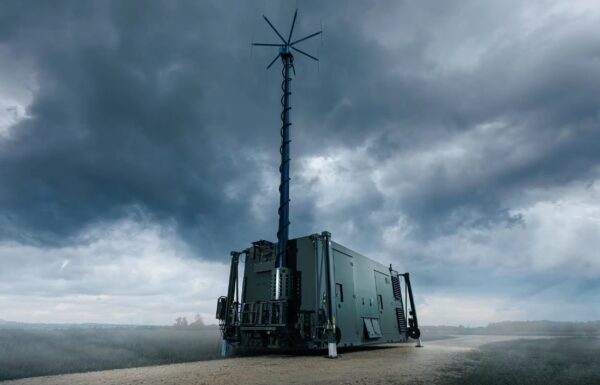




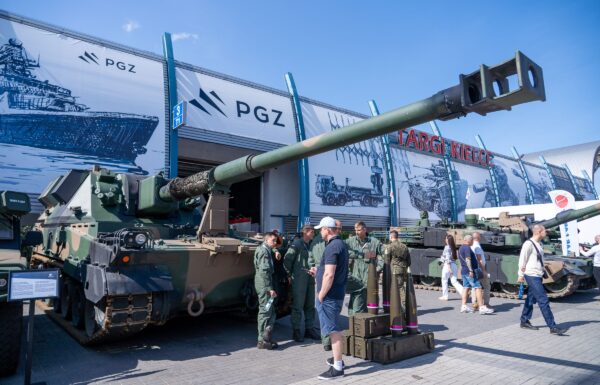


















On Monday, April 13, 2026, during Polish Deputy Prime Minister and Minister of National Defence Władysław Kosiniak-Kamysz’s visit to Oslo, two noteworthy debuts took place: the first was a new, heavier Jelcz 8×8 chassis for NSM missile launchers intended for the Polish Navy’s Coastal Missile Units, and the second was a counter-unmanned aerial system integrated with the Ukrainian Inguar-3 armored personnel carrier, which is to be deployed to the front soon.
 Photo: Master Corporal Paweł Kmiecik, Polish Ministry of National Defence
According to the Ukrainian defense outlet Defence Blog, Kongsberg Defence & Aerospace (KDA) of Norway has integrated its CROWS C-UAS Kit counter-unmanned aerial system package with the Ukrainian vehicle.
The system has been mounted on the roof on a retractable mast. It includes a CROWS remote weapon station equipped with electro-optical and infrared (EO/IR) systems. Its armament consists of a 12.7 mm M2 Browning heavy machine gun and an Arnold Defense Land-LGR4 Fletcher launcher for four 70 mm Hydra rockets fitted with WGU-59/B APKWS II (Advanced Precision Kill Weapon System) laser-guidance modules, designated AGR-20A.
The core component of the WGU-59/B APKWS II module, produced by BAE Systems Inc., is the DASALS (Distributed Aperture Semi-Active Laser Seeker) guidance system, which is installed between the Mk 152 warhead with the Mk 435 fuze and the Mk 66 Mod 4 rocket motor and fuel section. This converts unguided 70 mm Hydra 70 rockets into semi-active laser-guided anti-armor missiles.
The presentation of this solution during the visit of Poland’s minister of national defence was not accidental, as 54 APKWS II launchers have been contracted as part of 18 battery fire modules under the San air-defense system program, which will also have the capability to counter unmanned aerial systems.
As Defence Blog reported, sources familiar with the project at KDA said the platform is being developed specifically for Ukraine with donor funding and is close to delivery after completing the first round of testing. Although the number of vehicles ultimately to be delivered to Ukraine has not been disclosed, the project appears to have moved beyond the conceptual stage.
The Inguar-3 was developed by Kyiv-based Inguar Defence. It is an MRAP-class (Mine-Resistant Ambush Protected) armored vehicle that completed trials in January 2025 and entered service with Ukrainian users.
The vehicle’s armor meets NATO standards at Level 3a/3b under STANAG 4569, protecting the crew against 7.62×51 mm armor-piercing rounds, fragments from 155 mm artillery shells at a distance of 60 meters, explosions of 8 kg TNT charges, and anti-tank mine blasts.
It is powered by a 356 hp Deutz diesel engine coupled to an Allison automatic transmission, while the engine compartment is additionally protected by ballistic armor. The armored cabin, made of armored steel and aluminum, is equipped with blast-resistant seats, fire-suppression systems, and chemical filters. The crew consists of two soldiers, and the vehicle can carry up to eight additional personnel. It can be armed with systems ranging from 12.7 mm and 14.5 mm weapons on pintle mounts to remote weapon stations with a 30 mm automatic cannon or anti-tank guided missiles. The first concept of the vehicle was presented as early as late 2022.