



























On Wednesday, May 6, 2026, the U.S. trade magazine Aviation Week was the first to report that President Donald Trump’s defense budget request under the National Defense Authorization Act for Fiscal Year 2027 included funding to launch analytical work on a potential successor to the Boeing B-52 Stratofortress strategic bombers, which are expected to remain in service into the 2050s.
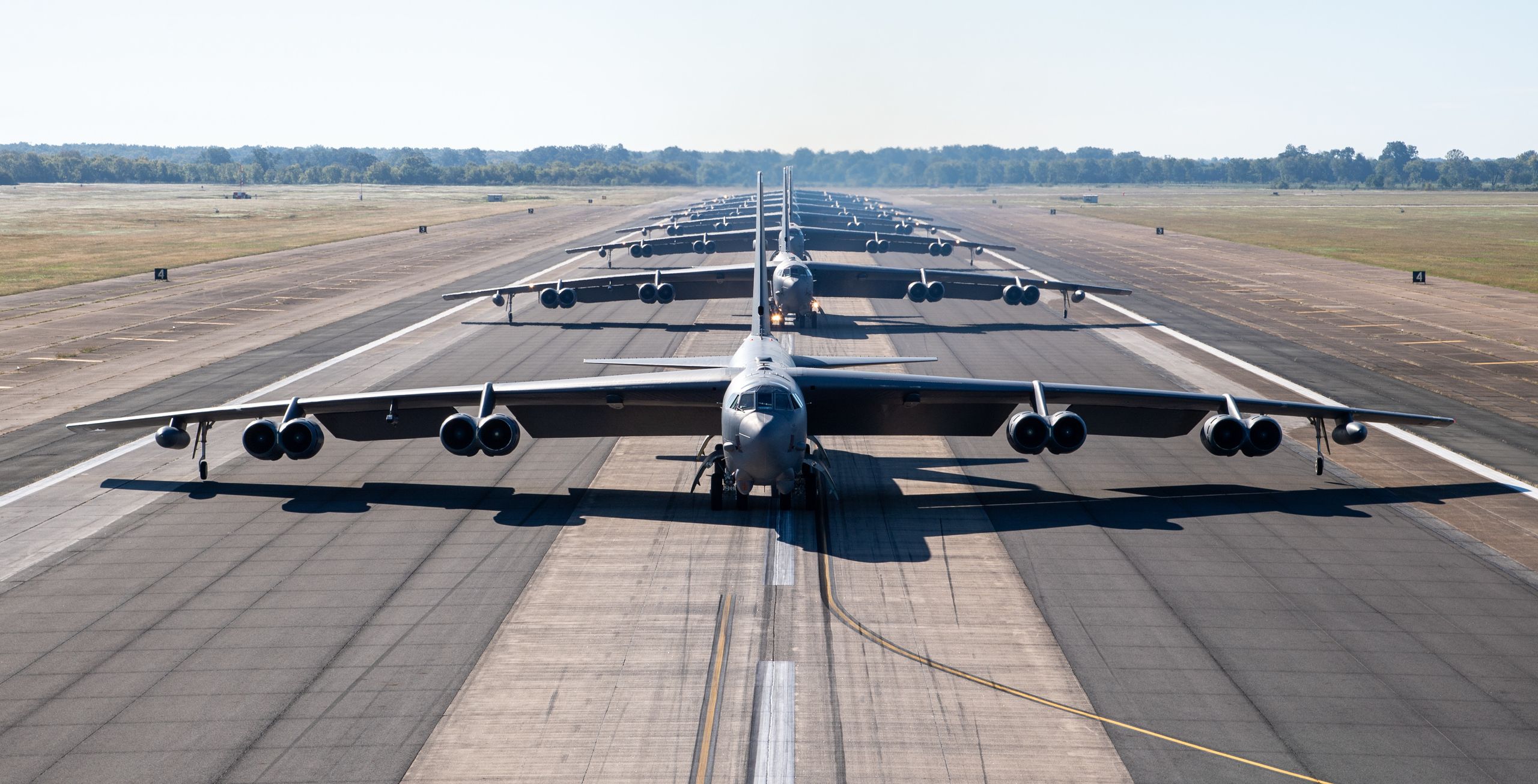 Photos: Senior Airman Tessa B. Corrick and Senior Airman Lillian Miller, 2nd Bomb Wing, AFGSC
Under the budget request titled New Heavy Bomber Analysis of Alternatives (AoA), the USAF wants to obtain initial funding of 1 million USD.
“[A] new heavy bomber analysis of alternatives will begin initial planning activities to develop key performance parameters, key system attributes, and additional performance attributes for a follow-on heavy bomber in the USAF,” the Air Force’s budget justification document shows.
The analysis would follow a 3 million USD proof-of-concept project that ended in fiscal year 2025 and included a classified Proof of Concept demonstration on the B-52, according to the document. At the time, it was not clear whether that project concerned a potential successor to the B-52.
An Analysis of Alternatives usually begins after the military has defined and approved a new operational requirement, and its purpose is to present the command with well-considered options before a competitive procurement process is launched.
It is also unclear how the New Heavy Bomber program would fit into the USAF’s portfolio of modernization programs for long-range strike capabilities, which are currently investing tens of billions of dollars in the next-generation Northrop Grumman B-21A Raider strategic bomber program, codenamed LRSB (Long Range Strike-Bomber), which is to replace the Northrop B-2A Spirit by 2032 and the North American/Rockwell B-1B Lancer by 2036, in accordance with the 2018 Bomber Vector plans, as well as in the modernization of the B-52H to the B-52J standard, which will extend their service life even into the 2050s. It is worth recalling that both the Lancer and the Spirit were designed during the Cold War as successors to the B-52, but will ultimately be retired sooner.
The New Heavy Bomber project appears to be part of a program describing a long list of modernization tasks for the fleet of 76 B-52 bombers. Such placement may suggest that the concept is ultimately intended to replace the B-52. An Analysis of Alternatives often precedes the fielding of a new aircraft by 10 to 15 years.
As a reminder, the last B-52 rolled off Boeing’s production line in 1962, and the design has been modernized ever since. Most recently, B-52Hs were used in combat operations against Iran during Operation Epic Fury. They remain an important component of the U.S. nuclear triad.
To illustrate just how old the B-52 design is, it is worth citing several dates:
- November 23, 1945: The USAAF, the predecessor of the USAF, issued operational requirements for a new long-range strategic bomber.
- February 13, 1946: Requests for proposals were sent to Boeing, Consolidated, and Martin.
- June 5, 1946: Boeing won the competition with Model 462, initially a straight-wing design with six turboprop engines.
- June 28, 1946: Boeing received its first USD 1.7 million contract to build a mock-up and conduct preliminary work. The design then evolved into an aircraft with swept wings and eight turbojet engines.
- April 15, 1952: First flight of the YB-52 prototype.
- June 29, 1955: The B-52B entered service.