


















On Monday, May 4, 2026, the U.S. Air Force press service announced that on April 23 this year, the U.S. Department of Defense granted Milestone C approval to begin Low-Rate Initial Production (LRIP) of the Boeing-Saab T-7A Red Hawk advanced trainer aircraft.
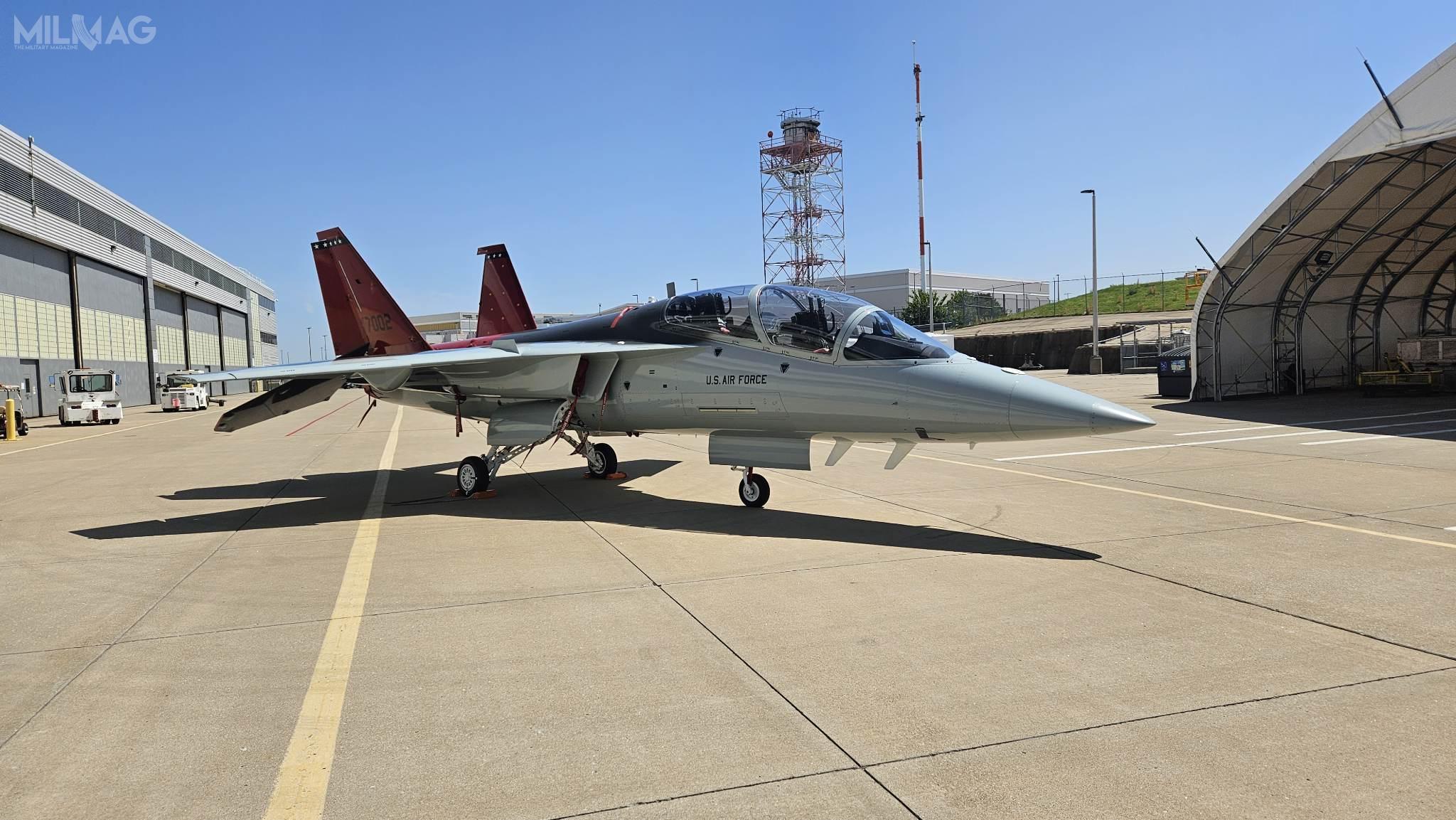 Photo: Jakub Link-Lenczowski, MILMAG
This means the award to Boeing, as the prime contractor, in cooperation with Sweden’s Saab Defence and Security, of the first LRIP Lot 1 production contract, worth 219 million USD, for the delivery of 14 T-7A Red Hawk aircraft, together with spare parts, support equipment, and a training package.
This achievement marks a milestone moment for the T-7 Advanced Pilot Training Program. It follows a year of intensive development under an active management strategy resulting from cooperation among the Air Force, Air Education and Training Command, or AETC, and Boeing.
This approach, in line with Department of the Air Force guidance on acquisition transformation, is intended to optimize both programmatic and operational risk in order to deliver new capabilities to the USAF as quickly as possible.
The Milestone C decision was preceded by deliveries of the first five pre-production aircraft from September 2023 to Edwards Air Force Base in California for testing, and of the first aircraft in production configuration in December 2025 to Joint Base San Antonio-Randolph in Texas. In the meantime, in June 2023, a Military Flight Release, or MFR, was obtained.
The next locations to receive production aircraft will be Columbus Air Force Base in Mississippi, from 2027; Laughlin in Texas, from 2032; Vance in Oklahoma, from 2034; and Sheppard in Texas, from 2035. To meet this schedule, Initial Operational Capability, or IOC, is planned to be declared in August 2027, and the 14 aircraft just ordered are to be delivered to Joint Base San Antonio-Randolph. Serial deliveries of 40–60 aircraft per year are expected, with the number increasing by 2033, and final acceptances taking place around 2035–2036.
The T-7A Red Hawk was selected by the USAF in 2018 under the T-X, or Trainer-X, program, with an estimated value of up to USD 9.2 billion. Under the program, Saab and Boeing may deliver between 351 and as many as 475 aircraft as successors to around 500 Northrop T-38 Talon aircraft, which have been in service since 1961 and will remain in service until a sufficient number of replacements is introduced.
The T-7A is 14.15 m long, has a wingspan of 10 m, and is 4 m high. It is powered by a single GE Aviation F404-GE-402 afterburning turbofan engine with 79 kN of thrust, providing a maximum speed of 1,300 km/h, a range of 1,839 km, a rate of climb of 170 m/s, and a service ceiling of 15,000 m.
The Red Hawk, in the T-7B variant, is also being offered to the U.S. Navy under the Undergraduate Jet Training System, or UJTS, and Tactical Surrogate Aircraft programs, as well as for export to Australia, Serbia, Japan, Sweden, Brazil, and the United Kingdom. Around 30 countries are currently expressing preliminary interest, while Boeing estimates global demand at 2,700 aircraft. Plans also include the development of a combat-capable trainer version.
Ready and able.
Thank you, @USAirForce, for your trust and partnership on the T-7A #RedHawk. Milestone C clears the way for low-rate initial production. Getting this trainer to future fighter and bomber pilots quickly is our mission and commitment to you. Let's go fly! pic.twitter.com/RcWtjv58Wy
— Boeing Defense (@BoeingDefense) May 4, 2026
The T-7A Red Hawk has officially been cleared for production.
Explore how this milestone brings the #USAirForce one step closer to putting an essential capability into the hands of instructor pilots and students: https://t.co/5ZJfbDvJB8 pic.twitter.com/BvmN9Gsmgt
— U.S. Air Force (@usairforce) May 4, 2026