
















On Sunday, March 29, 2026, NAVAIR (Naval Air Systems Command) of the U.S. Navy published information that three days earlier it had launched an open tender procedure under the UJTS (Undergraduate Jet Training System) program for new advanced jet trainer aircraft.
 One of the previously announced proposals: the T-7B derived from the T-7A Red Hawk, offered by Boeing and Saab, which was selected by the USAF / Graphic: Boeing
This Request for Proposals (RFP) was preceded by six updated Requests for Information (RFI), beginning with the first issued on May 14, 2020, and the most recent on December 15, 2025.
The deadline for submitting requests to participate in the tender is June 29, 2026, at 3:00 p.m. EST. Proposals may be submitted only electronically through the PIEE Solicitation Module system. The winning bid will be selected based on an evaluation of technical factors, cost, and the contractor’s experience.
The procurement covers the Engineering & Manufacturing Development (EMD) phase, production of the first Low-Rate Initial Production Lot 1 (LRIP), an initial number of Ground Based Training System (GBTS) simulators, as well as logistics support and maintenance at the start of service.
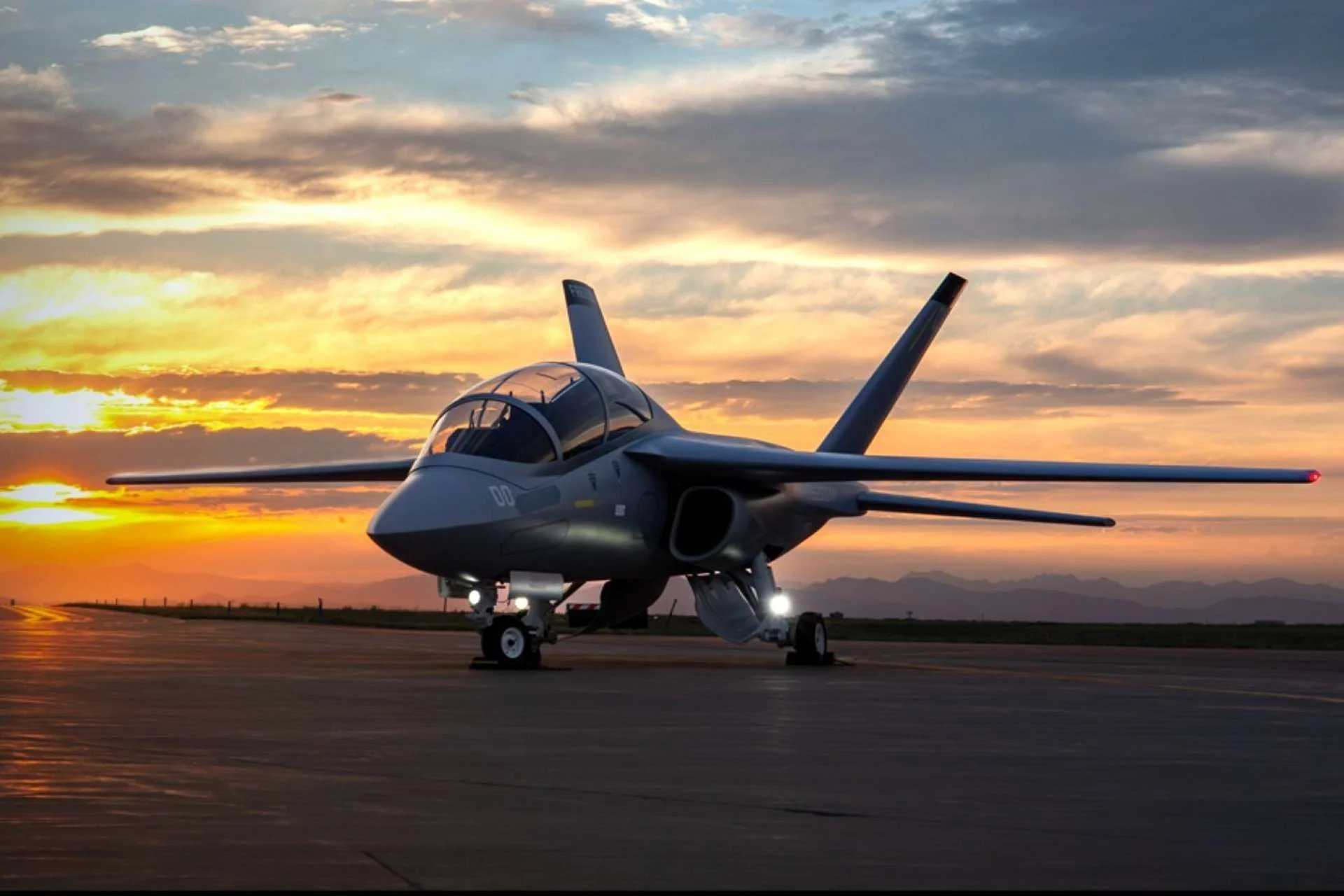 The Freedom Trainer offered by Sierra Nevada Corporation / Photo: SNC
At the same time, the GBTS is to constitute, in effect, a system of training systems including the Operational Flight Trainer (OFT), Unit Training Device (UTD), Cockpit Procedural Trainer (CPT), and Desktop Avionics Trainer (DAT), integrated with a Live/Virtual/Constructive (LVC) training system, that is, training employing a combination of real and virtual assets.
The program’s initial budget is 52.8 million USD in fiscal year 2027 and 181 million USD in 2028.
The procurement covers 216 aircraft of a new type, with deliveries scheduled for 2032–2042, including 7 aircraft in 2032, 12 in 2033, 20 in 2034, 25 in 2035, 25 in 2036, 25 in 2037, 25 in 2038, 25 in 2039, 25 in 2040, 20 in 2041, and 7 in 2042. They will be delivered to three locations: Naval Air Station Meridian (the first 95 aircraft in 2033–2038), Naval Air Station Kingsville (the next 96 aircraft in 2039–2042), and Naval Air Station Pensacola (the final 25 aircraft by 2042).
 Beechcraft M-346N offered by Leonardo and Textron / Photo: Greg L. Davis, Textron Aviation Defense
The aircraft are required to have avionics equipped with Precision Landing Modes (PLM) modules, similar to those on the carrier-based F/A-18E/F Super Hornet and F-35C Lightning II. Each aircraft must be capable of flying 35 hours per month, for at least 12 months, with an option to extend, as well as conducting Field Carrier Landing Practice (FCLP). The minimum required speed is Mach 0.9, the minimum load factor is 6 G, and the airframe must have a service life of 10,000 flight hours and 35,000 landings.
The cockpit must reflect the latest US Navy carrier-based aircraft, while the wingtip pylons must allow the carriage of external fuel tanks, pods, and up to six Mk 76 practice bombs.
The aircraft to be replaced are the 189 Boeing T-45C Goshawk aircraft currently still in service, used to train pilots of the US Navy and the U.S. Marine Corps (USMC), out of an original 221 delivered between 1988 and 2009.
As previously announced, the following were interested in participating in the program:
- Sierra Nevada Corporation with the Freedom Trainer;
- Leonardo and Textron with the Beechcraft M-346N;
- Lockheed Martin and Korea Aerospace Industries with the TF-50N, a development of the T-50 Golden Eagle;
- Boeing with the T-7B, a modified T-7A Red Hawk;
- Stavatti Aerospace with the SM-31T Stiletto, the latter being regarded as a controversial company lacking experience and having had legal and financial disputes with local authorities (editor’s note).
India’s Hindustan Aeronautics Limited had also previously announced its intention to participate with the Tejas in a variant called LIFT (Lead-In Fighter Training), but later withdrew.
Finally, it is worth adding that the US Navy is also seeking a supplier for another training aircraft type under the codename Tactical Surrogate Aircraft (TSA), which is intended to serve as a surrogate trainer for multirole aircraft pilots.