




















On Friday, February 13, 2026, during a visit by the President of Ukraine, Volodymyr Zelenskyy, and Germany’s Federal Minister of Defense, Boris Pistorius, to the facilities of the joint venture Quantum Frontline Industries (QFI), established by Quantum-Systems and Frontline Robotics in Munich, the first serial-production Linza 3.0 multirole drone, intended for the Armed Forces of Ukraine, was symbolically handed over.
 Photo: Quantum Systems
Matthias Lehna, Managing Director of Quantum Frontline Industries, and Mykyta Rozhkov, Head of Development at Frontline Robotics, welcomed the President of Ukraine, Volodymyr Zelenskyy, and Germany’s Federal Minister of Defense, Boris Pistorius, ahead of the official opening of the 62nd Munich Security Conference 2026, to highlight the start of serial production at the new facility of the recently established joint venture.
The QFI plant in Munich will enable large-scale production of 10,000 drones per year for the Ukrainian Armed Forces in Germany and, as announced in December 2025, has already begun low-rate initial production. Quantum Frontline Industries will automate its production capacity to meet Ukraine’s demand and plans further scaling in order to deliver Ukrainian technology to Europe.
The visit was facilitated and supported by the Ukrainian Council of Defense Industry, representing private Ukrainian defense manufacturers.
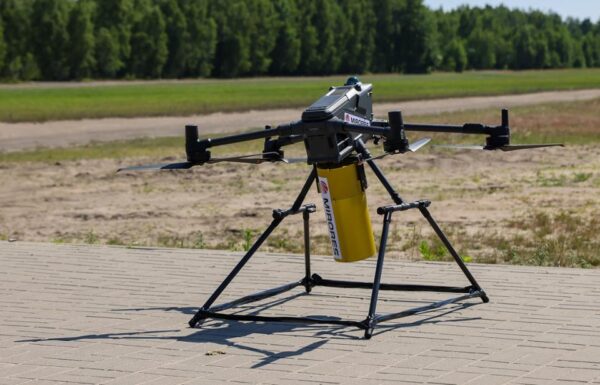
Linza 3.0, the first Ukrainian drone produced in Germany, was recently unveiled by Frontline Robotics. It is the latest generation of a multifunctional drone already used by more than 60 units of the Armed Forces of Ukraine. The drone features an AI-supported visual-inertial navigation module, a 12-inch frame, and can carry a payload of up to 4 kg over a distance of up to 15 km, remaining airborne for up to 60 minutes.
Its navigation system enables stable hovering over a target at altitudes of up to 200 meters, orbit mode with route mapping and path visualization, precise landing and position holding without GPS, as well as resistance to GPS/RF jamming. It is available in both daytime and nighttime configurations, equipped with a gyrostabilized camera offering 6× hybrid zoom.
Linza 3.0 can carry small explosive charges and mines for strike missions, conduct short-range reconnaissance, serve as a communications relay, and has even been tested for the evacuation of other small drones damaged in combat. It succeeds the Linza 1.0 and Linza 2.0 drones, which have been used on the battlefield since 2024.
During his address to QFI employees and media representatives, President Zelenskyy said:
“I want to thank the people of Germany for the support of your nation since the start of the war. Your solidarity means a great deal to us. I also want to congratulate both companies and say how proud I am of the important work they are doing.”
The German Minister of Defence, Boris Pistorius highlighted Germany’s support and partnership with Ukraine and said:
“I would like to express my gratitude for this project, which, as someone put it, was implemented at lightspeed. We learn from successes achieved on the battlefield and benefit from spillover effects in innovations that are exploited.”
Matthias Lehna, Managing Director of QFI said:
“Quantum Frontline Industries has started production in just two months after the announcement. QFI is the first of its kind but will not be the last. We are proud to be a flagship company for Ukrainian German industrial cooperation and proud to support the Armed Forces of Ukraine with the best technology of both countries.”
Mykyta Rozhkov, Chief BD Officer of Frontline Robotics said:
“This first QFI produced Linza 3.0 represents months of dedication from Ukrainian engineers and our international partners. It was created from frontline experience and is already helping Ukrainian forces operate more effectively. We are proud of the rapid progress of our joint venture and the way it strengthens long-term cooperation between our countries.“