




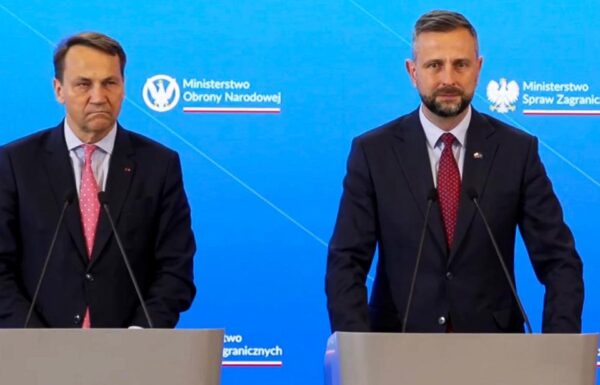



















On Thursday, March 12, 2026, at the Naval Port in Gdynia, Deputy Prime Minister and Minister of National Defence Władysław Kosiniak-Kamysz met with Swedish Minister of Defence Pål Jonson.
 During a speech at the Naval Port in Gdynia-Oksywie, Deputy Prime Minister Władysław Kosiniak-Kamysz, in the context of plans for cooperation between the Polish and Swedish defense industries, mentioned the Miecznik-class frigates / Photos: Przemysław Gurgurewicz, MILMAG
“The new security architecture on the Baltic Sea is based on the Polish-Swedish alliance: building shared capabilities, joint procurement, cooperation and training. We have a great future with Sweden ahead of us. We will develop all those capabilities and skills. We will invest together in the defence industry and build the new security architecture in the Baltic Sea” said Deputy Prime Minister Władysław Kosiniak-Kamysz during the meeting with the Swedish Minister of Defence.
“The entry of a submarine of the Kingdom of Sweden into the port in Gdynia has symbolic meaning. It is a sign of allied capabilities, cooperation, joint exercises and mutual responsibility. It is also a symbol of the contract we have signed at the end of last year. We meet here on a symbolic date. 27 years ago, Poland has joined the North Atlantic Alliance – it has joined NATO. Sweden is the latest country to have joined the Alliance and it has changed the position of NATO. The Baltic Sea became an inner sea of the Alliance,” emphasized the Polish Minister of National Defence.
 ORP Orzeł together with the Swedish HMS Uppland. This image can be seen as a symbolic presentation of the past and future of Poland’s submarine forces.
“It is not only an expression of allied skills and capabilities, nor merely a sign of our mutual willingness to improve our abilities, conduct joint exercises, and take responsibility for one another, but it is also a symbol of the agreement we concluded with the minister at the end of last year, when Poland, after many years of running the Orka submarine program, is moving to the final stage of implementing the submarine acquisition. We signed an intergovernmental agreement on this matter at the end of November and decided to select Sweden as the partner with whom we will carry out the purchase of submarines—three A26 submarines, preceded by the acquisition of a modernized A17 gapfiller, very similar to the one currently in the port of Gdynia. The acquisition of skills already this year, exercises and training for our soldiers, investment in the Polish defense industry, and joint production of components are all elements of the government agreement. Business negotiations are now underway between the Armament Agency and the companies that will produce and deliver the capability to operate underwater. Everything is proceeding at a good pace and according to the planned schedule,” added the Minister of National Defence.

He also addressed issues of industrial cooperation between the two countries, noting that: “We also discussed joint procurement, because we want to make purchases together. Minister Pål Jonson mentioned the Piorun system as a flagship Polish product in which Sweden is interested, which it is purchasing and evaluating very highly. We are open to cooperation in other areas as well. We talked about frigates. We have frigate production here in Pomerania under the Miecznik program, and the deputy minister will have the opportunity to familiarize himself with this program.”
Speaking about the future and further cooperation, the Minister of National Defense emphasized that both Poland and Sweden will take shifts in the command responsible for security in the Baltic Sea region. A major task will also involve the protection of critical infrastructure in the face of the ongoing hybrid war.

“We are also preparing to assume command on the Baltic Sea. Right now, it is Germany that executes this command for four years, then Poland, then Sweden. The Baltic Sea is not just a transport and shipping route, it is also one of the most sensitive areas in NATO with regards to threats from the Russian Federation” – added the Deputy Prime Minister.
“We live in difficult, dangerous times. Russia tests out unity and determination. We also see this in your region, where Russian drones violate airspace and threaten security. It was only two weeks ago that we have witnessed Russian drones operating in the region. Russia tests us, but we will remain united, and this brings results. This is why it is important for us to continue modernizing our militaries and strengthening NATO, so that the Alliance is able to defend and protect every fragment of its territory” – said the Minister of Defence of Sweden, Pål Jonson, in turn
 HMS Uppland is one of three A19 (Gotland-class) submarines, which entered service in 1996. During their modernization they also received solutions developed for the A26 program, which will form the basis of Poland’s Orka submarine program
The visit to the Naval Port in Gdynia was organized in connection with the official state visit of Their Majesties the King and Queen of Sweden to Poland and aims to strengthen the strong Swedish–Polish partnership in defense and security within the framework of the Baltic Sea Security Pact.
See also:
- The Polish Orka approaches the port. The entry, however, is not easy
- Everything We Know About the Swedish Submarine for Poland’s Orka Program
- Poland and Sweden Sign Cooperation Agreement
Photos: corporal Wojciech Król/Polish Ministry Of National Defence:


