
























According to Bulgarian press reports from March and April 2026, including Novinite and 24 Chasa, the country’s Ministry of Defence intends to acquire the German-Israeli MARS 3 multiple launch rocket system, also known as EuroPULS (European Precise & Universal Launching System), instead of the American M142 HIMARS (High Mobility Artillery Rocket System).
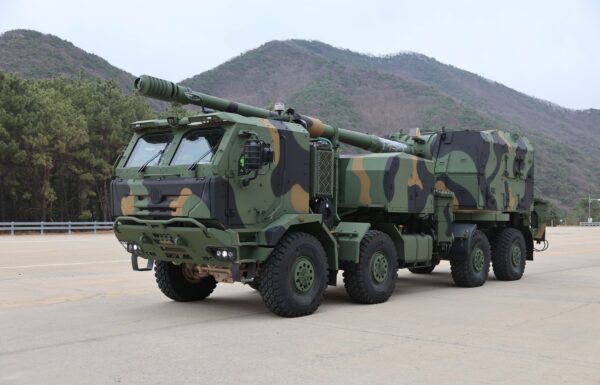
 Photo: KNDS Deutschland
According to the reports, the government in Sofia is interested in purchasing 12 MARS 3 multiple launch rocket systems as part of a planned production run of around 500 units by the newly established joint venture EuroPULS GmbH, made up of Germany’s KNDS Deutschland (part of the Franco-German KNDS group) and Israel’s Elbit Systems, as previously reported by the German press. In this case, the main technology provider will be the Israeli side. This is all the more significant because, according to earlier information, of the roughly 500 MARS 3 launchers, half are to go to interested allies, with the remainder destined for the Bundeswehr.
Earlier, under a government-to-government agreement between the Kingdom of the Netherlands and Israel, which ordered 20 launchers, Germany, as a partner, ordered the first five MARS 3 launchers (to be adapted for multiple types of ammunition required by Berlin) on the Iveco Trakker FSA 8×8 chassis, with delivery and qualification planned for 2027.
As for Bulgaria’s Defence Investment Program through 2032, approved on 9 May 2024, it included plans to purchase 12 M142 HIMARS launchers with ammunition, manufactured by the American company Lockheed Martin, as successors to the OTR-21 Tochka missile systems, which means that the required ammunition includes ballistic missiles. Now, however, the Bulgarian Ministry of Defence appears to have changed its mind, although there had still been no formal approval from the U.S. State Department for any potential sale of the systems. The reason was reportedly the excessively long waiting time.
The details of the purchase of the German-Israeli launchers are not yet known, including the types of ammunition involved or any possible participation by local industry in deliveries. First, a framework agreement must be concluded between the Bundeswehr procurement agency BAAINBw (Bundesamt für Ausrüstung, Informationstechnik und Nutzung der Bundeswehr) and EuroPULS GmbH. Only afterward will other countries be able to join the orders. This agreement is expected in the second half of the year, following approval by the Budget Committee (Haushaltsausschuss) of parliament, the Bundestag.
At present, the basic PULS rocket systems, from which the MARS 3 variant is derived, are being ordered directly from the original manufacturer by various countries, apart from those mentioned above: Denmark (8 units), a first undisclosed customer, a second undisclosed customer, a third undisclosed customer, Peru (undisclosed number), and Serbia (undisclosed number). It recently emerged that India has also become an operator of the system, where it received the designation SuryAstra and was one of the three previously undisclosed customers, while at the beginning of this week Greece ordered 36 units. By contrast, Spain canceled its purchase of 16 units for political reasons: the order had been placed in October 2023, but in September 2025 the government terminated the contract as part of a broader embargo on Israeli arms.
The PULS system, which is a development of the Lynx system designed by Israel Military Industries (IMI), can carry 122 mm Accular rockets (18 at a time) with a range of up to 35 km, 160 mm Accular rockets (10 at a time) with a range of up to 40 km, 306 mm EXTRA rockets (4 at a time) with a range of 150 km, and 370 mm Predator Hawk rockets (2 at a time) with a range of 300 km (370 km in the Israeli version).
The MARS 3 is ultimately intended to fire missiles with ranges of 150 km and 300 km. Other effectors under consideration include the still undeveloped MBDA Deutschland JFS-M (Joint Fire Support-Missile) cruise missile, the Saab/Diehl Defence RBS 15, missiles with self-guiding anti-tank submunitions, multirole munitions, RCM² armed unmanned systems, and the Kongsberg NSM anti-ship missile, the latter of which has already been tested with the MARS 3.