


















On Monday, 13 April 2026, Russia’s Kalashnikov Concern announced the start of preliminary testing of the new Krona surface-to-air missile system, mounted on the wheeled chassis of a BTR-82A armored personnel carrier. The export version, Krona-E, made its public debut in February 2025 at IDEX 2025 in the United Arab Emirates.
 Image: Kalashnikov Concern
“Preliminary testing of the Krona air defense system prototype is being conducted under conditions close to its intended operational environment, with the participation of law enforcement personnel, in line with the system’s intended purpose and design assumptions. These tests will help identify possible issues, promptly introduce the necessary modifications, and continue testing,” the press release states.
“It took less than two years to go from research and development to the creation of an entirely new, unique, highly automated combat system. This was made possible by the extensive experience gained in countering enemy drones during the special military operation. I am confident that the Krona system will prove highly effective and in demand in the special operation zone,” noted Alan V. Lushnikov, President of Kalashnikov Concern and a member of the Bureau of the Russian Engineering Union.
The specifications of the Krona system itself are not known, although data on the export version has been made public. In the case of Russian weapon systems, export variants usually have inferior tactical and technical characteristics.
It is worth recalling that the Krona-E air defense missile system is intended to provide protection against air attacks on important government facilities, urban infrastructure, specially significant sites, special cargo in storage areas, and facilities along strategic transport routes. The system’s primary mission is to defend against hostile tactical-class unmanned aerial vehicles.
The Krona-E system consists of a reconnaissance, command, and automation complex with modules mounted on mobile or stationary platforms, equipped with launchers for 9M337 Sosna-R and 9M333 surface-to-air guided missiles, the latter also used by the 9K35 Strela-10M3 air defense system.
The 9M333 is a new type of weapon that has been delivered to the Russian military since November 2021. It is capable of intercepting targets at ranges from 800 to 5,000 m, at altitudes from 10 to 3,500 m, and flying at speeds of up to 679 m/s. The 9M337, in turn, can intercept targets at ranges of up to 10,000 m, at altitudes of up to 5,000 m, and flying at speeds of up to 500 m/s.
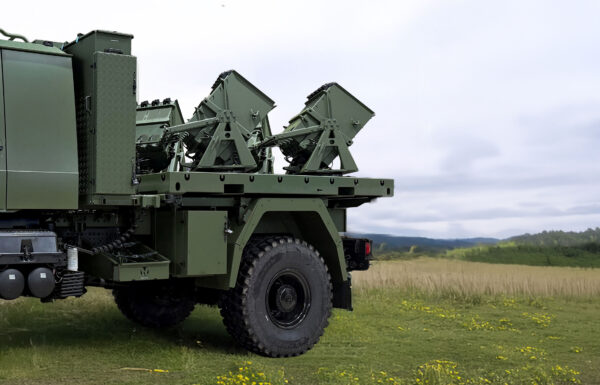
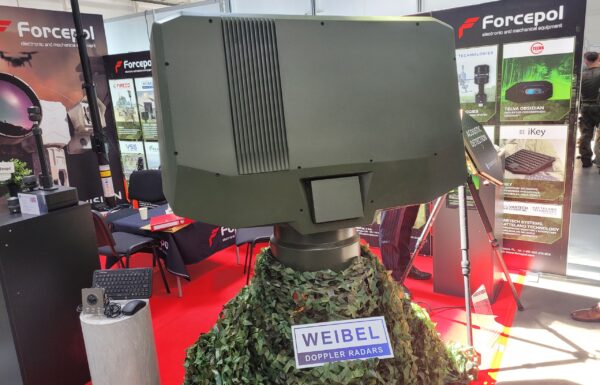
The system is said to consist of a command vehicle mounted on an 8×8 KamAZ truck chassis, probably from the KamAZ-6350 series, and a BTR-82A wheeled armored personnel carrier fitted with a launcher carrying six 9M340 missiles and four 9M333 missiles. It is also supported by portable radars for detecting drones. The turret mounted on the BTR-82A is equipped with an integral electro-optical suite consisting of a daylight camera and a thermal imaging camera, and it can also use the aforementioned external sensors, supported by the Barnaul command-and-control system. The missiles are guided to their targets by a laser beam. The system can operate in automatic mode.
It is worth adding that mounting an air defense system on a BTR-82A chassis is nothing new. In 2013, Russia’s Almaz-Antey Air and Space Defense Corporation presented the Sosna system, which could also be integrated with MT-LB and BMP-3 chassis, and in 2021 an upgraded version was unveiled. That system uses twelve of the aforementioned Sosna-R missiles, giving it a larger ready-to-fire load than the Krona-E. So far, it has not received any orders, either from the Ministry of Defense of the Russian Federation or from any foreign customer.