



























On Friday, 10 April 2026, the Armament Agency announced on social media that it had already received 22 of the 25 ordered Wizjer mini-class unmanned aerial system (UAS) sets from the consortium of the Polish Armaments Group (PGZ) and WZL-1 and WZL-2.
 Photo: Armaments Agency
“More Wizjers are entering service! The Polish Armed Forces have just received the 22nd set of Wizjer drones, a Polish reconnaissance system developed by the Polish Armaments Group with a range of up to 35 km and an endurance of more than three hours. The delivery process for all 25 Wizjer sets being acquired by the Armament Agency will be completed in the coming weeks.”
Armaments Agency
The first Wizjer mini-class unmanned aerial system (UAS) set was delivered to the military on 19 May 2025, while on 20 February this year the transfer of the 19th set was announced.
The UAS was developed by a consortium comprising the Polish Armaments Group, Military Aviation Works No. 2, and Military Aviation Works No. 1 in Łódź under a contract with the Armament Agency, acting on behalf of the State Treasury, dated 29 December 2021 for the delivery of 25 sets comprising a total of 100 aircraft, together with logistics and training packages. Deliveries were originally scheduled to begin in 2024, but were delayed, and factory testing was completed in March 2025.
Each set includes four unmanned aircraft (air platforms), four EO/IR optoelectronic payloads, one launch system, one ground control station (GCS) set, one ground data terminal (GDT), one portable video terminal (PVT), and a maintenance support package. The entire set fits into 10 crates, with an eleventh crate containing the logistics package, including consumables and repair kits.
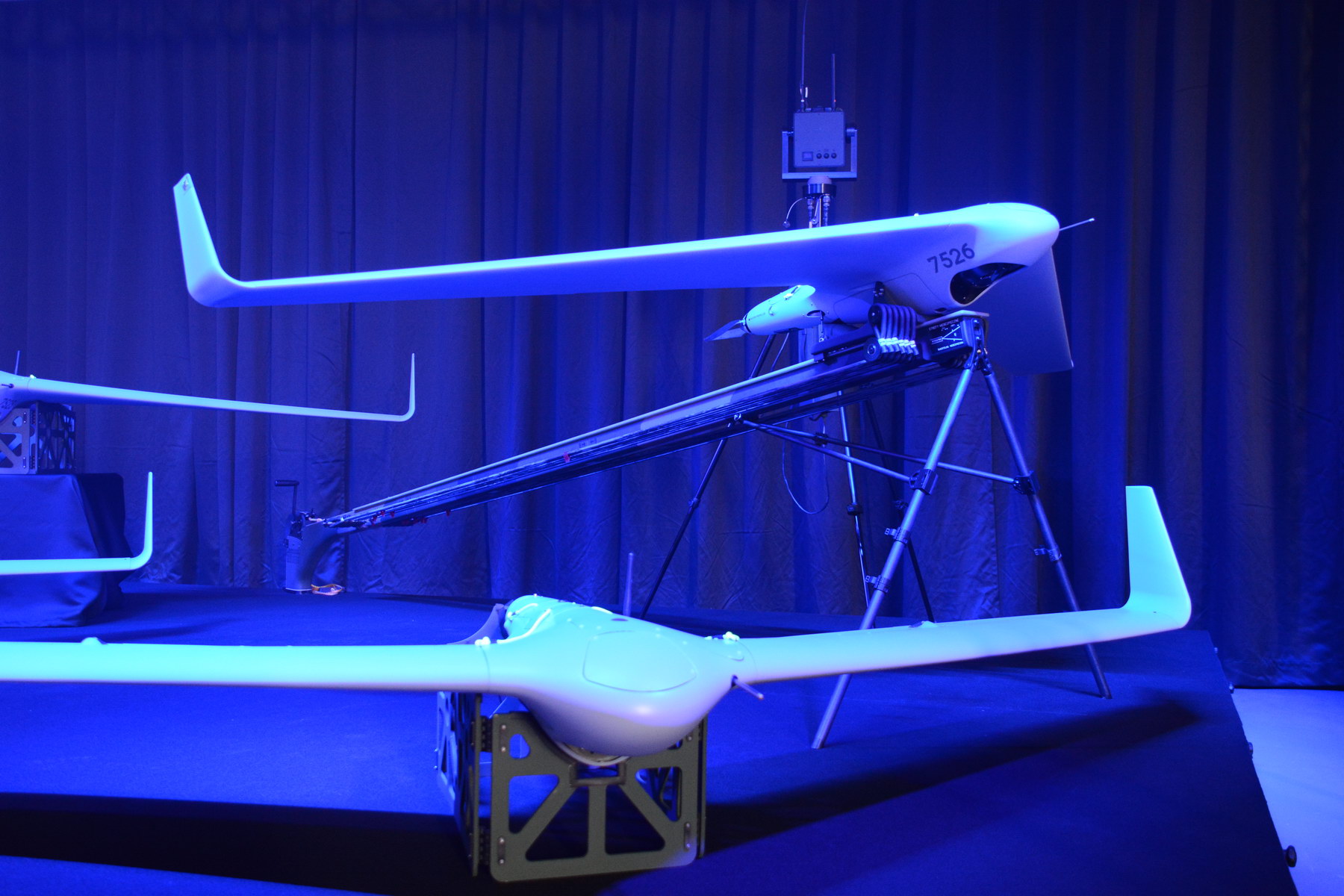 Photo: Przemysław Gurgurewicz, MILMAG
The UAS was developed by the Air Force Institute of Technology for the needs of the Land Forces and Special Forces. It is intended for optical reconnaissance operations at a depth of approximately 30–35 km, including the detection, recognition, identification, and geolocation of objects. To this end, the unmanned aircraft that form part of the system are equipped with a dual-sensor optoelectronic payload featuring a daylight camera with a resolution of 1280×720 px and up to 30x optical zoom, as well as a thermal imaging night camera with a resolution of 640×512 px, ensuring high-quality reconnaissance data both by day and by night. The observation system is capable of automatic target tracking and real-time determination of the coordinates of observed objects.
The Wizjer UAS launches automatically using a composite launch rail weighing 13 kg and performs an automatic landing maneuver using a parachute and airbag. Wizjer is designed to withstand difficult weather conditions, such as rain and haze. Its open architecture allows for future system expansion, it features innovative payload-positioning kinematics during operational flight phases, and its operator interface has been assessed as intuitive.
The Wizjer UAS also includes an advanced simulator using the actual ground control station (GCS), enabling training across all system functionalities under simulated weather conditions and allowing users to create their own tactical scenarios.
Technical specifications of the unmanned aircraft:
- minimum speed: 65 km/h
- maximum speed: 120 km/h
- service ceiling (AMSL): 4,000 m
- range (LOS): 30 km
- maximum takeoff weight: 13 kg
- endurance: more than 3 hours
- electric propulsion with a two-blade pusher propeller
- low noise signature
- operating air temperature range: from -30°C to +50°C
Kolejne Wizjery wchodzą do gry!#WojskoPolskie właśnie otrzymało 22 zestaw dronów #WIZJER – polskiego systemu rozpoznawczego @PGZ_pl o zasięgu do 35 km i długotrwałości lotu ponad 3 godziny.
W najbliższych tygodniach zakończy się proces dostaw 25 zestawów Wizjer pozyskiwanych… pic.twitter.com/38xEwg0MSj
— Agencja Uzbrojenia (@AgencjaUzbr) April 10, 2026