























Just a few years ago, May 9 remained a holiday in Ukraine celebrated almost exactly as it was in Russia. Only the full-scale war finally severed that symbolic bond. Kyiv moved its commemoration of the end of World War II to May 8, following the path taken by Poland and the Baltic states, which rejected the Soviet calendar of historical memory after the fall of the Eastern Bloc. Today, May 9 no longer carries much political significance for Ukraine. For Russia, it is the opposite. It is one of the foundations of state propaganda, a symbol of imperial continuity and military power. That is why any threat to disrupt the Moscow parade is treated with exceptional seriousness in the Kremlin.
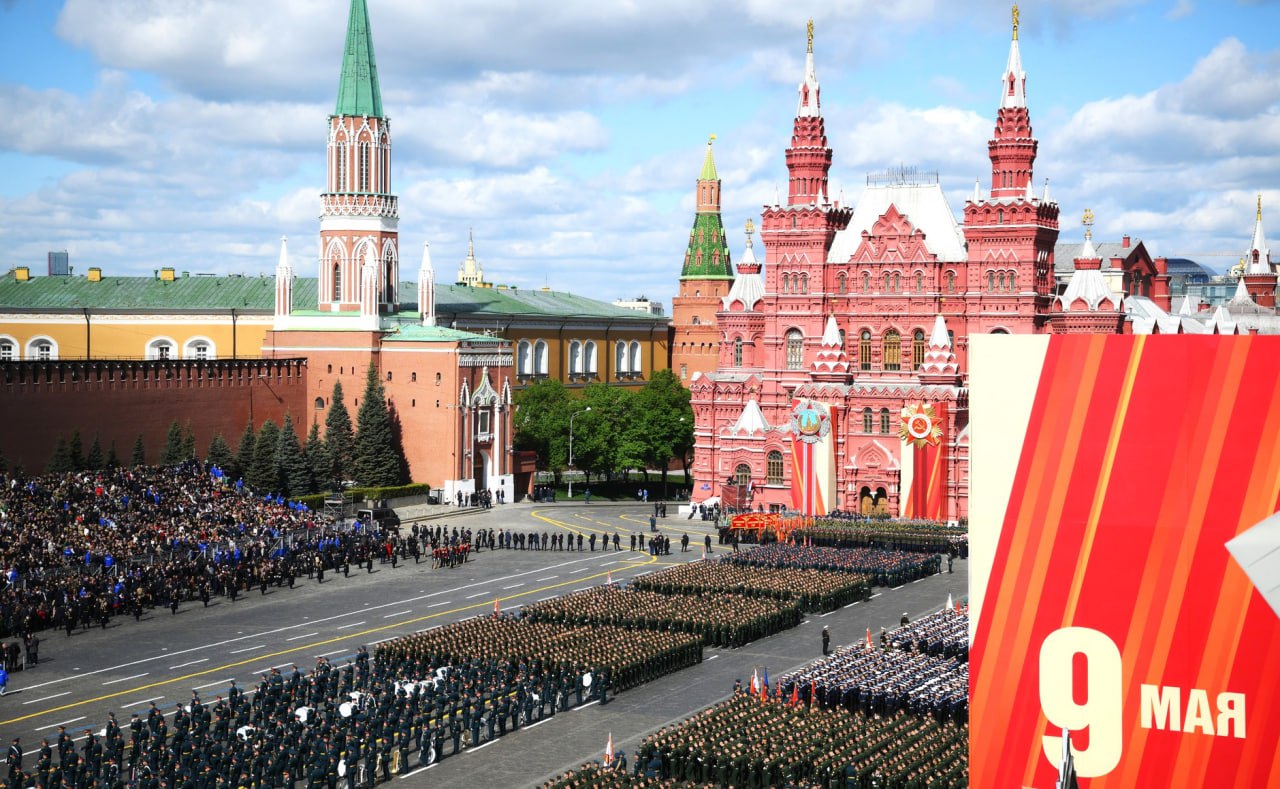 Photo: @Russia via X
That is why Moscow proposed a brief ceasefire for May 8–9 and addressed it to Kyiv. This was not a gesture of goodwill. The Kremlin needs a quiet day on Red Square more than Ukraine needs a quiet front. The very fact that Russia proposed suspending operations precisely during Victory Day celebrations shows the scale of concern over the security of the parade.
Especially since Ukrainian drones have been regularly reaching hundreds of kilometers into Russian territory for months. Strikes on refineries, fuel depots, industrial plants, and strategic air bases have ceased to be isolated incidents. They have become part of a sustained campaign against Russia’s rear. In recent weeks, unmanned aircraft have also appeared over Moscow.
On the night of May 3–4, one of them struck an apartment building on Mosfilmovskaya Street, just a few kilometers from the Kremlin. Soon afterward, the dress rehearsal for the parade was canceled. Officially, this was due to security concerns and the operational situation. Unofficially, it was because the Russian command judged the risk of another attack to be too high.
A wartime parade
This year’s celebrations have looked different from previous years from the outset. Russia has scaled back the ceremony. According to information appearing in Russian media, the parade is to take place without heavy equipment. This is a fairly significant change. For years, the passage of tanks, infantry fighting vehicles, and missile systems was the central element of the display. Now the Kremlin has apparently concluded that the risk associated with concentrating equipment in central Moscow is too great, or it simply does not want to show the scale of the losses being suffered at the front (This year’s Moscow parade to feature no ground equipment for the first time).
At the same time, Russian social media began reporting the redeployment of air defense systems, even from areas near the front, to protect the capital. This applies in particular to Pantsir-S1 systems deployed near strategic sites. The problem, however, is that Russian air defense, though built in layers and theoretically very strong, is having increasing difficulty countering small unmanned aircraft.
The lowest layer of protection consists primarily of Pantsir-S1 systems, but also ZU-23-2 artillery systems and man-portable air defense systems. In theory, these are systems capable of effectively countering drones. In practice, their effectiveness has proven much lower than claimed. Based on the ratio of missiles fired to targets hit, it can be estimated at around 50–70 percent, depending on the type of target and the conditions of the attack.
The Russians also face a growing problem with the number of available systems. Losses sustained at the front are not being offset by industrial production. As a result, some systems have been withdrawn from Ukraine and moved to protect strategic infrastructure deep inside the country. But individual systems deployed at specific points do not create a sealed shield. They can protect particular sites, but they cannot establish a continuous protective zone over a vast metropolitan area such as Moscow.
The middle layer of defense consists of Buk-M2 and Buk-M3 systems. They were designed primarily to counter aircraft, helicopters, cruise missiles, and, to some extent, short-range ballistic missiles. Against such targets, their effectiveness does indeed remain high and exceeds 80–90 percent under test conditions. The problem is that the war in Ukraine today looks completely different from the scenarios Russian designers anticipated more than a decade ago.
The limits of air defense
The limitations of Russian anti-aircraft artillery have become particularly visible. It has turned out that, when countering small unmanned aircraft, old manually operated guns are often more effective than modern missile systems. That is why ZU-23-2 systems dating back to the Soviet era are increasingly appearing around refineries, ports, and fuel storage facilities. Their capabilities, however, remain very limited. They lack modern fire-control systems, electro-optical heads, and automatic target tracking.
The contrast is well illustrated by the example of Poland’s PSR-A Pilica system. The Polish system has received a stabilized electro-optical head capable of observing, detecting, and identifying targets independently of its weapons and regardless of weather conditions. In many cases, Russian operators still have to rely mainly on visual observation and manual fire control. Against night attacks by small drones flying at low altitude, this means very limited effectiveness.
Even the most extensive air defense system, however, cannot provide complete coverage. This is especially true against saturation attacks carried out simultaneously by numerous drones and supported by decoys. In such situations, some targets almost always get through the shield. This is all the more true because Ukrainian attacks are increasingly well planned and coordinated. Kyiv is systematically increasing production of long-range unmanned aircraft while constantly analyzing the responses of Russian air defenses.
An image catastrophe
From an image and public-relations standpoint, even a single drone reaching the vicinity of Red Square would pose a far greater problem for the Kremlin than any actual damage it might cause. This is primarily about the psychological and propaganda dimension. For years, the Russian state has built an image of Moscow as a fortress beyond the reach of war. A successful attack during the most important state holiday would show millions of Russians that the conflict has long since reached the center of the empire.
That is why the Kremlin is reacting so nervously. And that is why Zelenskyy is allowing himself increasingly open suggestions about the possible “presence” of the Ukrainian military at the Moscow parade. Even if no attack ultimately takes place, the threat itself is proving to be an effective tool of influence. It forces Russia to redeploy air defense systems, scale down the celebrations, and create an atmosphere of danger around an event that was supposed to demonstrate the strength of Putin’s state.
The paradox is that, in this way, Ukraine has already partially achieved its goal. This year’s parade will not be a display of confidence. It will be a demonstration by a state that is afraid of its own holiday. And that, in itself, is already a defeat.