

























The new vessels have been assigned project number 876, continuing the numbering system for special-purpose vessels, including hydrographic ships, that was introduced in the late 1950s at what was then Central Ship Design Bureau No. 2 in Gdańsk. The last completed project in this series was Project 874, under which both hydrographic vessels currently serving with the Polish Navy ‒ ORP Heweliusz (265) and ORP Arctowski (266) ‒ were built at the Bohaterów Westerplatte Northern Shipyard in Gdańsk, now Remontowa Shipbuilding (Two hydrographic ships for Poland under the SAFE program).
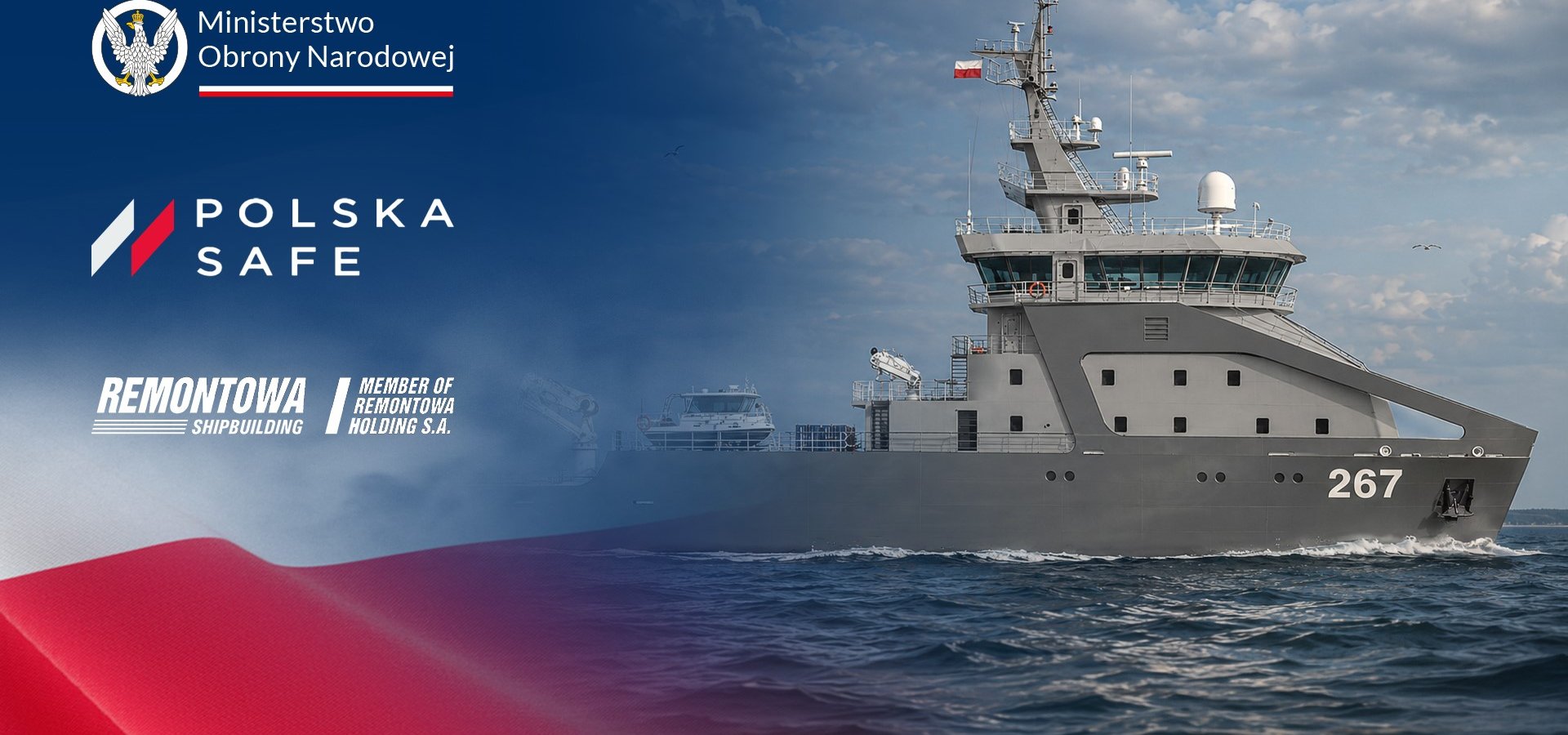 Image: Armaments Agency
Most hydrographic vessels designed during the communist-era Polish People’s Republic were developed in response to demand from the Soviet Navy. After the political changes of the late 1980s and early 1990s, no new vessels of this class were built in Gdańsk for more than two decades. It was not until 2016 that the search began for successors to the two B91-type vessels used by Polish maritime offices: Zodiak and Planeta.
Both vessels, classified as buoy tenders, were based on Project 872 hydrographic ships. For years, they were used to support navigational marking on approaches to ports. Their tasks included the transport, handling, replacement and inspection of sea buoys. As a result of a tender procedure launched on September 12, 2017, for the delivery of new multipurpose vessels, the offer submitted by Remontowa Shipbuilding was selected, based on the B618-type vessel. Under the contract signed on March 5, 2018, two vessels of this type were built: Zodiak II for the Maritime Office in Gdynia and Planeta I for the Maritime Office in Szczecin. The shipyard completed the contract in just over two and a half years, with the second vessel delivered to the customer on October 30, 2020.
Why are we devoting so much attention to the two vessels built for the maritime offices? Because Project 876, selected for implementation for the Polish Navy, will be a development of the civilian B618 design. It will, of course, differ from it, both because of the requirement to incorporate defense standards into the design and because of the somewhat different primary purpose of the two projects. While their civilian predecessors are mainly tasked with maintaining navigational marks, hydrographic work, although also included among their intended tasks, is of secondary importance. In addition, the B618 vessels are also adapted for auxiliary roles such as firefighting, maritime rescue, spill response, towing and icebreaking.
The emphasis will be different in the case of the hydrographic vessels for the Polish Navy. For them, hydrographic tasks will be the primary function, while the maintenance of navigational marks will be secondary. This follows from the tasks of the Hydrographic Service of the Polish Navy, for which the new vessels will operate. The service is responsible for navigational, hydrographic, meteorological and oceanographic support for the operations of the Polish Navy.
The main elements of the service are the Hydrographic Office of the Polish Navy and the Polish Navy Hydrographic Support Squadron, which the new vessels will join, as well as functional cells within the flotillas. The Hydrographic Office of the Polish Navy also serves as the state maritime hydrographic and navigational marking service in the field of hydrography and nautical cartography. This means that its main role is to conduct hydrographic surveys, both in maritime waters and naval ports, for cartographic and navigational safety purposes; to prepare and publish official nautical charts and nautical publications and keep them updated; and to ensure the operation of the navigational warning system.
In terms of dimensions and overall layout, the Project 876 vessels will be very similar to their civilian B618 predecessors. The stated length of about 60 meters and maximum beam of 13 meters fully correspond to those parameters for the B618. Since the details of Project 876 are not yet known, let us cite the basic technical parameters of the B618 multipurpose vessels.
These vessels have an overall length of 60.1 meters, a length between perpendiculars of 53.63 meters, a beam of 12.8 meters, an overall beam of 13.4 meters and a draft of 3.5 meters. They are equipped with diesel-electric propulsion consisting of three main power generators rated at 1,590 kW, each powered by a Cummins QSK50-DM1 engine rated at 1,628 kW, as well as one 220 kW emergency generator. These power two azimuth thrusters rated at 1,400 kW each and an 850 kW bow thruster. The propulsion system allows the vessels to reach a speed of 13 knots.
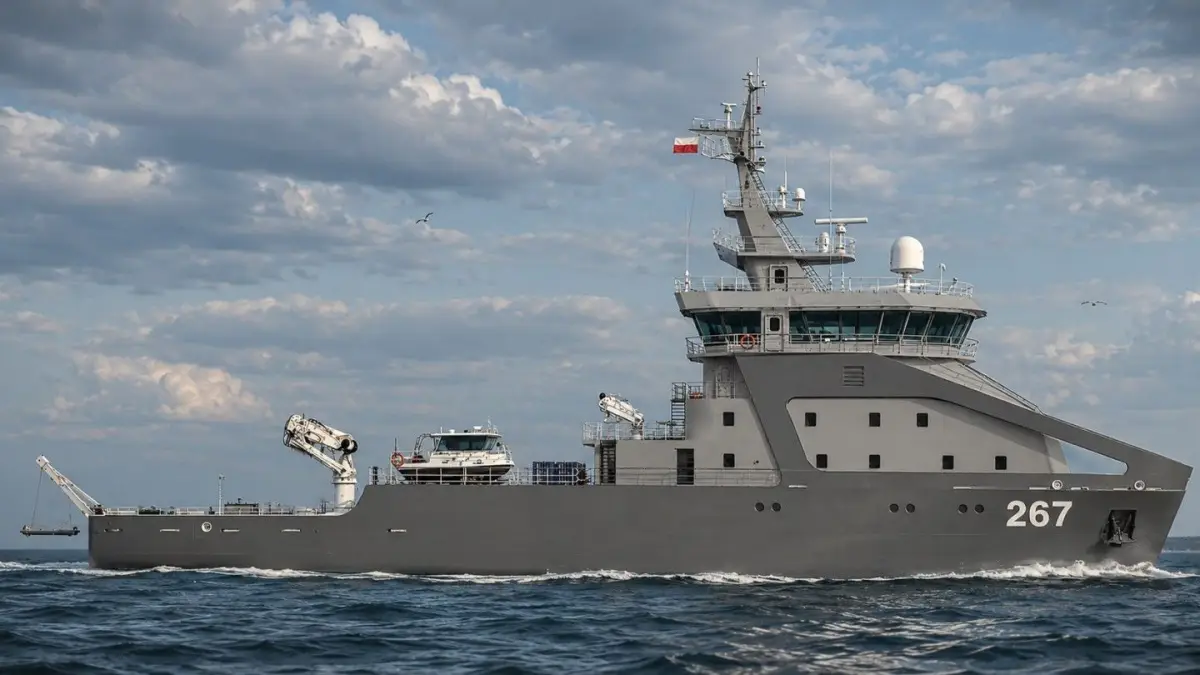 Image: Remontowa Shipbuilding
The crew numbers 13, although accommodation is provided for 21 people on board. In the military version, due to the different nature of the tasks performed and the more extensive specialist equipment, the crew will certainly have to be significantly larger, which will result in a different internal layout.
Since the main task of the B618 is the maintenance of navigational marks, it was fitted on the working deck with a roller ramp for lowering buoy anchors and a large hydraulic telescopic deck crane with a reach of 17 m and a lifting capacity of 100 kN, or 10 t, for lifting buoys. Its tasks include both crane operations and the handling of workboats. In Project 876, this position will be occupied by a smaller crane, while the stern will be fitted with equipment for launching unmanned underwater vehicles or towed sonars.
The hydrographic equipment of the new vessels will undoubtedly be much more extensive, although the B618 vessels also have quite considerable capabilities in this regard. They received a hydrographic multibeam echo sounder (MBES) intended for maritime bathymetric surveys, as well as for detecting and identifying underwater objects that constitute navigational hazards, especially shipwrecks and their remains, as well as underwater objects of military origin, such as torpedoes, naval mines or aerial bombs. This is complemented by a single-beam echo sounder (SBES), a remotely operated vehicle (ROV) for visual inspections, and a cabin hydrographic boat equipped with multibeam and single-beam sonars with parameters similar to those installed on the vessel.
Replacing the two Project 874 vessels currently in service for more than 43 years had become an increasingly urgent matter. Although their specialist equipment had been successively modernized and replaced, it is difficult to regard the operation of vessels more than 40 years old as a normal situation, especially in a country that prides itself on being among the world’s 20 largest economies. Attempts to replace Heweliusz and Arctowski with new vessels had been underway unsuccessfully for years, which, unfortunately, is typical of efforts to replace ships in the Polish Navy. In 2024, the Armament Agency again began market research into the construction of new vessels of this class, but until additional funding from the SAFE program appeared, the fate of the Hydrograf program hung by a thread.
As a result, when the civilian maritime administration replaced the previously used Zodiak and Planeta in 2020, after just over 35 years of service — they had been commissioned on April 8, 1982, and January 31, 1983, respectively — the Polish Navy still had only vague prospects of replacing its vessels of the same age. Paradoxically, however, this situation has had a positive impact on the current implementation of the Hydrograf program. Thanks to the availability of a design for a vessel with a similar purpose, developed by Remontowa Marine Design & Consulting, as well as the shipyard’s experience from their recent construction, it was possible to include this acquisition on the list of projects implemented under SAFE. Its very tight deadlines, especially in the context of building vessels of this size, would most likely have made it impossible to use these funds for the Hydrograf program if the ships had had to be designed from scratch (NERDS: MMC Designs for the Polish Navy).