






















On Tuesday, April 14, 2026, the U.S. Naval Safety Command (NAVSAFECOM) published an update to its report on U.S. Navy and USMC Class A aviation mishaps, a category covering total losses, damage of at least 2.5 million USD, or the death or permanent disability of a crew member. The report confirms that on April 9 this year, a large High-Altitude Long Endurance (HALE) MQ-4C Triton autonomous unmanned aerial vehicle was lost in an accident.
 Confirmation of the UAV’s loss appears on page 50 of the report in question. Interestingly, another MQ-4C was damaged on the ground during routine maintenance on December 12. / Photo: NAVSAFECOM
The first reports of the possible loss of an MQ-4C Triton over the Persian Gulf emerged through commercial ADS-B flight-tracking maps. The ill-fated flight on April 9 this year began at the U.S. Navy’s NAS Sigonella in Sicily. It was conducting an intelligence, surveillance, and reconnaissance mission over the Strait of Hormuz and the Persian Gulf. Shortly before the signal was lost, a sudden loss of altitude was recorded. The aircraft reportedly transmitted the general emergency squawk code 7700, although other reports suggest it had earlier transmitted squawk code 7400, indicating loss of operator control.
It is not known, at least publicly, where the MQ-4C Triton may have crashed. At the time its signal was lost, it was in international airspace, flying toward Iran, but there is no evidence that it went down in that country’s territorial waters. It is also unclear whether the U.S. Navy is attempting to recover the wreckage due to the sensitive onboard equipment.
On its way back to base, the US Navy MQ-4C Triton reconnaissance drone that had been patrolling the Strait of Hormuz took a turn towards Iran, squawked code 7700 (general emergency), and started descending, falling off ADS-B as it dropped under 10k feet. pic.twitter.com/1Ki8OsEk9k
— OSINTtechnical (@Osinttechnical) April 9, 2026
Apart from the U.S. Navy, for which Triton was developed under the Broad Area Maritime Surveillance (BAMS) program as a maritime derivative of the RQ-4 Global Hawk UAV, only Australia has decided to purchase the aircraft. Germany withdrew from its planned acquisition, while the platform was later offered to India and is currently being offered to Norway.
Triton is 14.5 m long, has a wingspan of 39.9 m, a height of 4.7 m, and a weight of 14.63 t. A single Rolls-Royce AE 3007 turbofan engine, with thrust of 28.89–39.66 kN, provides a maximum speed of 575 km/h and a service ceiling of 18,288 m. The UAV’s maximum range is 15,186 km.
On September 19, 2024, Northrop Grumman reported that a U.S. Navy aircraft had flown in the Arctic and North Pole region for the first time. Earlier, during Exercise Northern Edge 23-1 in the Gulf of Alaska, Triton had designated simulated hostile surface targets for allied forces’ weapons. On July 30, 2021, the first Triton with upgraded Integrated Functional Capability Four (IFC-4) software made its maiden flight.
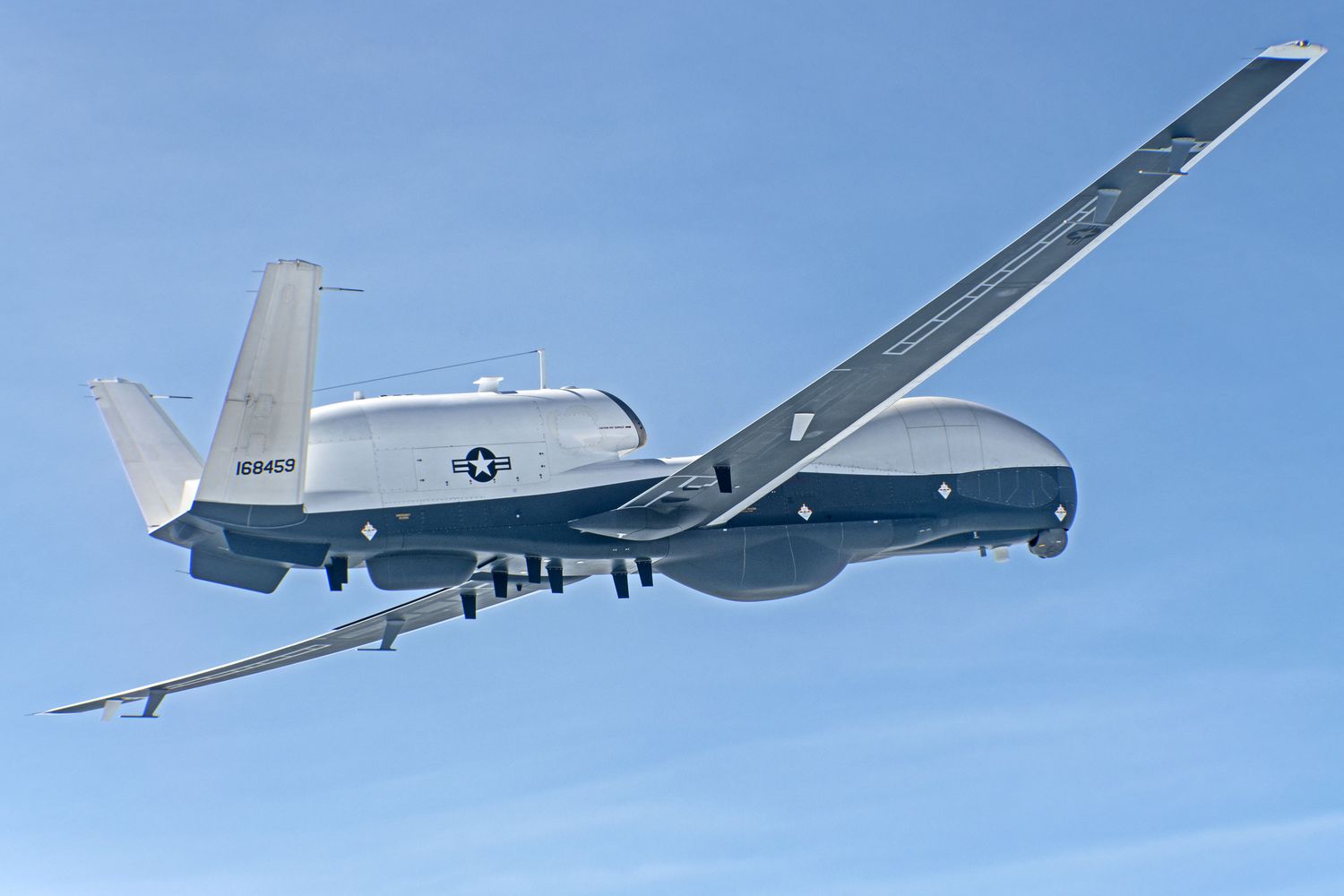 MQ-4C Triton / Photo: Northrop Grumman
In the context of Iran, it is worth recalling that on June 20, 2019, the Islamic Revolutionary Guard Corps (IRGC) reported that it had shot down an MQ-4C Triton near Hormozgan Province. As evidence, it presented aircraft wreckage the following day, collected from the crash site in the area of Mount Mubarak; some of the debris was said to have fallen into the waters of the Strait of Hormuz. In reality, however, it was an RQ-4 BAMS-D, the precursor to Triton. In late October 2021, something resembling an RQ-4 was spotted being transported on a public road in Iran.
In June 2022, a partially reconstructed aircraft based on the remaining wreckage was presented.
More photos of the shot down RQ-4A landing gear, and the fuselage composite material (likely carbon fabric).https://t.co/bx0lh74dMF pic.twitter.com/p7wWDEkDLQ
— Mehdi H. (@mhmiranusa) June 20, 2022
As for current combat operations involving Iran, the United States has reportedly lost 24 MQ-9A Reaper UAVs. The loss of a Triton is particularly significant, as its current unit cost exceeds 238 million USD.
This is in addition to crewed aircraft losses: three F-15E Strike Eagle aircraft (accidentally shot down in Kuwait), one F-15E (shot down by Iran), one A-10C+ Thunderbolt II (shot down by Iran), one E-3G Sentry AWACS (destroyed in Saudi Arabia by Iran, along with multiple damaged KC-135 Stratotankers), one KC-135 Stratotanker (crashed over Iraq, with another damaged), one damaged F-35A Lightning II (over Iran), two MC-130J Commando II aircraft (destroyed in Iran along with two MH-6 Little Bird helicopters), two damaged MH-60G Pave Hawk helicopters (over Iran), and one CH-47 Chinook (destroyed by Iran in Kuwait).
See also:
