


















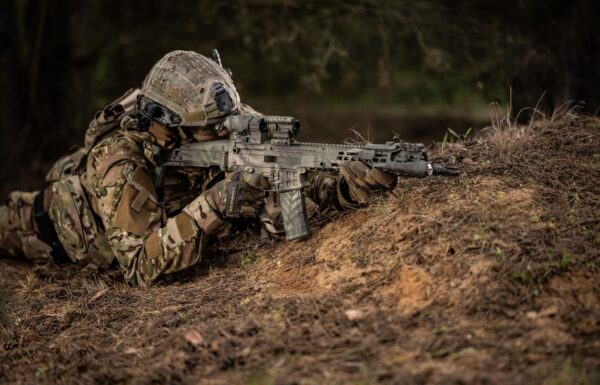








The engineers focused on improving ergonomics and reducing weight, creating an even more mobile firearm without sacrificing the proven, legendary reliability.

Photos: Jakub Buczma, MILMAG
What’s new for shooters? Above all, an impressive range of available calibers. The new Scout enters the market from the outset in the following versions: .308 Win, .350 Legend, 5.56 NATO, and 7.62×39 mm. All variants are fitted with a 16.1-inch barrel, marking a significant shift in strategy compared to the predecessor. The first generation debuted exclusively in .308 Win (with a 16.5-inch barrel), while versions chambered in 5.56 NATO and the powerful .450 Bushmaster were added to the lineup only in later years.

Each barrel is factory-threaded and fitted with an A2 Birdcage muzzle device. Standard equipment also includes fully adjustable AR-15–style iron sights and an extended Picatinny rail, designed so that mounting optics does not interfere with operation of the bolt handle. In addition, the rifle features a three-position safety, a stainless-steel bolt, and a stiffer stock improved over the original design.
The rifle feeds from 5- or 10-round magazines. This apparent minimalism is, in fact, a deliberate design choice. The compact magazine does not protrude excessively beyond the rifle’s profile, allowing its handy nature to be fully appreciated. Using higher-capacity magazines could negatively affect balance and make the carbine harder to maneuver in difficult terrain—precisely the environment this rifle is intended for.
The Ruger handles very well, shoulders naturally, and feels compact and lighter than one might expect. The trigger is also pleasant, with a clearly perceptible wall and a crisp break in the 1.5–2.5 kg range, fully adjustable.
The rifle is already available in stores in the United States; locally, buyers will need to wait a bit longer, as the shipment still has to cross the ocean. The U.S. price is 929 USD.
The distributor of Ruger in Poland is RP ARMS
Advertising partnership